
Zainab Shamsuna Ahmed, Nigeria’s minister of finance, budget and national planning in Abuja Tuesday, presented a draft of the 2020-2022 Medium Term Expenditure Framework and Fiscal Strategy Paper (MTEF/FSP).
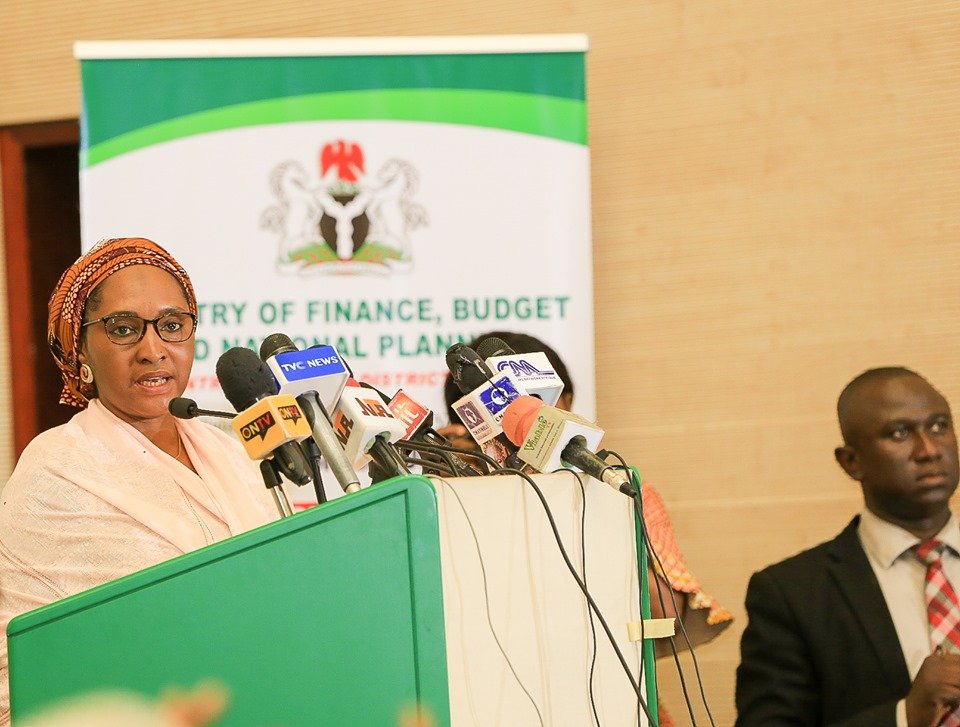
The presentation shows the Federal Government has projected a Gross Domestic Product (GDP) growth of 2.93 percent and a revenue profile of N7.634 trillion for the 2020 budget.
Lower growth forecast, higher revenue projection
A comparison with current year’s figures indicates that the 2.93 percent GDP forecast is lower than the 3.01 percent in the 2019 budget, while the revenue projection is higher than the N7.594 trillion contained in the 2019 budget passed by the National Assembly.
Other key assumptions
Also, the minister said the Federal Government will propose to the National Assembly a total sum of N9.79 trillion as expenditure for the 2020 budget, representing an increase of 9.75 percent over N8.916 trillion spending for 2019.
The framework targets oil production of 2.18 million barrels per day, as other key forecast of the MTEF places oil price at $55 per barrel, official exchange rate of N305 to a dollar and inflation rate of 10.81 percent.
Giving reasons for the forecasts, Ahmed explained that all the assumptions were done in consistency with the goals of the Economic Growth and Recovery Plan (ERGP).
“Oil production volume is projected to be average 2.18mbpd for 2020. Although this is lower than the projected oil production volume of 2.3mbpd for 2019, we believe that it is a more realistic projection. For 2021 and 2022, the projections are 2.22mbpd and 2.36mbpd respectively.
A lower benchmark oil price of $55 per barrel is projected in 2020 against $60 per barrel in 2019. This is considering the expected oil glut in 2020 as well as the need to cushion against unexpected price shock. Also the Organisation of Petroleum Exporting Countries (OPEC), International Energy Association (IEA) non OPEC production growing by around 2 million barrels this year, and by next year.
Our real GDP growth projections are rates of 2.93 percent, 3.5 percent and 3.85 percent for 2020, 2021 and 2022 respectively. Even though it falls short of ERGP projections,” she explained.
Recurrent vs Capital Expenditure
A breakdown of the recurrent expenditure and capital expenditure (non-debt) in the framework show that recurrent expenditure is set at N4.749 trillion for the 2020 budget, N4.88 trillion and N4.90 trillion in 2021 and 2022 budget respectively.
The recurrent expenditure includes personnel cost for MDAs, overhead cost, pension, gratuities and retirees benefits, other service wide votes, presidency amnesty programme among others.
Similarly, aggregate capital expenditure in 2020 budget is projected at N2.05 trillion, lower than the 3.184 trillion in 2019, showing a drop from 32 percent to 21 percent.
2021 and 2022 budget plans
In 2021, N2.03 trillion capital expenditure is projected and N2.047 trillion in 2022 respectively.
The framework also projects N10.110 trillion and N10.418 trillion for the 2021 and 2022 budgets respectively.
The document stated that additional financing from privatisation proceeds is projected at N126 billion in 2020 budget, N296.3billion in 2021 and N246 billion in 2022.
Also, N328.128 billion is projected as additional financing from multilateral/bilateral tied loans in 2020 even as N203.7 billion is projected in 2021 and N95 billion in 2022. Also, an additional borrowing of N1.7 trillion is projected in 2020, while N1.6 trillion in 2021 and N1.3 trillion in 2022 respectively.
Non debt proposals
A breakdown of the non-debt proposal, the minister said, includes Ministries, Departments and Agencies (MDAs) personnel cost of N2.675 trillion; Government-owned enterprises (GOEs) personnel costs (N218.8 billion; overheads for MDAs (N280.3 billion; overheads of GOEs (N146.14 billion).
Also, proposals for pensions, gratuity and retirement benefits will be about N536.72billion; transfers Nigerian Bulk Electricity Trading (NBET) for power sector reform programme (N59.44 billion; Service-wide votes (N418.7 billion), and Presidential Amnesty Programme (N65 billion).
Under Special Interventions (recurrent), the minister said about N350 billion has been proposed for the year, while aggregate Capital expenditure has been reduced from N3.18 trillion in 2019 to about N2.05 trillion in 2020. Details of the capital expenditure include capital supplementation (N234.2 billion); Statutory transfers for capital expenditure (N289.1 billion); capital allocation for special Intervention Programme (N150 billion); MDAs Capital expenditure (N827.3 billion).
The minister said capital expenditure for 10 top GOEs have been put at about N188.23 billion; grants and donor-funded projects (N36.4 billion), and multilateral/bilateral project-tied (N328.13 billion).
How we will fund deficit- Minister
On deficit financing, Ahmed said the government plans to mobilise additional financing from the sale of government property, proceeds from privatisation, sale of non-oil assets, multi-lateral and bilateral project-tied loans and new foreign and domestic borrowings.
In her overview of the proposals, the minister said the draft MTEF showed the country was facing significant medium-term fiscal challenges, especially with respect to revenue generation and rapid growth in personnel costs.
To reverse the challenges, she said key reforms under the strategic revenue growth initiative will be implemented to boost revenue collection and expenditure management.
To further the objective of greater comprehensiveness and transparency in the budget process, she said the government has proposed to reflect the revenue and expenditure of government-owned enterprises and multi-lateral/bilateral projected loans and related expenditures in the 2020 budget.
Bailout funds deduction
The finance minister also said that the Federal Government will begin deduction of the N614bn bailout funds to state government beginning from the next Federal Accounts Allocation Committee (FAAC) release this month.
The minister clarified that the refund to be made by states will not be used to fund the 2020 budget.
“N614bn is not part of the revenue to fund the 2020 budget. It is a loan which was facilitated by the Central Bank of Nigeria.
Therefore, we will start deducting from the next FAAC allocations to states and then we remit to the Central Bank because it is a loan,” she explained.
In the area of recurrent expenditure, the minister lamented the personnel cost at over 3.0 trillion (Inclusive of Pension Cost) which has continued to rise. “Personnel cost is on the rise at over N3 trillion which is serious issue. The Federal Government is however taking steps to contain the raising personnel cost, including an October 2019 deadline by Mr. President for all MDAs to implement Integrated Personnel and Payroll Information System (IPPIS).
Therefore any Department or Agency of government that is not captured on the IPPIS will not be getting salaries starting from October 2019. “Also the rise in the personnel cost and overhead cost can be attributed to rise to the addition of five new ministers which has further increased the recurrent cost,” she said.
Minister’s thoughts on AfCFTA
On Nigeria signing the agreement establishing the African Continental Free Trade Area (AfCFTA), Ahmed foresees tremendous opportunities for the country in the medium term, noting that the agreement could become a huge nightmare if the right policies and actions are not implemented to boost Nigeria’s competitiveness.
Ahmed said Africa’s largest oil exporter is producing roughly 2.3 million barrels per day (bpd) of crude oil and condensates. It has agreed on a cap of 1.685 million bpd of crude oil with the Organisation of the Petroleum Exporting Countries (OPEC).
Read Also: Nigeria risks fiscal crisis without increased revenue — Ahmed








Who’s afraid of the T+1 settlement cycle of CSCS?