We have all been in situations where it is easier to follow the crowd than to go against it. We change our mind and succumb to group pressure just by being told that most people think about an issue in a certain way. By unconsciously internalising the opinions, feelings and moods of others, we can end up thinking these ideas are our own.
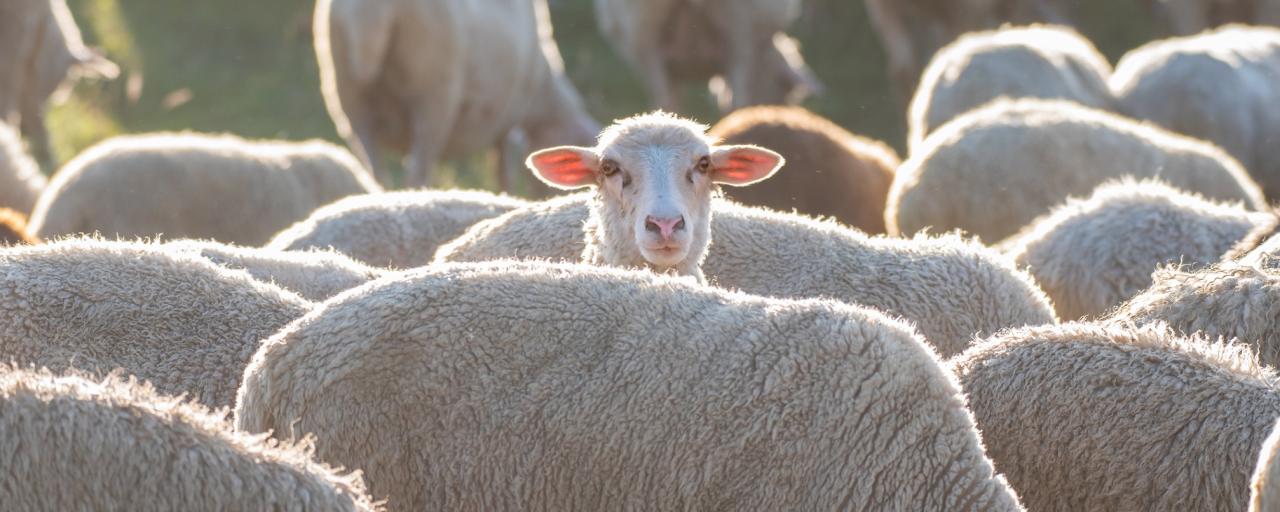
Herd mentality or “sheeple” behaviour can be found everywhere from the financial sector to outbursts of mob violence, political movements, religious gatherings, sporting events, riots, strikes and even consumer preferences such as fashion trends. In each of these instances, individuals adopt opinions based on what other people say and do without considering the evidence for themselves.
Many threatening situations – real or imaginary – can provoke sheeple behaviour. These are not just circumstances of physical danger, but also the fear of being different, uncertain or the odd one out. For example, people will make irrational or non-optimal decisions and behave in a herd-like fashion when motivated by the desire to fit in, which can result in groupthink.
When following the crowd is dangerous
Without herd instinct, our ancestors would not have banded together to fight off animals or help each other collect food. While there are many benefits to be gained by living and working cooperatively in groups, sheeple behaviour also makes us easily susceptible to manipulation. This is particularly the case in the context of leadership, where neo-authoritarian leaders exploit herd mentality to rise to power.
The dark side of sheeple behaviour manifests when individual judgment and opinion-forming processes shut down. Essentially, a process of social contagion takes place, meaning a tendency to automatically mimic and synchronise expressions, words, postures and movements with other people, which contributes to behavioural convergence.
It only takes 5 percent of what scientists call “informed individuals” to influence the direction of a crowd, mobilising the other 95 percent to follow without even realising it. Historic leaders including Hitler, Stalin and Mussolini and their contemporaries Bolsonaro, Trump and Xi have exploited this behaviour among populations. Today, we can clearly see how Putin is manipulating and indoctrinating the Russian people with disturbing propaganda material to rationalise his disastrous war.
This sheeple programming in our brains explains why otherwise sane and sensible people can reject common sense. It should therefore come as no surprise that in times of uncertainty, we will always look to strong leaders to guide our behaviour.
How do we stop regressing into herd mentality?
Probe your personal beliefs
Fostering independent thought and reflection can reduce the risk of sheeple behaviour. We need to ask questions, consider our options and educate ourselves in order to make well-informed decisions, even if that means running the risk of looking foolish.
Just because everyone else is making a quick decision doesn’t mean that they know best. It will always be the easier option to follow the herd rather than make independent judgements. Thus, when making a choice, we should examine the biases we may have and question their sources.
Evaluate and justify your options
Realising the need to justify our choices will make us less likely to blindly mimic other people. It will prevent us from living in an echo chamber and accepting ideas without further scrutiny. It is our task to evaluate our personal beliefs when they contradict what others are doing. We should welcome different opinions, but at the same time try to understand why they are so different.
Large numbers of people can be wrong
Whatever position we take, there will always be much (conscious and unconscious) pressure to belong to a group. Hardwired as we are to blend in, it will be difficult to oppose the opinion of the majority. We will always have to struggle with the belief, irrational as it may be, that large numbers of people cannot be wrong.
It is our challenge, however, to oppose this idea. We should never assume that something is right simply because the majority of people agree on it. Instead, we should ask ourselves whether the choices that we make are really our choices, or whether we have fallen into a sheeple pattern.
Reflect and delay taking action
We also need to be aware of the degree to which stress affects our decision-making capabilities. Reflective decision-making is more important than ever when we feel pressured to act quickly. It is wise to delay taking action until we have assessed the situation and are fully aware of what’s happening.
Whenever we feel the pull of sheeple behaviour, we should remind ourselves that it is our capacity for both independent and dependent thought that has made humankind so successful and allowed our species to progress. It has helped us learn new things, as well as discover, develop and advance ideas.
Of course, this doesn’t mean that we should ignore our evolutionary heritage. After all, a society of people all working off completely different scripts – with no common themes – would be dysfunctional. Humans are socially wired, meaning that we are looking for common ground when we get together as a group. Our brains will therefore always rely on a certain degree of groupthink.
At the same time, we should not forget that stimulating independent thought is the only way to reduce the risk of collective madness. It is thus our challenge to distinguish between the wisdom and the madness of crowds.