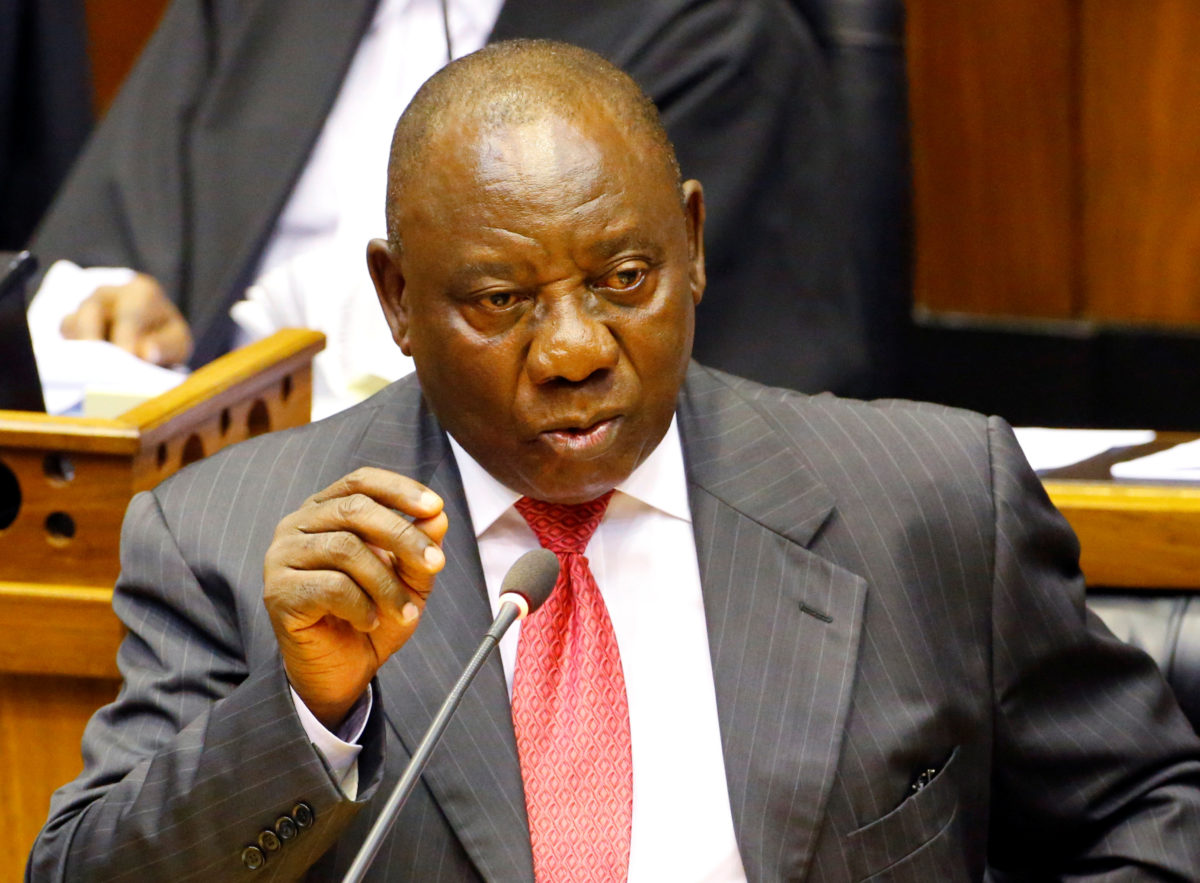
Cyril Ramaphosa, South Africa’s new President has pledged to redistribute land by taking it from white farmers and giving it to black people. But why is the millionaire pursuing such a drastic course of action and how will it work?
How did white farmers get the land in the first place?
Dutch Calvinist settlers first landed on the Cape of Good Hope in 1652 and soon began setting up farms in the arable regions around Cape Town. Over the following decades, the number of Dutch (and some German and French) settlers grew. They continuously claimed land from the local Khoikhoi until the entire cape was colonized.
The British seized the region in 1795, sparking a long-running conflict with the original Dutch settlers, now known as the Boers. To escape British rule the Boers pushed deeper north and northeast, claiming land in the present-day provinces of Free State and Natal. Eventually, they established independent Boer republics.
Numerous wars and conflicts between colonists, both British and Boer, and local people including the Xhosa, Zulu, Basotho, and Ndebele broke out over the intervening years, particularly as gold and diamonds were discovered. The colonists took advantage of their superior weaponry to claim further territories.
Eventually tensions between the Boers and the British boiled over, resulting in two Anglo-Boer wars. In the aftermath of the second war, the British unified the colonies into a single country called the Union of South Africa.
The country’s 1913 Natives’ Land Act earmarked only eight percent of the land for black people. White people, who made up about 20 percent of the population, owned 90 percent of the land. The act set the legal framework for the control of South African land up until the fall of Apartheid in 1991.
Who actually owns the land
The amount of land actually owned by whites is a contentious and much-debated issue. The statistics remain unclear. Many South African politicians in favour of land reform claim that, in a country of 55 million people, a mere 40,000 white farmers own 80 percent of the country’s agricultural land. However, a study by fact-checking website Africa Check found that the claim isn’t supported by any dataset, labelling is incorrect.
“Land ownership is still deeply skewed along racial lines, but these figures do not illuminate the current land dispensation,” Professor Cherryl Walker said.
New South African president wants to seize land from white farmers without compensation
Walker, the author of ‘Landmarked: Land Claims and Land Restitution in South Africa,’ prepared a fact sheet on land distribution for the Institute for Poverty, Land and Agrarian Studies (PLAAS) last year. It revealed that 67 percent of South Africa is used for agriculture and that, while the vast majority of this is indeed owned by white farmers, “small numbers” of black people with access to capital have managed to acquire land independent of land reform.
Why is the government doing it now?
The African National Congress (ANC), which has ruled South Africa since the fall of apartheid, has long promised reforms to redress racial disparities in land ownership. Despite more than 20 years of ANC rule whites still, own most of South Africa’s land.
Land redistribution was the key talking point ahead of last year’s ANC national conference where Cyril Ramaphosa was chosen to replace Jacob Zuma as party leader. The party appeared deeply divided in the run-up to December’s vote and, while it still dominates the South African political landscape, it had its worst result since 1994 in last year’s local elections.
On Tuesday the radical left Economic Freedom Fighters (EFF) party, who control only 25 of the parliament’s 400 seats, brought a motion seeking to change the constitution to allow for land expropriation without compensation. Crucially the move was backed by the ANC, which controls 249 seats, and was passed.
Speaking in parliament, EFF leader Julius Malema said “it was time for justice” on the land issue. “We must ensure that we restore the dignity of our people without compensating the criminals who stole our land,” he said.
The official opposition Democratic Alliance party (DA) has come out against land redistribution. The DA’s Thandeka Mbabama told parliament that the efforts are merely a way to divert attention from the failure of successive ANC-led governments.
How will it be done?
Redistribution moved a step closer after Tuesday’s vote, yet how the process would work in reality remains to be fleshed out by the government. After taking up the presidency, Ramaphosa said expropriation without compensation will be one of the measures used by the government to speed up redistribution.
But the new president stressed that the process will be handled properly and not in a “smash and grab” manner. “We will handle it with responsibility. We will handle it in a way that will not damage our economy, that is not going to damage agricultural production,” he said.
The perils of land redistribution are seen in the program carried out by then-Zimbabwean President Robert Mugabe in the late 1990s and early 2000s. The plan saw thousands of white farmers stripped of their lands and, in the years that followed, food production plummeted and the country’s economy collapsed. Likely referring to their neighbor to the north Ramaphosa said that “in dealing with this complex matter” South Africa would not “make the mistakes that others have made.”