
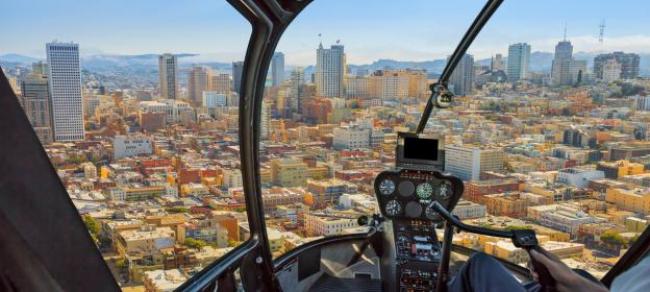
Leaders must cultivate the seamless ability to mix forward-vision thinking, tactical execution and self-awareness – across the altitudes of leadership.
High altitudes hold a special place in the history of human achievement. We remember Sir Edmund Hillary and Nepalese sherpa, Tenzing Norgay as the first climbers to reach the summit of Mount Everest. Other altitude pioneers include Russian cosmonaut, Yuri Gagarin, the first human to fly in outer space, and Neil Armstrong, the first person on the moon. More recently, in 2012, Austrian Felix Baumgartner skydived from a capsule at 127,000 feet.
In the world of leadership, altitudes are significant, too. However, the concern is much less about how high a leader can go, than about how he or she can seamlessly move between three distinct altitudes of leadership thinking.
Ram Charan*, the distinguished author, advisor and scholar, first developed the concept of leadership altitudes based on many decades of observing CEOs and leaders. Together, we extended it into a framework that stresses the importance of thinking flexibly for leadership success in the disruptive, volatile, uncertain, complex, ambiguous and diverse 21st century world.
The three critical leadership altitudes are: 50,000 feet, 50 feet and 5 feet**. Effective leaders develop the capacity to “fly” their thinking at all three altitudes, not getting trapped at any one of them. They travel up and down easily, making the connections between all the altitudes. Using this analogy can focus people in a simple, yet profound way, to generate crucial leadership insights, as each altitude is so clearly different.
Connecting the three altitudes
At 50,000 feet – the maximum altitude for commercial aircraft – leaders are able to see the big picture. They envisage possibility in disruption, and connect the dynamic external world of customers, markets and change to a holistic view of their organisation. This is also where they can encourage large-scale transformation and innovation linked to action, using what I call “panorama vision”.
Concrete action happens at 50 feet, the tactical level close to the ground. At this altitude, thinking encompasses granular short-term goals and the crucial steps of planning, implementation and execution. This is also the space where leaders interact with their networks, inside and outside their organisation.
Last but not least is the ability to think at 5 feet, the level of the self. Leaders need to be profoundly self-aware and grasp what they need to do to develop themselves. From this personal level, they can move to the tactical level of 50 feet and then soar to the big-picture altitude of 50,000 feet.
I argue that leaders using all the altitudes are able to combine complex and sometimes contradictory mindsets – global, strategic, tactical, value-creating, intellectual, creative, learning, emotional, pragmatic, process, customer, community and self – to become “insightfully aware” from multiple perspectives.
Leadership altitudes in the real world
There are many leaders who capably connect all three altitudes. Notable examples are Warren Buffett at Berkshire Hathaway; or Gail Kelly, former CEO of Westpac Bank in Australia. Both easily link big-strategy choices with day-to-day execution, while maintaining a healthy sense of self-awareness. It’s not just modern leaders, either. Consider Marie Curie, who imagined the possibilities of radiation, then led concrete experiments for years, displaying personal resilience, persistence and courage.
There are also leaders who, though they remain flexible, produce remarkable outcomes at particular altitudes. Consider 50,000-foot thinkers like Elon Musk, Jack Ma or Steve Jobs. At the 50-foot level, a leader like Larry Bossidy (former CEO of Honeywell) brought implementation into absolute focus. But in his book Execution, co-authored with Ram Charan, he also described how day-to-day agility and acumen connect to the big picture and how to grow individuals and teams. Similarly, Facebook COO Sheryl Sandberg, a model of highly self-aware leadership, continually shows how operations interlock with vision and why diversity matters.
Other leaders can leave a strong mark at 5 feet, too. For example, Chade-Meng Tan, one of Google’s earliest engineers, created the “Search Inside Yourself” course on emotional intelligence and mindfulness in 2006/7. The course eventually grew into a leadership institute. Through INSEAD’s Advanced Management Programme, I meet hundreds of executives who deepen their self-awareness and commit to closing the gaps holding them back from being the best leader they can be.
Altitude sickness
However, in my research work, I was startled to discover that around 70 percent of senior executives display a phenomenon called “altitude sickness”. They become disproportionally trapped at one of these three altitudes. This lack of flexibility can be dangerous for themselves, their teams and their organisations.
The largest group are those who almost never leave the 50-foot sphere and eventually become resistant to change. Ram Charan describes them as stuck in the “rear-view mirror”. They do not use “outside-in” or “future-back” thinking. I see them as “legacy hostages” as they don’t open themselves to new ideas and the outside world. Just think of the leaders of Kodak. Leaders caught in 50-foot thinking see neither the opportunities nor the threats of disruption. While being effective at the tactical level of 50 feet is essential for business performance – and is often richly rewarded, it can become a dangerous comfort zone.
The second largest group with altitude sickness are trapped at 50,000 feet. Living “in the clouds”, such leaders announce a new vision every other week, never executing effectively to deliver results. As Nelson Mandela said, “Vision without action is merely day dreaming. But vision with action can change the world.”
The third, yet much smaller group with altitude sickness, comprises perhaps the most problematic leaders of all: those trapped at 5 feet. These super egoists and narcissists spend an excessively large amount of time thinking about themselves. The archetypal micro-managers, they get in everybody’s way. This group includes psychopathic leaders and others suffering from mental disorders.
How to fight altitude sickness
Our leadership development work shows vital benefits in using all three leadership altitudes. The time spent at each is not likely to be identical. However, leaders who can consciously and flexibly think, act and communicate at the three different altitudes are perceived as extremely effective.
So, my advice is simple. Reflect upon your leadership and your direction, and then practise thinking, acting and communicating at the different altitudes. Even if you’re not responsible for setting your organisation’s vision, spend some time each week thinking and learning about the outside world, its possibilities, its changes, its trends and the resulting opportunities or threats, now and in the future (50,000 feet). Likewise, allot time for executing, implementing and doing (50 feet). Lastly, set aside time to reflect on who you are, what you’re doing, why you’re doing it and how you can challenge yourself to be the best leader that you can be (5 feet).
In this leadership journey, support your growth by getting coaching, mentoring, and feedback, and by making time for reflection and learning. Consciously create a set of mindsets and habits that work effectively across all three leadership altitudes: from the big picture, to the tactical, to the self. Connect them all. Just avoid altitude sickness.

A TEDx talk by Professor Woodward on the altitudes of leadership and the leadership journey is available here. It was delivered on 9 September 2017 at the TEDxYouth@AIS event held at the Australian International School in Singapore.
* Ram Charan’s books incorporating the idea of Leadership Altitudes include The Talent Masters and The Attacker’s Advantage.
** The altitudes are expressed in feet rather than metres, as the main global standard for describing altitudes in flying is to use feet as the measurement type.
This article is republished courtesy of INSEAD Knowledge. Copyright INSEAD 2017.







