Automation is the focus of intense interest in the global banking industry. Many banks are rushing to deploy the latest automation technologies in the hope of delivering the next wave of productivity, cost savings, and improvement in customer experiences. While the results have been mixed thus far, McKinsey expects that early growing pains will ultimately give way to a transformation of banking, with outsized gains for the institutions that master the new capabilities.
There are clear success stories (see sidebar “Automation in financial services”), but many banks face sobering challenges. Some have installed hundreds of bots—software programs that automate repeated tasks—with very little to show in terms of efficiency and effectiveness. Some have launched numerous tactical pilots without a long-range plan, resulting in confusion and challenges in scaling. Other banks have trained developers but have been unable to move solutions into production. Still more have begun the automation process only to find they lack the capabilities required to move the work forward, much less transform the bank in any comprehensive fashion.
Despite some early setbacks in the application of robotics and artificial intelligence (AI) to bank processes, the future is bright. The technology is rapidly maturing, and domain expertise is developing among both banks and vendors—many of which are moving away from the one-solution-fits-all “hammer and nail” approach toward more specialized solutions. Banks are also learning critical lessons about workflow in this new world—for example, how to more effectively manage handoffs between man and machine, and where typical process redesign/re-engineering can be put off or even skipped in favor of automation—particularly where systems are likely to be replaced.
McKinsey sees a second wave of automation and AI emerging in the next few years, in which machines will do up to 10 to 25 percent of work across bank functions, increasing capacity and freeing employees to focus on higher-value tasks and projects. To capture this opportunity, banks must take a strategic, rather than tactical, approach. In some cases, they will need to design new processes that are optimized for automated/AI work, rather than for people, and couple specialized domain expertise from vendors with in-house capabilities to automate and bolt in a new way of working.
A strategic transformation that delivers the full benefits of automation should be based on six building blocks:
- Develop the end state vision and strategy. Successful banks develop a bank-wide vision for the future, reimagining how they will be organized and how work will get done—both with the automation capabilities that exist today and those on the horizon. They focus on automating the processes that are essential to their long-term competitiveness, and turn to vendors for the processes they expect to become commodities (for example, routine finance functions, basic reporting). Banks should begin with a rapid diagnostic to assess the full value at stake, define organizational aspirations, and develop a high-level implementation sequencing, or roadmap, to achieving those aspirations. Banks should not hesitate to set ambitious targets, aiming to lower costs by more than a third and turn their restructured cost base into a competitive advantage.
- Set up a small central team. Putting a well-run center of excellence (COE) in place early is critical to the long-term automation effort. A COE administers the enterprise-wide approach to transformation, and plays a number of critical roles, from managing vendor relationships to building capabilities and interfacing with the business and critical support functions—in particular IT and human resources.
There are many potential designs for a COE. A key consideration is the center’s capabilities, which should include not only technical capabilities, but those needed to reimagine groups and organizations, redefine how people will work with technology, work with multiple stakeholders across the bank, and translate new ways of working into measurable efficiencies. These capabilities will enable the bank to adopt—and adapt to—future technologies.
- Ensure IT is a partner. In most cases, automation at scale needs to be sponsored by each individual business and function, but a close partnership with IT is particularly important. IT designs the overall systems lifecycle, manages the rollout against IT priorities, supports development, and performs ongoing maintenance. A successful partnership thus requires early and ongoing engagement with IT through a program steering committee and governance structures.
- Focus on human resources. The people changes associated with implementing automation at scale—and realizing its full value—are substantial. New automation technologies will touch on many different roles within the bank, and employees will need to learn new ways of working. While automation can have significant benefits in terms of risk, revenues, and client experience, many efforts will also automate work that is currently being done by people. HR therefore plays an essential role, creating new workforce-management practices, proactively managing changes, and using analytics to plan and coordinate the redeployment and reskilling of employees. Working closely with HR from the beginning is thus essential. Many organizations are taking advantage of shifting workforce demographics to minimize forced exits, seeing automation as an opportunity to fill holes in the workforce that are emerging naturally.
- Create detailed roadmaps and anoint change champions. Though some of the implementation of new automation capabilities will take place relatively quickly, banks will spend several years rolling out the transformation across all businesses and support functions. To succeed in the long term, they need a clear plan for each business and function, as well as for the entire enterprise. Without it, they can continue to experiment without developing a view of the overall opportunity.
By focusing on one area and creating a detailed roadmap, banks can avoid paralysis, get all stakeholders involved, and make the initial area a “change champion” that will build excitement and rally the enterprise with an inspiring narrative. Such early deployments can also be used to train the businesses and functions that implement later. Additional ways to achieve follow-up success include secondments, go-and-see events and the sharing of learnings through the COE.
- Carefully choose the first pilot area. The first business or function chosen for an automation pilot will be crucial, as it—and its leaders—will ideally become the initial change champion for the entire automation effort. While the size of the opportunity and the ease of implementation are important, having the right leaders as sponsors for the initiative is critical to success. When selecting the first pilot area banks should consider the energy level and commitment of the business’s leader, the level of respect she commands in the organization, and other initiatives the business has in progress that may help or hinder the work. Most banks also choose to start in a middle- or back-office area to avoid customer-facing processes and riskier areas during trials. Initial areas of focus in finance would include accounts payable, reconciliations, template processes, and reporting (exhibit).
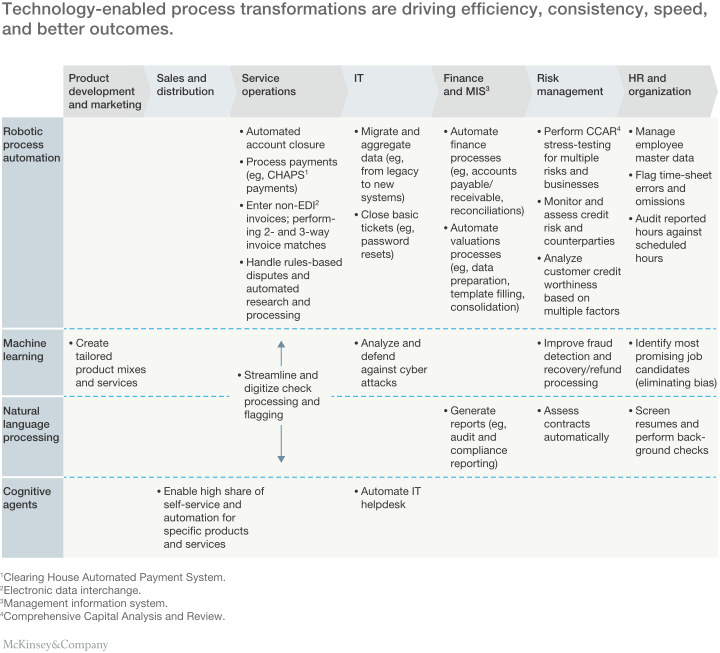
With these six building blocks in place, banks can evaluate the potential value in each business and function, from capital markets and retail banking to finance, HR, and operations. When large enough, these opportunities can quickly become beacons for the full automation program, helping persuade multiple stakeholders and senior management of the value at stake. Instead of seeing the results of numerous disparate experiments across the enterprise, these leaders will now see clear transformation opportunities—and be justifiably excited to build the capabilities, systems, and approaches necessary to reach automation at scale.
Courtesy mckinsey