Business A.M
No Result
View All Result
Wednesday, February 18, 2026
  • Login
  • Home
  • Technology
  • Finance
  • Comments
  • Companies
  • Commodities
  • About Us
  • Contact Us
Subscribe
Business A.M
  • Home
  • Technology
  • Finance
  • Comments
  • Companies
  • Commodities
  • About Us
  • Contact Us
No Result
View All Result
Business A.M
No Result
View All Result
Home Frontpage

Global financial stability at risk from geopolitical tensions, IMF warns

by Admin
January 21, 2026
in Frontpage, WORLD BUSINESS & ECONOMY

Onome Amuge

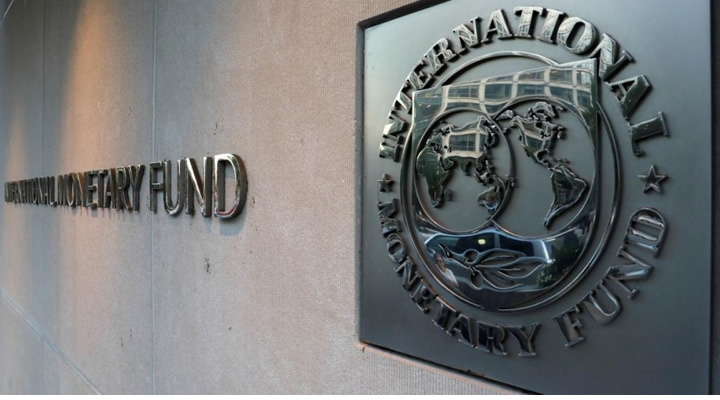
The recent global geopolitical tensions have the tendency to trigger declines in asset prices, strain financial institutions, and curtail lending to the private sector, ultimately dampening economic activity and jeopardising financial stability, the International Monetary Fund (IMF) has warned.

The multilateral lender, in its latest Global Financial Stability Report, highlighted that events such as wars, diplomatic friction, and terrorism can severely disrupt international trade and investment flows.

The IMF further noted that the unpredictable nature, infrequent occurrence, and uncertain duration of geopolitical shocks make them particularly challenging for investors to price, often leading to sharp market corrections when they materialize.

The report also pointed out a significant correlation between heightened geopolitical risk, as indicated by increased adverse news mentions, and declining stock prices. On average, major geopolitical events are associated with a one percentage point monthly drop in stock prices across countries, with emerging market economies experiencing a more pronounced average decline of 2.5 percentage points.

Notably, the IMF found that international military conflicts have the most severe impact on emerging market equities, triggering an average monthly drop of five percentage points – double the impact of other types of geopolitical events. This is likely due to the more substantial economic disruptions associated with such conflicts.

The analysis also revealed that elevated geopolitical risks can strain public finances as economic growth slows and government spending increases. Consequently, sovereign risk premiums, measured by credit default swap prices, tend to rise following geopolitical events. The IMF emphasised that these financial strains are particularly acute in emerging markets, where premium increases can be up to four times larger.

Furthermore, the report highlighted the potential for cross-border spillovers through trade and financial linkages, increasing the risk of contagion. When a major trading partner is involved in an international military conflict, stock valuations in other economies decline by an average of approximately 2.5 percent. Similarly, sovereign risk premiums increase when trading partners are affected by geopolitical events, with the impact being at least twice as large for emerging market economies characterised by high public debt, low international reserves, and weak institutions.

The IMF identified heightened uncertainty as a key transmission channel for asset price reactions. Geopolitical shocks tend to elevate macroeconomic uncertainty for several months. Recognizing these risks, investors demand a premium for holding assets that may underperform during such events.

The report cautioned that a sudden drop in asset prices could ultimately strain banks and non-bank financial institutions, potentially spilling over to the broader financial system and the real economy. For instance, banks may reduce lending, and investment funds could face lower returns and increased redemption risks when exposed to geopolitical shocks.

Addressing risk mitigation, the IMF acknowledged the seemingly constant barrage of unpredictable global events. However, it stressed that the financial sector and its regulators can take proactive steps to bolster financial stability.

The IMF recommended that financial institutions and their supervisors dedicate sufficient resources to identify, quantify, and manage geopolitical risks, including through stress tests that consider the potential interactions of these risks with financial markets. Furthermore, financial institutions are advised to maintain adequate capital and liquidity buffers to absorb potential losses stemming from geopolitical events.

For emerging markets and developing economies, the IMF suggested further developing and deepening financial markets to enhance investors’ ability to manage risks. 

In conclusion, the report emphasised that countries with weaker buffers are particularly vulnerable to geopolitical shocks, underscoring the importance of sufficient fiscal policy space and adequate international reserves to better withstand such disruptions.


Admin
Admin
Previous Post

Aba Power’s mass prepaid meter rollout creates 350 new jobs 

Next Post

Trump’s second term: A rare opportunity for real African energy independence 

Next Post

Trump’s second term: A rare opportunity for real African energy independence 

  • Trending
  • Comments
  • Latest
Igbobi alumni raise over N1bn in one week as private capital fills education gap

Igbobi alumni raise over N1bn in one week as private capital fills education gap

February 11, 2026
NGX taps tech advancements to drive N4.63tr capital growth in H1

Insurance-fuelled rally pushes NGX to record high

August 8, 2025

Reps summon Ameachi, others over railway contracts, $500m China loan

July 29, 2025

CBN to issue N1.5bn loan for youth led agric expansion in Plateau

July 29, 2025

6 MLB teams that could use upgrades at the trade deadline

Top NFL Draft picks react to their Madden NFL 16 ratings

Paul Pierce said there was ‘no way’ he could play for Lakers

Arian Foster agrees to buy books for a fan after he asked on Twitter

BUA Group leads Gulf–West Africa drive for integrated food and logistics corridor

BUA Group leads Gulf–West Africa drive for integrated food and logistics corridor

February 18, 2026
FairMoney expands SME credit access to boost financial capacity

FairMoney expands SME credit access to boost financial capacity

February 18, 2026
Logistics coordination is a structural efficiency reform, not luxury —Scott Dubin, Logistics Marketplace

Logistics coordination is a structural efficiency reform, not luxury —Scott Dubin, Logistics Marketplace

February 18, 2026
Ladi, rising on global tech space

Ladi, rising on global tech space

February 18, 2026

Popular News

  • Igbobi alumni raise over N1bn in one week as private capital fills education gap

    Igbobi alumni raise over N1bn in one week as private capital fills education gap

    0 shares
    Share 0 Tweet 0
  • Insurance-fuelled rally pushes NGX to record high

    0 shares
    Share 0 Tweet 0
  • Reps summon Ameachi, others over railway contracts, $500m China loan

    0 shares
    Share 0 Tweet 0
  • CBN to issue N1.5bn loan for youth led agric expansion in Plateau

    0 shares
    Share 0 Tweet 0
  • What’s Behind the Fourth-Quarter Earnings Dip?

    0 shares
    Share 0 Tweet 0
Currently Playing

CNN on Nigeria Aviation

CNN on Nigeria Aviation

Business AM TV

Edeme Kelikume Interview With Business AM TV

Business AM TV

Business A M 2021 Mutual Funds Outlook And Award Promo Video

Business AM TV

Recent News

BUA Group leads Gulf–West Africa drive for integrated food and logistics corridor

BUA Group leads Gulf–West Africa drive for integrated food and logistics corridor

February 18, 2026
FairMoney expands SME credit access to boost financial capacity

FairMoney expands SME credit access to boost financial capacity

February 18, 2026

Categories

  • Frontpage
  • Analyst Insight
  • Business AM TV
  • Comments
  • Commodities
  • Finance
  • Markets
  • Technology
  • The Business Traveller & Hospitality
  • World Business & Economy

Site Navigation

  • Home
  • About Us
  • Contact Us
  • Privacy & Policy
Business A.M

BusinessAMLive (businessamlive.com) is a leading online business news and information platform focused on providing timely, insightful and comprehensive coverage of economic, financial, and business developments in Nigeria, Africa and around the world.

© 2026 Business A.M

Welcome Back!

Login to your account below

Forgotten Password?

Retrieve your password

Please enter your username or email address to reset your password.

Log In
No Result
View All Result
  • Home
  • Technology
  • Finance
  • Comments
  • Companies
  • Commodities
  • About Us
  • Contact Us

© 2026 Business A.M