Onome Amuge
The Securities and Exchange Commission (SEC) is taking its investor protection and market development mandate in a new direction; one that begins not on the trading floor, but in the classroom.
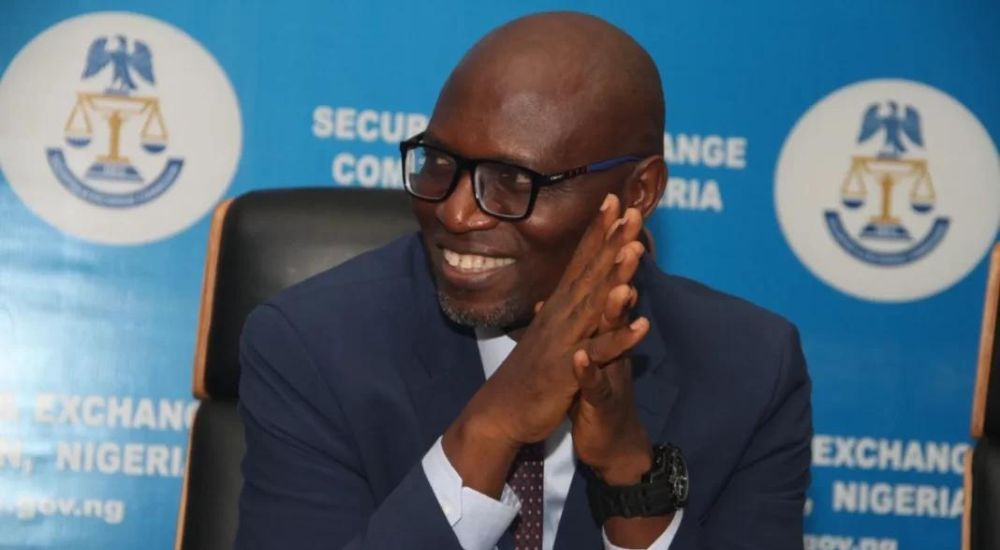
Speaking at the official handover of a reviewed National Universities Commission (NUC) Curriculum on Securities and Investment Management (SIM) in Abuja on Tuesday, Emomotimi Agama, the SEC director-general, noted that financial literacy is not merely an academic subject, but a survival tool in today’s economy.
For decades, financial literacy has been treated as a peripheral concept in Nigeria, championed sporadically by NGOs, banks, and regulators, but rarely embedded into formal education. The SEC’s collaboration with the NUC seeks to change that narrative.
Agama, represented by Bola Ajomale, executive commissioner, operations, described the reviewed curriculum as “a foundation for sustainable financial empowerment,” stressing that the initiative is part of a long-term vision to integrate financial education into all levels of learning; from primary schools to universities.
“This initiative recognizes that financial discipline and awareness are best nurtured early, when curiosity is highest and habits are still forming. Early intervention is key to producing responsible, confident, and financially empowered citizens,” Agama said.
The SEC DG said the effort is not just about teaching money management, but about shaping a new kind of Nigerian; one who understands how saving, investment, and value creation drive both personal and national prosperity.
The underlying ambition of the SEC’s education strategy goes beyond academia. It is, at its core, an economic blueprint, an attempt to prepare the next generation for participation in a modern, digital, and increasingly global financial system.
Agama made the link explicit, stating; “Embedding financial education into the national curriculum is an investment in human capital — the most critical driver of sustainable, inclusive, and resilient economic growth.”
The initiative aligns with the federal government’s goal of building a trillion-dollar economy within the next decade. That target, analysts say, cannot be achieved without a financially literate population capable of making informed investment decisions and mobilizing domestic savings into productive sectors.
Currently, less than 5 per cent of Nigeria’s adult population participates in the capital market directly, according to SEC data. High levels of financial illiteracy, coupled with mistrust of formal institutions, have limited the pool of retail investors.
By starting financial education early, the SEC hopes to expand the future investor base, not just for the capital market, but for the broader economy.
The Commission’s pilot programmes in Nasarawa and Ibadan,where the reviewed curriculum was first tested ,have reportedly shown “encouraging results.”
According to Agama, both teachers and students demonstrated strong adaptability and enthusiasm. “These early successes affirm that when given the right tools and guidance, Nigerian youth can quickly understand and apply concepts such as saving, investing, budgeting, and responsible financial decision-making,” he said.
Professor Uche Uwaleke, who chaired the SEC-appointed committee that reviewed the curriculum, said the reforms were guided by the need to align Nigerian universities with global capital market trends.
“The Committee was tasked with reviewing and expanding the existing curriculum to ensure our universities equip students with the knowledge and competencies to thrive in a modern market environment,” he said.
Among the key recommendations is the introduction of a Basic Course in Capital Market Studies, a mandatory course for all first-year university students across the country.
“This initiative is inspired by the recognition that awareness and understanding of the capital market remain relatively low, especially among young Nigerians. By introducing this foundational course, we aim to promote early exposure, foster capital market literacy, and ultimately deepen financial inclusion,” Uwaleke said.
The committee further recommended extending the course to all tertiary institutions, including polytechnics and colleges of education, to ensure that financial awareness becomes a national cultural norm, not a niche skill.
Agama acknowledged the NUC’s role in harmonizing academic standards, saying the partnership strengthens the bridge between education and enterprise, between classroom theory and the financial realities of everyday life.
The SEC chief’s emphasis on this bridge reflects a pragmatic understanding of Nigeria’s development challenges, which is a disconnect between academic learning and market realities.
By integrating practical financial education into curricula, the SEC hopes to reduce that disconnect; producing graduates who not only seek jobs but also understand capital formation, entrepreneurship, and investment dynamics.
While the policy direction is widely applauded, the path to execution is fraught with challenges. Nigeria’s education system continues to face overcrowded classrooms, outdated teaching materials, and limited funding.
Experts warn that unless the federal government and private sector provide adequate support, the initiative may struggle to gain traction.
Agama appeared mindful of these constraints, assuring stakeholders that the SEC would continue to support curriculum development, teacher training, resource provision, and collaboration across all levels of education.
He described the push as a national necessity, not an academic luxury, stating; “As our nation pursues the goal of building a trillion-dollar economy anchored on innovation, knowledge, and inclusive growth, financial literacy will be one of the strongest pillars supporting that ambition.”