Onome Amuge
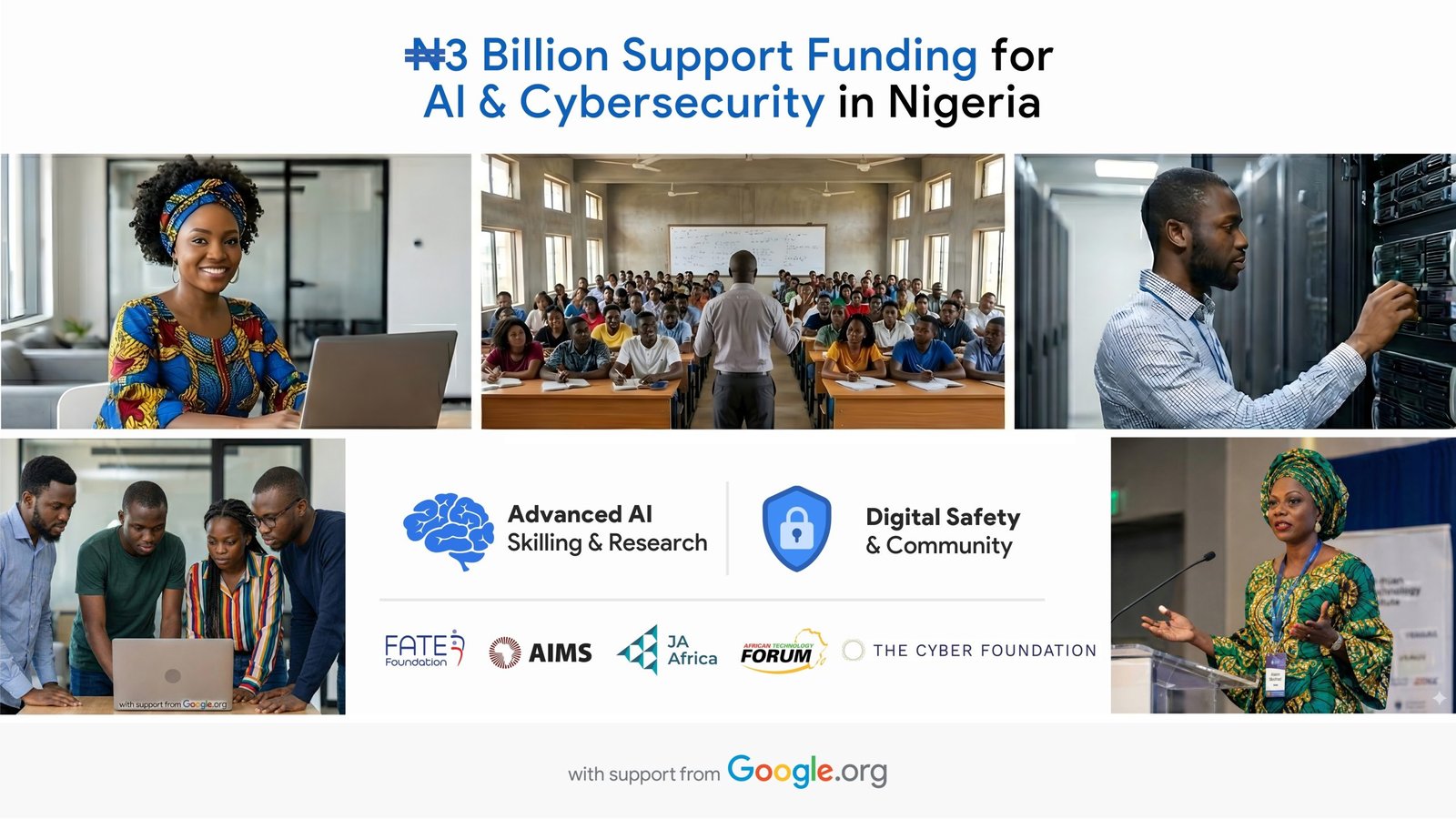
Google has deepened its long-running bet on Nigeria’s digital economy with a fresh N3 billion commitment aimed at accelerating the country’s ambition to become Africa’s leading hub for artificial intelligence. The significance of the pledge extends well beyond its monetary value, signaling an escalating contest among global technology firms to influence the talent pipelines, standards and institutional architecture that will underpin Africa’s next phase of digital transformation.
The investment, channelled through Google.org, the company’s philanthropic unit, comes at a moment when Nigeria is attempting to reposition itself from being primarily a consumer of technology to a producer of high-value innovation. Central to that agenda is the National AI Strategy, launched earlier this year, and the federal government’s target of generating one million digital jobs. Policy makers estimate that artificial intelligence could unlock up to $15 billion in economic value for the Nigerian economy by 2030, a projection that has drawn global attention.
What makes Google’s new commitment notable is not only the timing, but the dual-pillar structure that places equal emphasis on advanced technical training and digital safety. The company is betting that Nigeria’s digital economy cannot scale sustainably unless talent development is matched with stronger safeguards for institutions and users, a challenge that has become increasingly urgent as cybercrime grows in sophistication across West Africa.
Speaking at the launch, Bosun Tijani, minister of communications, innovation and digital economy described the announcement as evidence of the government’s drive to build strategic alliances that can translate policy ambition into measurable outcomes. “Artificial Intelligence sits at the heart of Nigeria’s desire to raise the level of productivity in our economy as well as our ambition to compete globally in technology and innovation,” he said. According to him, the partnership illustrates how private-sector actors can help operationalise the National AI Strategy by strengthening digital infrastructure and nurturing technical talent.
The N3 billion package will be implemented through five organisations tasked with strengthening different layers of the digital ecosystem. On the talent side, FATE Foundation and the African Institute for Mathematical Sciences (AIMS) will embed advanced AI curricula in universities, targeting lecturers and students who will form the backbone of Nigeria and Africa’s future technical workforce. Meanwhile, the African Technology Forum (ATF) will run an innovation challenge designed to guide early-stage developers from classroom learning to market-ready product development.
Adenike Adeyemi, executive director of FATE Foundation, described the initiative as a direct response to the urgent need for deep AI competencies in Africa, adding that the continental scope, including Ghana, Kenya and South Africa, positions Nigeria as a central node in Africa’s emerging AI talent network.
On the digital safety front, Junior Achievement (JA) Africa will scale the Be Internet Awesome curriculum to equip young people with online-safety skills, while the CyberSafe Foundation will work to strengthen cybersecurity practices across public institutions; an area where vulnerabilities have disrupted services and exposed sensitive national data in recent years.
According to Google, the investment reflects a continuation of its multi-year effort to entrench itself as one of Nigeria’s most influential technology partners. “Google has been a foundational partner in Nigeria’s digital journey, and this N3 billion commitment is the next chapter in that story,” said Olumide Balogun, the company’s Director for West Africa. The focus, he added, is to empower people with advanced AI skills while ensuring a safe digital space to operate.
The company’s previous interventions have already left a visible imprint. Its Equiano subsea cable, which landed in Lagos in 2022, expanded international bandwidth and helped drive down wholesale internet prices. In 2023, Google’s N1.2 billion Skills Sprint initiative trained nearly 21,000 Nigerians, more than 5,000 of them women, and facilitated placements for over 3,500 participants in jobs, internships or entrepreneurial ventures.