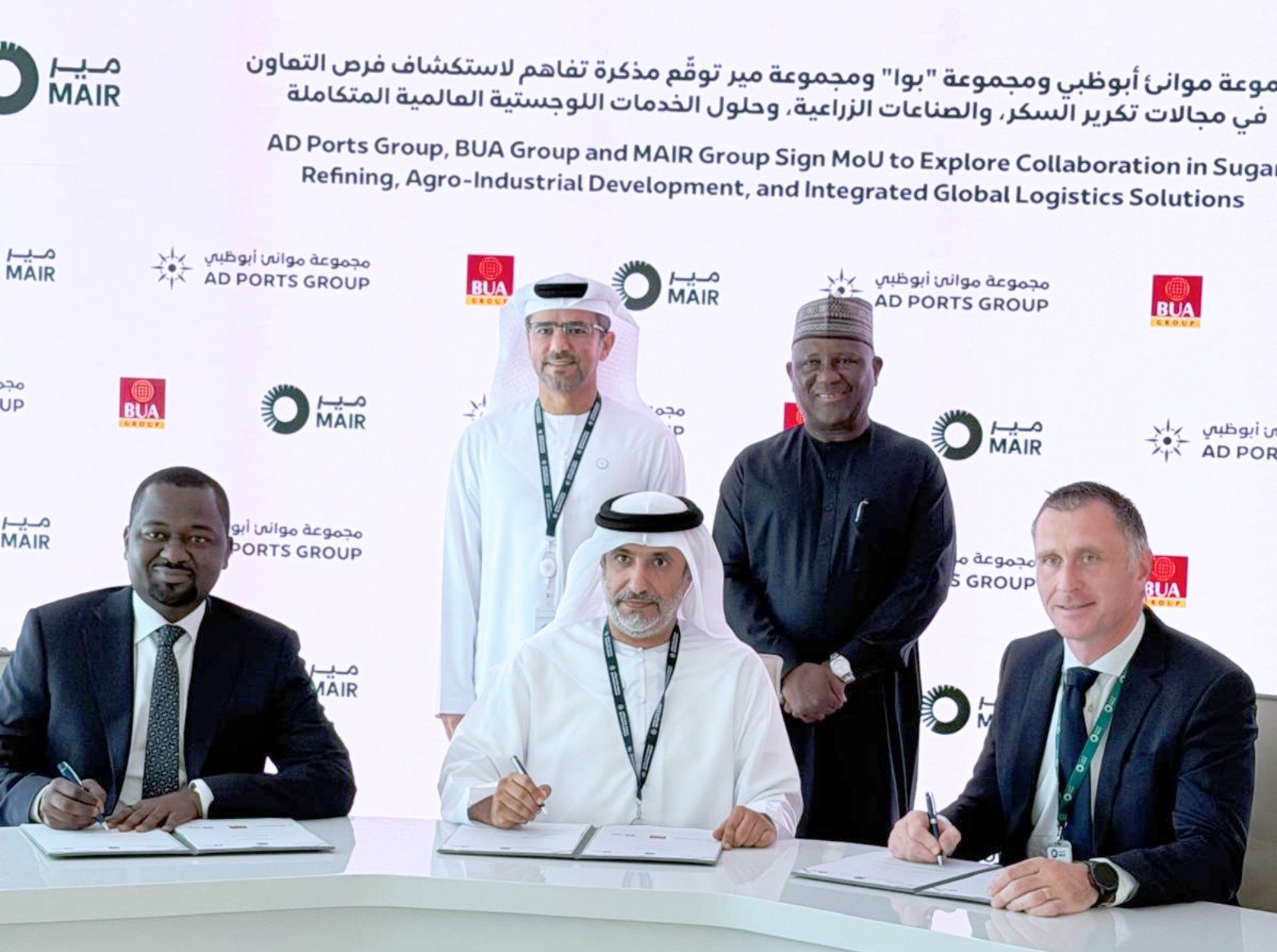
A new cross-regional industrial alliance is emerging between West Africa and the Gulf, as BUA Group, AD Ports Group and MAIR Group sign a memorandum of understanding to explore cooperation in sugar refining, agro-industrial processing and integrated logistics.
The proposed collaboration focuses on creating a structured trade corridor linking agricultural production zones in Nigeria with processing, storage and export infrastructure in Abu Dhabi. Executives involved describe the plan as both a commercial expansion and a geopolitical hedge, designed to strengthen supply resilience while tapping rising food demand across the Middle East and Asia.
Central to the initiative is Khalifa Port, one of the Gulf’s most advanced maritime logistics hubs. The port’s capacity, integrated industrial zones and multimodal connectivity provide the backbone for what participants hope will become a predictable export channel for agricultural commodities and processed food products.
Supply chain specialists say such infrastructure is increasingly critical as food security concerns intensify globally. Climate variability, geopolitical disruptions and rising population growth have encouraged governments and private investors to build diversified sourcing networks rather than relying on single production regions.
For Nigeria, whose agricultural sector remains underdeveloped relative to its potential, partnerships that improve post-harvest logistics and export processing could unlock additional value. Analysts note that inefficiencies in storage, transport and quality control often erode margins for African producers, limiting their competitiveness in international markets.
The agreement also reflects a strategic initiative by Gulf economies to expand beyond hydrocarbons into industrial manufacturing, logistics and food production. By linking African agricultural capacity with Gulf infrastructure and capital, the partners aim to create vertically integrated value chains spanning cultivation, processing, distribution and export.
BUA Group brings significant industrial capabilities to the venture, including large-scale operations in sugar refining, flour milling, cement manufacturing and infrastructure development. The conglomerate has steadily expanded its footprint in agro-processing, positioning itself as a regional player in food production as well as heavy industry.
MAIR Group is expected to contribute investment structuring expertise and integrated logistics development, while AD Ports Group provides operational experience in maritime trade corridors and industrial zone management. Together, the companies aim to reduce bottlenecks such as fragmented storage networks, inconsistent quality standards and limited traceability, issues that often complicate cross-border agricultural trade.
Abdul Samad Rabiu, founder and chairman of BUA Group, described the partnership as part of an expanded international expansion strategy. He emphasised the ambition to develop globally competitive industrial platforms capable of supporting resilient food supply chains while expanding export opportunities for African producers.
“This MoU marks an important milestone in BUA’s international expansion and reflects our long-term vision of building globally competitive industrial platforms. Together with AD Ports Group and MAIR Group, we aim to develop sustainable food production and logistics solutions that strengthen regional supply chains and support the UAE’s Food Security Strategy 2051,” he stated.
He further added that the partnership represents not just a commercial arrangement but a strategic food corridor anchored on shared economic ambition, resilient infrastructure, and disciplined execution, reinforcing long-term food security objectives for both nations.”
A representative of MAIR Group added: “This collaboration underscores our commitment to advancing strategic industries in Abu Dhabi and building integrated solutions that reinforce the UAE’s position as a global hub for trade, food security, and industrial excellence.”
A spokesperson from AD Ports Group commented: “Our partnership with BUA Group and MAIR Group highlights Khalifa Port’s role as a catalyst for high- impact industrial investments. This initiative will enhance regional food security, strengthen global trade connectivity, and support Abu Dhabi’s economic diversification goals.”
If implemented successfully, the proposed corridor could facilitate structured aggregation of agricultural commodities, standardised processing and streamlined maritime exports. However, execution risks remain significant. Agricultural logistics projects often encounter challenges ranging from infrastructure financing constraints to regulatory complexity and fluctuating commodity prices. Ensuring consistent quality standards and reliable shipping volumes will be critical to the initiative’s commercial viability.