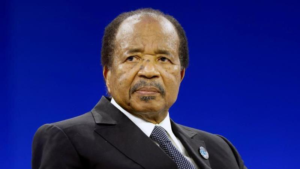
At a US-Africa Leaders Summit, Paul Biya was guided to his seat on stage like a man who had wandered into the wrong building. His microphone was live. “Qui sont ces gens?” he asked his assistant. Who are these people? The assistant reminded him that he had been briefed — he was at an important gathering and was expected to speak. Biya considered this. “Est-ce qu’ils m’attendent?” Are they waiting for me? “Sont-elles des personnes importantes?” Are they important people? This was a man who could not recognise where he was, sitting among heads of state whose presence he was incapable of acknowledging. What, exactly, was he likely to say to them?
Biya has spent the best part of his last two presidential terms living in the InterContinental Hotel in Geneva, a five-star retreat that doubles as a hospital for a man whose body has been failing him for years. His entourage takes over an entire floor at forty thousand dollars a day. In October 2025, this same man — who cannot navigate a room without a guide, who does not know where he is or who he is speaking to — won an election to lead Cameroon into an eighth term. He is ninety-two. His new mandate will keep him in power until he is nearly one hundred.
So the question must be asked plainly: what does Paul Biya need power for? What could he possibly do with it? He cannot walk unaided. He cannot recognise a room full of his peers. He governs from a hotel in a foreign country. He has held power for over forty years and Cameroon has nothing to show for it except the confirmation that power was held.
Perhaps there is only one purpose. Keep power so that no one else gets to exercise it. Not to govern, not to build, not to transform — simply to ensure that authority remains permanently occupied and permanently empty. Biya cannot leave power because he is no longer truly in power. The decisions are made elsewhere, by people who prefer invisibility. He is the legal face of arrangements he does not control. Power owns him more than he owns power. He is not clinging to the office. He is being kept there by those who need the office filled and the authority unused.
Biya is the purest case only because his body can no longer disguise what is happening. In Nigeria, the art is practiced with far greater energy, which is what makes it harder to see.
The president has become an activist for state police. He first promised it during his 2023 campaign. He endorsed it at a governors’ meeting in February 2024. He declared a state of emergency on insecurity in 2025 and urged the National Assembly to amend the constitution. Then, in the last week of February 2026, he announced it three times in five days — to governors on Monday, to senators on Wednesday, to the House of Representatives on Friday — each audience receiving the same unfulfilled commitment as though it were fresh. Three Iftar dinners. Three pledges. No legislation. No bill. No timeline. No state police. Many of those who heard him the first time in 2023 and believed are no longer alive. The gap between intention and action is where power is supposed to live. That gap is widening, and it is swallowing people.
In October 2024, the president announced a thirty-day National Youth Conference in his Independence Day broadcast. By December, nothing had happened. The Presidency fixed it for February 2025. February passed. In March, a forty-four-member planning committee was inaugurated — not the conference, a committee to plan it. In June, a registration portal was launched. Seventeen months later, the conference has not been held. What exists is an announcement, a committee, a website, and a theme. The Senate, for its part, has summoned security chiefs over insecurity at least seven times since 2023. The chiefs sometimes do not appear. When they do, they pledge. New chiefs replace old ones. The Senate summons again. Minutes of silence are observed. Condolences are extended. The country buries its dead and waits for the next summons.
This is not failure. Failure implies an attempt. This is activity organised entirely around maintaining the appearance of governance. And here is the thing that must be understood: the art of doing nothing is not the absence of activity. It is an art, and art implies doing. The announcements are work. The committees are work. The Iftar dinners are work. The summoning of security chiefs is work. The per diem is paid, the logistics are tendered, the communiqué is drafted, the report is published, the vision is shared. The doing is real. The “nothing” is its achievement.
When Nigerian leaders are given the choice between power and the country, they have been crystal clear: power, all days, any day. You must compete for power, but you must work together to build a country, and competition does not end at the inauguration. It rewires whoever wins. Who needs a country when you are not the one ruling it?
But let no one imagine this art belongs to the government alone. Check the political news in a country whose national unity is now a subject of discussion in foreign capitals. It is all Wike versus Fubara, Akpabio versus Natasha, APC versus ADC, Ribadu versus El-Rufai. The opposition wants power. If you are aware of what they propose to do with it differently, please inform me. A year before the next election, there is not a single policy document, not one concrete alternative, not a vision for the country that extends beyond the question of whose turn it is and which coalition absorbs which. The opposition performs opposition the way the government performs governance — with maximum visibility and zero construction.
The intellectual class is no different. We diagnose. We publish. We attend conferences. We produce frameworks that nobody is obligated to act on. The trap is this: the intellectual believes that because he sees clearly, he has done his part. Seeing is not building. Naming the disease is not treating it. The press covers the seventh announcement of state police as though it were news, without ever writing the sentence that matters: this is the same promise made seven times with no legislation attached. The churches and mosques hold vigils for the nation, declare fasting weeks, prophesy restoration — and their leaders accumulate wealth through the same structures they pray over. The prayer is the product. God is not expected to answer because the question was never seriously asked.
The government announces. The opposition condemns. The intellectuals diagnose. The press covers. The clergy prays. The citizens complain. Every sector of the Nigerian elite performs its designated role with extraordinary discipline. The collective output is zero. That is the art perfected: not just doing nothing in government, but making it structurally impossible for anyone outside government to do something either. And so the young leave. They leave to preserve sanity — to escape the unbearable knowledge that the country they understand best has decided not to exist as a serious project. But Nigeria follows them with the food, the churches, the music, the comedy, and now the crimes. “Make am” does not transform into civic responsibility at Heathrow. It was never about geography. It was about what the failed state taught people to believe about collective life. When many of them realise the anonymity abroad was relief but not purpose, they contemplate becoming politicians back home. The cycle completes. Nobody is building. Everyone is relocating the competition.
I am one of those quiet Nigerians who wanted this government to do well. I have written forcefully in its defence when I believed it was unjustly attacked — and it was, and in many ways still is. But to continue defending the poor management of the decline of our nation, of our history, is to deny ourselves the blessing of our God-given senses. It is to deny the reality those senses cannot escape from. It is to join the ranks of those to whom nothing in our past inspires any idea of greatness, and to settle for this art of doing nothing as the best of all possible worlds we can hope for.
In doing this, we will not only compromise today. We will be weaving with our own hands the rope with which future generations will be hanged. Instead of leaders who believe a country is worth building, we have Paul Biya asking who is in the room. And we have our own leaders, who know exactly who is in the room and have decided it does not matter, because the room itself — the country, the people, the future — is dispensable. The purpose of this enormous and organised expense of human effort is to perfect the art of doing nothing.
- business a.m. commits to publishing a diversity of views, opinions and comments. It, therefore, welcomes your reaction to this and any of our articles via email: comment@businessamlive.com

Damilare Ebeniza studied Political Science and International Relations in Nigeria, Benin Republic, and France, with a research focus on Nigerian history, economy, and foreign politics. He has experience as a conference interpreter and external relations management across Chad, Niger, Mali, and Guinea Conakry, for governmental, regional and international organisations in West Africa. Proficient in French, English, and four additional non-Nigerian African languages, he embodies a commitment to cross-cultural understanding and effective communication. He can be reached via comment@businessamlive.com