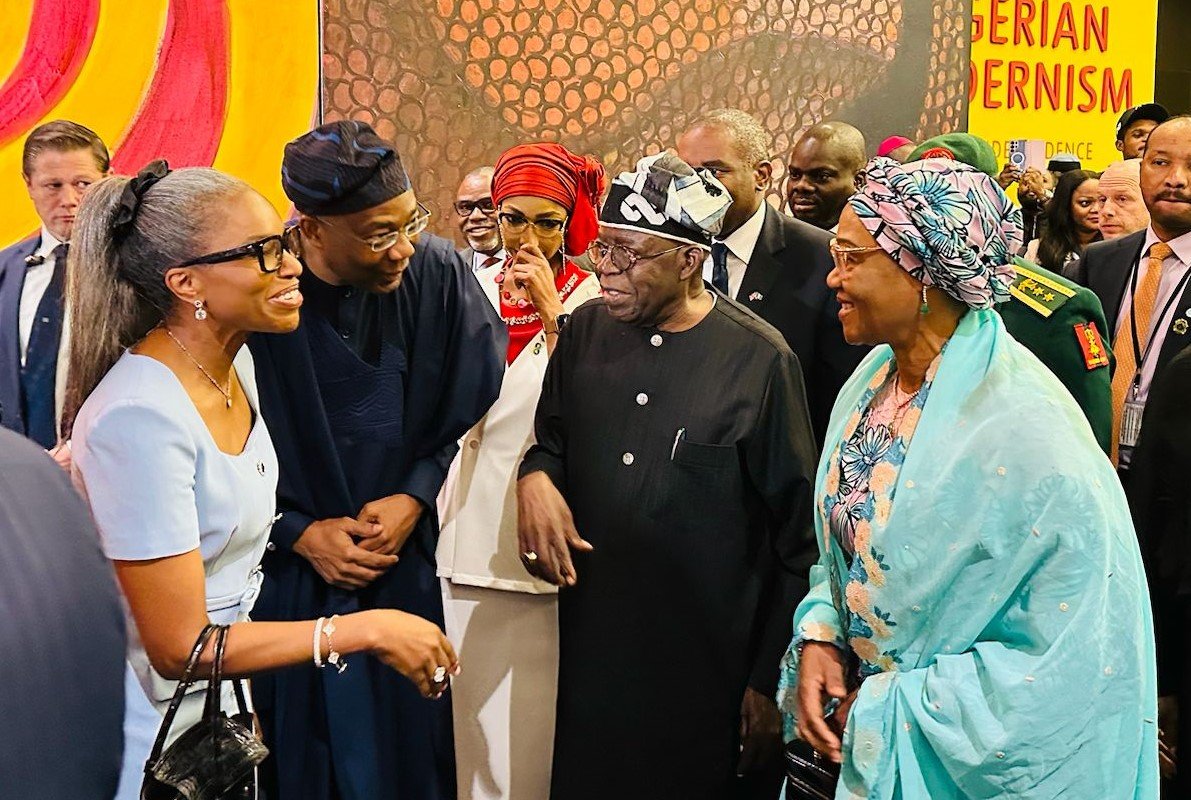
President Bola Ahmed Tinubu brought his state visit to the United Kingdom to a close with a high-profile reception at the Tate Modern, leveraging culture as a vital instrument of economic diplomacy and global positioning.
The event, anchored around the Nigerian Modernism exhibition, drew an influential audience that included David Lammy, the UK deputy prime minister, members of the diplomatic community, business leaders, and representatives of the Nigerian diaspora.
Held at the iconic Tate Modern, one of the world’s leading contemporary art institutions, the exhibition provided a platform to showcase Nigeria’s mid-20th century artistic evolution,an era widely regarded as foundational to the country’s modern cultural identity. President Tinubu described the collection as emblematic of a revolution, highlighting how Nigerian artists redefined their narrative beyond colonial influences and established a distinctive global voice.
“It is a profound honour to stand here and witness the soul of Nigeria on display,” Tinubu said, framing the exhibition as a fusion of global artistic techniques with indigenous heritage.
Central to the exhibition’s international staging was the role of the private sector, particularly Access Holdings Plc and Coronation Group. Both institutions were instrumental in supporting the showcase, reflecting a growing trend of corporate participation in cultural diplomacy and the creative economy. The President commended the organisations for facilitating what he described as a vital dialogue between Nigeria’s historical legacy and its global future.
The reception also served as a signal to international investors and stakeholders that Nigeria is seeking to diversify its global narrative beyond hydrocarbons and traditional sectors. By foregrounding culture in a global capital like London, the government aims to strengthen perception, enhance brand equity, and deepen bilateral engagement.
Tinubu urged Nigerians abroad to embrace their role as cultural and commercial ambassadors, emphasizing innovation and adaptability as defining national traits.
“You come from a lineage of pioneers,” he said, calling on diaspora communities to contribute to Nigeria’s evolving global footprint.
The evening further reinforced the longstanding relationship between Nigeria and United Kingdom, a partnership historically rooted but increasingly oriented toward shared opportunities in trade, investment, and creative collaboration. Observers point to the growing intersection of culture and commerce as a key pillar of this relationship, particularly as both countries explore new avenues for economic cooperation in a post-Brexit and rapidly digitising global economy.
Tinubu concluded by emphasizing the universal power of art as a connector across borders and markets. “Art has no borders. It is the language of our common humanity,” he said, framing the exhibition not only as a cultural milestone but as a strategic bridge between nations.