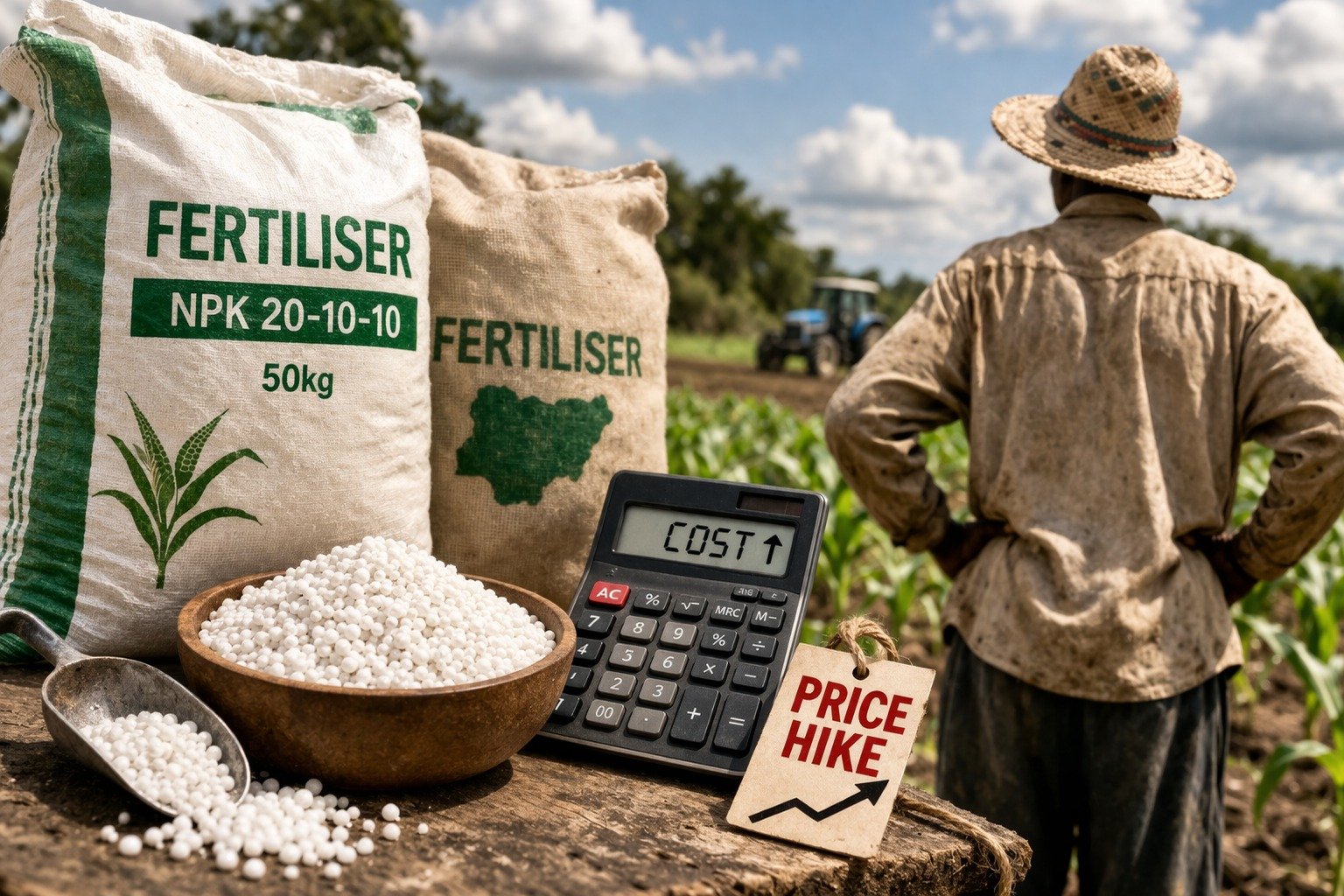
Urea prices have reached unprecedented heights, creating significant pressures on Nigeria’s food sector. The global benchmark, which hovered between $300 and $350 per tonne in early 2024, has risen to $452–$454 per tonne in early 2026. In constrained markets, spot prices now range from $590 to $700 per tonne. Given Nigeria’s heavy reliance on imported fertilisers to sustain its population of over 220 million, the economic and social implications are substantial, including higher food costs and potential declines in agricultural output.
The escalation of global agricultural prices is a direct consequence of compounded international disruptions, initiated by the Russia–Ukraine conflict in 2022. The conflict interrupted global supply chains, particularly for wheat and fertilisers, with both countries accounting for about 30 per cent of wheat exports and a significant portion of fertiliser production. The blockade of Black Sea routes led to an increase in commodity prices, culminating in the FAO Food Price Index reaching an all-time high of 159.7 points by mid-2022, reflecting substantial cost pressures on wheat, maize, and fertiliser markets.
Even as markets began to adjust, new shocks compounded pressures. Heightened geopolitical tensions involving the United States, Israel, and Iran have intensified volatility in oil and natural gas markets, key components in fertiliser production. Brent crude, averaging around $70 per barrel in mid-2025, has climbed above $100 per barrel, even briefly touching $119 per barrel, as markets price in supply risks through the Strait of Hormuz, a vital chokepoint for global oil flows. Natural gas, critical to ammonia and urea production, has also tightened due to upstream infrastructure pressures, pushing fertiliser production costs higher. Shipping delays in the Red Sea and elsewhere have further inflated freight costs, delaying deliveries and exacerbating price pressures across global agricultural supply chains.
The relationship between energy prices and food costs is direct and unyielding. When Brent crude remains elevated, transportation, storage, and processing costs rise, inflating import bills and increasing the cost of domestic production. Urea, forming the backbone of nitrogen fertilisers, now acts as a conduit through which energy shocks translate directly into food price inflation.
For Nigeria, the consequences cannot be ignored. Import-dependent staples become costlier, domestic agricultural production faces higher input costs, and market prices for food rise, squeezing consumers’ purchasing power. Every layer of urea, fuel, labour, machinery, and foreign exchange, adds upward pressure, leaving households to bear the brunt. In effect, strikes, insecurity, and production shocks compound an already critical hunger crisis.
Before the Russia–Ukraine war, Nigeria’s agriculture sector was already struggling under structural constraints including low investment, insecurity in key farming regions, and a limited domestic production base. Heavy reliance on imports for wheat, rice, and fertilisers left the country acutely vulnerable to global shocks. The temporary halt of LNG exports from Qatar added another energy shock, pushing domestic costs higher, while the removal of the fuel subsidy in May 2023 further increased transportation and production expenses.
The lingering effects of previous policy measures, including land border closures between 2019 and 2020, had already constrained domestic trade. Although most crossings reopened by 2023, farmers continued to face insecurity, high input costs, and limited support. Now, at the dawn of a new cultivation season, both producers and consumers confront higher fertiliser prices, labour costs, and transport fees, translating into reduced yields and escalating market prices.
While official reports point at a moderation in food inflation in 2025, analysts argue the apparent relief was largely statistical. Changes in the Consumer Price Index (CPI) base year by the National Bureau of Statistics (NBS) reduced the year-on-year comparison, showing food inflation declining from 38 per cent in February 2024 to about 23.5 per cent in February 2025. In reality, prices continued to rise, albeit at a slower pace. Fertiliser price increases, persistent energy shocks, and ongoing domestic insecurity ensured that households experienced little tangible relief.
By early 2026, the pressures that began years earlier had compounded. According to the World Bank, about 139 million Nigerians lived in poverty in 2025 (approximately 60–62 per cent of the population), up from 81 million in 2019. Projections indicate the number could reach 141 million by 2026, underscoring the human cost of structural vulnerabilities exacerbated by global disruptions.
Farmers are raising concerns over rising costs, warning that escalating transportation and energy expenses are threatening agricultural production. Farouk Rabiu Mudi, president of the All Farmers Association of Nigeria (AFAN), described the rise in transportation and energy costs as a critical threat to the sector. “Haulage costs have surged from between N400,000 and N800,000 to as high as N3 million to N4 million per trip on major routes. This increase significantly affects both producers and consumers, cutting deeply into margins and threatening the sustainability of production,” Mudi stated recently.
At the farm level, input inflation is diminishing profitability. Yakubu Ishaku, a Plateau State-based farmer, lamented that fertiliser costs have more than doubled over the past year. “Many farmers are struggling to maintain productivity because we can no longer afford the same level of input usage,” Ishaku said. He added that export-oriented crops face additional challenges due to foreign exchange volatility and high international logistics costs, reducing market competitiveness and earnings.
Industry stakeholders warn that Nigeria’s agricultural sector faces a fragile operating environment, with external shocks intersecting domestic inefficiencies. Rising freight costs, inflationary input prices, and currency instability create a cycle where both production and consumption are under pressure. Without targeted interventions to strengthen local production capacity and reduce reliance on imports, Nigeria’s food system will remain highly vulnerable to global shocks.
Urgent policy measures are necessary. Stakeholders call for investments in infrastructure, improved input distribution systems, and stronger policy support to stabilize production. Strengthening the agricultural value chain could reduce reliance on imports, improve market efficiency, and support long-term sustainability.
The fertilizer crisis reflects deeper macroeconomic pressures. High energy costs and import dependence are fueling inflation across sectors, while domestic production constraints leave Nigeria exposed to volatility in global commodity markets. For households, these pressures manifest as higher food bills, reduced nutrition, and intensified poverty.
The convergence of global and domestic shocks highlights the interconnectedness of energy, agriculture, and economic policy. Fertiliser costs, energy prices, logistics, and exchange rates interact in ways that amplify risks for producers and consumers alike. Mitigating these risks requires coherent policy coordination, targeted subsidies, and strategic investments to improve domestic production capacity and resilience.
Experts argue that Nigeria must urgently strengthen its domestic agricultural base. This includes expanding local fertiliser production, improving supply chain logistics, and providing financial and technical support to farmers. Enhanced coordination between energy, agriculture, and trade policies could help shield the sector from future global shocks.
Unless meaningful interventions are introduced, the cycle of rising costs is set to continue. For millions of Nigerians, this means more expensive food, weaker purchasing power, and a growing threat of hunger. The fertiliser crisis of 2026 stands as a reminder that global disruptions quickly become local realities, and that without structural reform, Nigeria’s food system will remain vulnerable to forces beyond its control.