The global chocolate industry is built on a supply chain whose foundation lies in West and Central Africa, yet the economic architecture of that chain tells a different story; one in which those at the base capture the least value. For decades, the narrative around cocoa has emphasised Africa’s production strength. A deeper crisis is unfolding beyond production figures, as Africa’s inability to retain value is what ultimately determines how much farmers earn, how much governments gain, and whether the sector can endure.
Across cocoa-producing regions, especially in Nigeria, Ghana, and Côte d’Ivoire, a structural imbalance persists. Smallholder farmers, who account for the overwhelming majority of production, continue to operate at subsistence levels, often earning less than a dollar a day. This is despite their central role in supplying about 70 per cent of global cocoa output. The disconnect between output and income is no longer seen as a temporary market inefficiency; it is increasingly understood as a systemic failure rooted in how the global cocoa economy is organized.
A value chain that excludes its producers
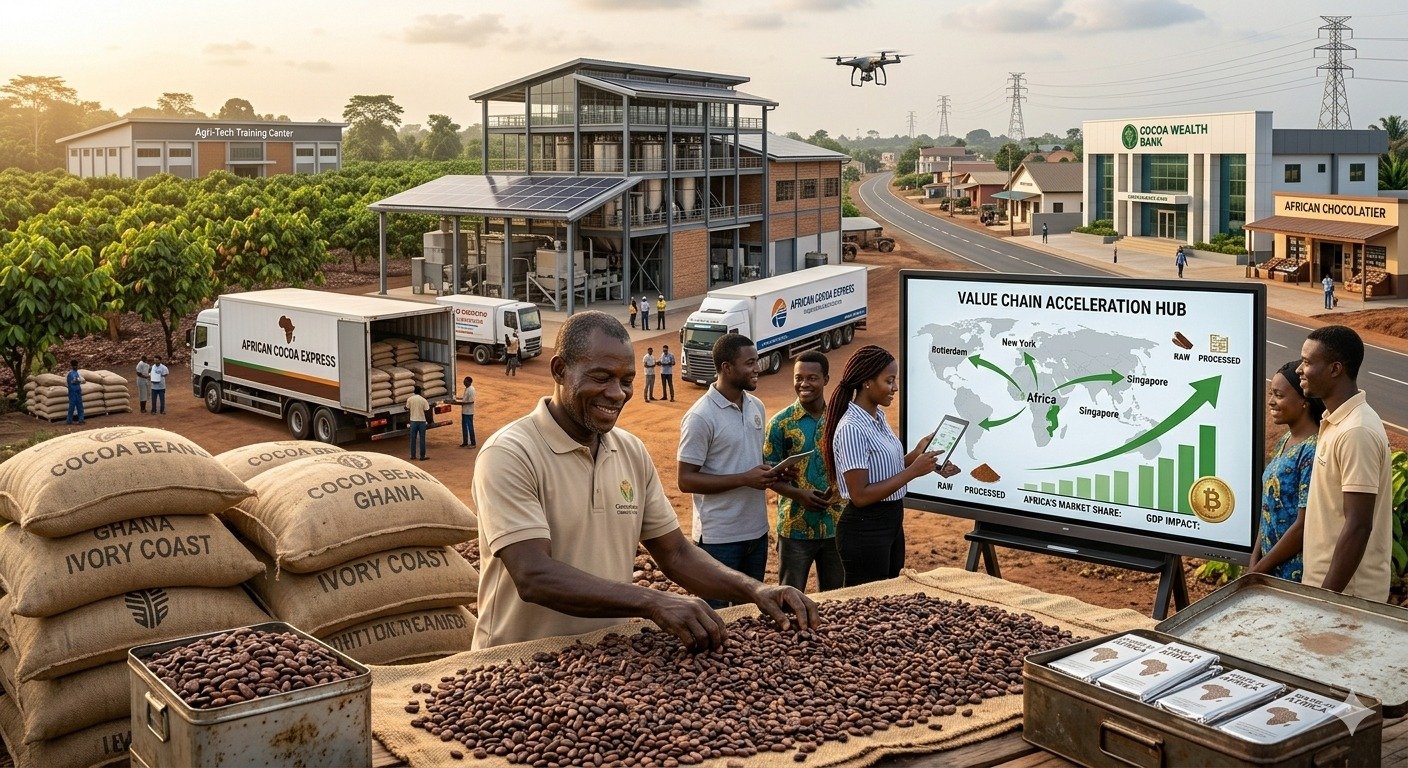
The modern cocoa value chain is heavily skewed toward downstream activities (processing, branding, distribution, and retail) most of which occur outside Africa. While raw beans are exported in large volumes, the higher-margin stages of transformation take place in Europe, North America, and parts of Asia.
This structure has resulted in a disproportionate distribution of value. African countries collectively earn less than 10 per cent of the global cocoa and chocolate market’s total value. In practical terms, this means that even as production increases, income gains for farmers and producing nations remain limited.
The implications are far-reaching. Exporting raw commodities without significant domestic processing effectively externalises economic opportunities including jobs, industrial growth, technological advancement, and foreign exchange earnings.
Recent volatility in global cocoa prices has brought renewed attention to farmer incomes. Price spikes have temporarily improved earnings in some producing countries, including Nigeria. However, analysts argue that focusing on prices alone misses the broader structural issue.
Commodity markets are inherently cyclical, and farmers remain price takers with little influence over global pricing mechanisms. Without deeper participation in value-added segments, income gains from price increases are unlikely to be sustained.
This has led to a reframing of the cocoa crisis, from one centered on price instability to one focused on structural power within the value chain. Who controls processing? Who owns the brands? Who captures consumer-facing value? These questions are now central to policy and industry discussions.
This shift in perspective is becoming more pronounced as new policy frameworks and development strategies emerge, including a continent-wide intervention spearheaded by the Cocoa and Coffee Farmers Alliance Association of Africa (COCEFAAA). The alliance’s newly expanded mandate, now covering both cocoa and coffee, signals a recognition that Africa’s agricultural future hinges not on volume, but on value.
For years, discourse around cocoa farmer poverty has centered on price volatility. Indeed, global cocoa prices have experienced significant swings, with recent spikes offering temporary relief to producers. However, experts argue that focusing solely on price obscures the deeper issue.
Price increases, while beneficial in the short term, do not fundamentally alter the structural dynamics of the industry. Farmers remain price takers in a global market they do not control. Without local processing and stronger participation in downstream activities, even high prices cannot guarantee sustainable income.
This reality is becoming increasingly evident in countries like Nigeria, where farmers are already facing the aftermath of recent price increases. While the boom provided a temporary income boost, it also exposed vulnerabilities; particularly the lack of financial literacy, investment planning, and resilience mechanisms needed to manage cyclical commodity markets.
One of the most critical levers for transforming Africa’s cocoa economy is local processing. Countries that have invested in grinding and semi-processing capacity are beginning to demonstrate the potential of this approach.
Côte d’Ivoire, for instance, has emerged as the world’s leading cocoa grinder, processing close to 800,000 tonnes domestically. Ghana is pursuing a similar trajectory, targeting the processing of at least 50 per cent of its cocoa output while implementing traceability systems to meet evolving global standards.
These efforts highlight a pathway for other African nations: moving up the value chain from raw exports to intermediate and finished products. However, scaling this model across the continent will require significant capital investment, policy coordination, and private sector participation.
COCEFAAA’s forthcoming three-year development plan is expected to prioritise exactly these areas; promoting sustainable production, strengthening cooperatives, and catalyzing investment in local processing and value addition.
The role of smallholders
According to industry analysts, any meaningful transformation of the cocoa sector must center on smallholder farmers, who constitute the backbone of production. In Nigeria alone, an estimated 300,000 to 350,000 smallholders cultivate cocoa across 1.4 million hectares, supporting over two million families.
Despite their central role, these farmers face a convergence of challenges including aging plantations, low productivity, limited access to improved seedlings, and inadequate extension services. Climate change further compounds these issues, with shifting rainfall patterns and rising temperatures affecting yields.
In response, targeted interventions are emerging at the grassroots level. Training programmes focusing on agroforestry, soil conservation, pest management, and organic farming practices are being implemented to enhance resilience and productivity.
These initiatives are not merely technical. They represent an enhanced shift toward viewing farming as an enterprise rather than a subsistence activity. By integrating business management and investment principles into training programmes, stakeholders aim to equip farmers with the tools needed to navigate an increasingly complex agricultural landscape.
Despite these efforts, adoption continues to be a major constraint.
Training programmes, workshops, and demonstration farms can introduce new techniques and knowledge, but their impact ultimately depends on whether farmers embrace and implement these practices. Behavioral change in agriculture is often slow, influenced by risk aversion, cultural norms, and resource constraints.
This gap between knowledge and practice is widely recognised by development practitioners. Farmers may understand the benefits of agroforestry or improved seed varieties, but without access to finance, markets, and consistent support, adoption remains limited.
Bridging this gap requires a more holistic approach; one that combines technical training with financial inclusion, market access, and continuous engagement.
Traceability and compliance pressures
Another critical dimension shaping the future of Africa’s cocoa sector is traceability. Global markets, particularly in Europe, are increasingly demanding transparency in supply chains, driven by concerns over deforestation, child labor, and environmental sustainability.
Regulations such as the European Union Deforestation Regulation (EUDR) are raising the bar for compliance. Producers must now demonstrate that their cocoa is not linked to deforested land, necessitating robust traceability systems and data collection mechanisms.
For many smallholder farmers, these requirements are both unfamiliar and burdensome. Questions abound: What does traceability mean in practical terms? How can farmers verify the origin of their produce? What systems are needed to ensure compliance?
Without adequate support, there is a risk that smallholders could be excluded from premium markets, further exacerbating income disparities.
Governments across cocoa-producing countries are increasingly acknowledging the need for strategic intervention. In Nigeria, for instance, subnational initiatives such as Cross River State’s seven-year agriculture strategy aim to boost production of cocoa, oil palm, and coffee.
However, experts caution that policy frameworks must be grounded in practical realities. Engagement with farmers is critical, as is the integration of emerging technologies, improved seedling distribution, and extension services.
There is also a growing call for governments to play a more active role in facilitating access to finance, infrastructure development, and market linkages. The absence of consistent public sector support has long been cited as a constraint on agricultural transformation.
Toward a new narrative
Stakeholders broadly agree that Africa’s cocoa sector must evolve beyond primary production toward greater value chain participation. Key priorities include expanding domestic processing capacity, developing competitive brands, diversifying export markets, and strengthening the role of farmers as active contributors to value creation.
COCEFAAA’s vision of increasing Africa’s share of the global coffee market to 20 per cent by 2030 reflects this ambition. While ambitious, it underscores the potential for transformative change if the right policies and investments are implemented.