
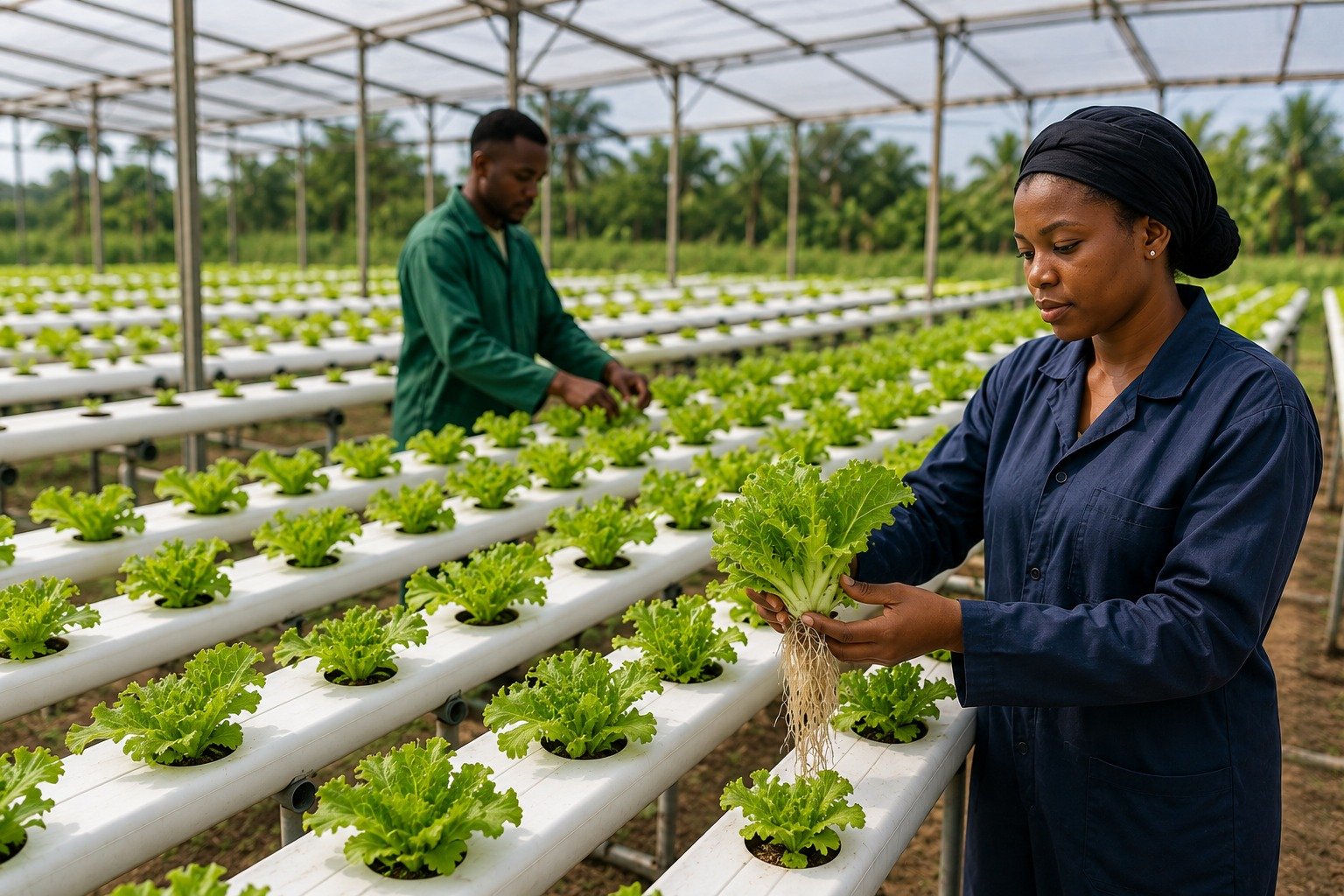
Hydroponic farming, also known as soilless farming, is emerging as a viable alternative for boosting food production as rising energy costs, climate shocks and weak agricultural productivity continue pressuring conventional farming systems. Stakeholders say worsening soil degradation and rapid urbanisation are making traditional agriculture increasingly unsustainable.
Although agriculture remained a major contributor to the Nigerian economy in 2025, accounting for 23.53 percent of nominal gross domestic product (GDP), productivity levels continue to face mounting threats from environmental decline and climate-related disruptions.
Across farming communities nationwide, flash floods, droughts, erosion and land degradation are steadily reducing the quality and availability of arable land, worsening concerns over the long-term sustainability of traditional farming practices.
Industry reports attribute the deterioration of soil quality to multiple factors, including pollution, over-cultivation, excessive fertiliser application and the impact of climate change, all of which continue to weaken crop yields and agricultural resilience.
Against this backdrop, hydroponic farming, a modern agricultural system that allows plants to grow without soil, is attracting growing attention as a technologically driven alternative capable of transforming food production in Nigeria.
Hydroponics relies on mineral nutrient solutions dissolved in water to nourish crops, enabling farmers to cultivate plants in controlled environments while significantly reducing dependence on fertile soil and large expanses of farmland.
Agricultural experts say the technique offers significant advantages over traditional farming systems, particularly within urban areas where land scarcity, poor soil quality and water shortages increasingly constrain food production.
One of hydroponics’ strongest advantages lies in its ability to provide highly controlled nutrient management, allowing farmers to deliver precise nutrient combinations directly to plant roots. Unlike conventional farming, where soil composition and fertility determine nutrient absorption, hydroponic systems give producers greater control over crop growth conditions, resulting in improved yields and resource efficiency.
The technology is also gaining global commercial momentum.
According to data from Fortune Business Insights, the global hydroponics market was valued at $12.24 billion in 2025 and is projected to grow from $13.45 billion in 2026 to $30.79 billion by 2034, reflecting a compound annual growth rate of 10.87 percent during the forecast period.
North America accounted for the largest market share in 2025, representing 36.02 percent of global hydroponics demand, underscoring growing international interest in controlled-environment agriculture and sustainable food systems.
Hydroponics experts argue that Nigeria cannot afford to remain on the sidelines as global agricultural systems transition toward climate-smart production models.
In Lagos, Gartner Callaway is among a growing number of firms pioneering hydroponic and aeroponic farming systems aimed at improving urban food production efficiency.
Yomi Williams explained that the company deploys aeroponics, an advanced hydroponic method that suspends plant roots in the air while misting them with nutrient-rich solutions.
The process uses coco coir, the fibrous outer layer of coconut shells, as a substitute growing medium instead of soil.
Williams noted that coco coir offers several advantages, including sterility, improved nutrient retention and superior aeration, all of which contribute to healthier plant growth and higher crop yields.
According to him, aeroponics is particularly suitable for urban environments where land and water resources remain constrained.
“The whole point is growing more using less space, less water and less nutrients to ensure sustainable farming,” he explained.
Industry analysts note that urban farming systems such as hydroponics and aeroponics could become increasingly important in Nigeria as population growth and urban expansion continue placing pressure on conventional food supply chains.
Nigeria’s rapidly growing urban centres already face rising demand for vegetables, grains and fresh produce, while transportation costs and post-harvest losses continue inflating food prices nationwide.
For proponents of hydroponics, controlled-environment farming offers an opportunity to shorten food supply chains, improve year-round crop production and reduce exposure to climate-related disruptions.
Ogbole Samson, whose agri-tech company specialises in soilless farming systems, believes hydroponics could become a critical pillar of Nigeria’s long-term food security strategy.
Samson argued that hydroponics offers Nigeria an opportunity to overcome many of the structural constraints undermining conventional agriculture, including poor soil fertility, land scarcity and climate volatility.
He also stressed that hydroponics farming remains more financially accessible than many Nigerians assume.
According to Samson, producers can establish small-scale hydroponic farms with as little as N50,000, while generating returns that significantly exceed the initial investment.
The affordability of entry-level hydroponic systems, combined with their relatively high productivity, could help attract young entrepreneurs into agriculture at a time when youth unemployment and declining interest in farming remain major economic concerns.
Samson believes wider adoption of hydroponics could support food security while simultaneously creating new agribusiness opportunities for Nigeria’s growing youth population.
However, he warned that awareness levels remain low among farmers and investors, slowing broader adoption of the technology.
According to him, skepticism toward unfamiliar agricultural innovations continues discouraging many farmers from transitioning away from traditional cultivation methods.
Samson also identified Nigeria’s unstable electricity supply as a major obstacle to scaling hydroponic systems, many of which rely on continuous power for irrigation pumps, nutrient circulation and climate control systems.
“In light of the global trend towards hydroponics farming, particularly for vegetable production, Nigeria must embrace this paradigm shift and invest in its development,” he stressed.
He urged both government agencies and private sector organisations to intensify investments in hydroponic research, training and public awareness campaigns capable of accelerating adoption across the country.
Agricultural regulators have also acknowledged the technology’s potential.
Fatuhu Mohammed Buhari, director general of the National Agricultural Seeds Council (NASC), praised hydroponics for its ability to accelerate cassava plant propagation and improve crop multiplication rates.
According to Buhari, hydroponic techniques applied within cassava cultivation have demonstrated faster multiplication cycles and stronger yields, suggesting broader applications for staple crop production beyond vegetables and leafy greens.
Yet despite the growing optimism surrounding hydroponics, industry stakeholders caution that the sector still faces significant structural and policy challenges.
Debo Onafowora, founder and CEO of BIC farm Concepts in Abeokuta, Ogun State, acknowledged the productivity and profitability benefits of hydroponic vegetable farming but expressed concern over the absence of government-backed policy frameworks capable of supporting industry growth.
Onafowora argued that Nigeria has yet to establish the institutional infrastructure necessary to promote large-scale investment in soilless farming technologies.
According to him, hydroponics requires specialised training, technical expertise and sophisticated equipment that differ significantly from traditional farming practices.
Without targeted policy support, financing mechanisms and technical assistance programmes, many prospective investors may struggle to participate meaningfully within the emerging industry.
Calling for stronger government involvement, Onafowora urged authorities to introduce grants, financial support schemes and youth-focused investment initiatives capable of encouraging wider participation in hydroponic agriculture.
He also advocated for the development of public-private partnerships designed to scale investments within the sector while creating employment opportunities and additional revenue streams for both government and private investors.
Industry observers note that hydroponics aligns closely with broader global efforts to build climate-resilient food systems capable of sustaining agricultural productivity amid worsening environmental conditions.
Controlled-environment farming techniques are increasingly viewed as critical tools for reducing dependence on unpredictable rainfall patterns, minimising water waste and preserving soil resources.
For Nigeria, where food inflation continues exerting severe pressure on household incomes, experts believe the adoption of high-efficiency farming systems may become increasingly necessary rather than optional.
Recent food price shocks linked to transportation costs, insecurity in farming regions and climate-related crop losses have intensified concerns over the country’s agricultural vulnerability.
At the same time, urban population growth continues increasing pressure on available farmland and food distribution systems.
Hydroponic systems, analysts say, could help bridge part of the food supply gap by enabling intensive production within smaller spaces, including warehouses, rooftops and urban greenhouses.
The technology also offers environmental benefits through reduced pesticide usage, lower water consumption and improved resource management compared to conventional agriculture.
Nevertheless, experts caution that hydroponics should not be viewed as a complete replacement for traditional agriculture but rather as a complementary system capable of strengthening overall food production resilience.
Large-scale staple crop cultivation, livestock production and rural farming communities will likely remain central to Nigeria’s agricultural economy for decades.
However, as climate pressures intensify and food demand accelerates, many analysts believe integrating hydroponic systems into Nigeria’s broader agricultural strategy could help diversify food production models and reduce future supply shocks.
For now, the sector remains at an early stage of development, driven largely by private innovators, agritech startups and a small but growing network of urban farmers.
But with global investment in controlled-environment agriculture rising rapidly and climate-related farming disruptions becoming more severe, hydroponics is increasingly being positioned as one of the technologies capable of reshaping the future of Nigerian agriculture.








Dear Trevor: Africa is calling (1)