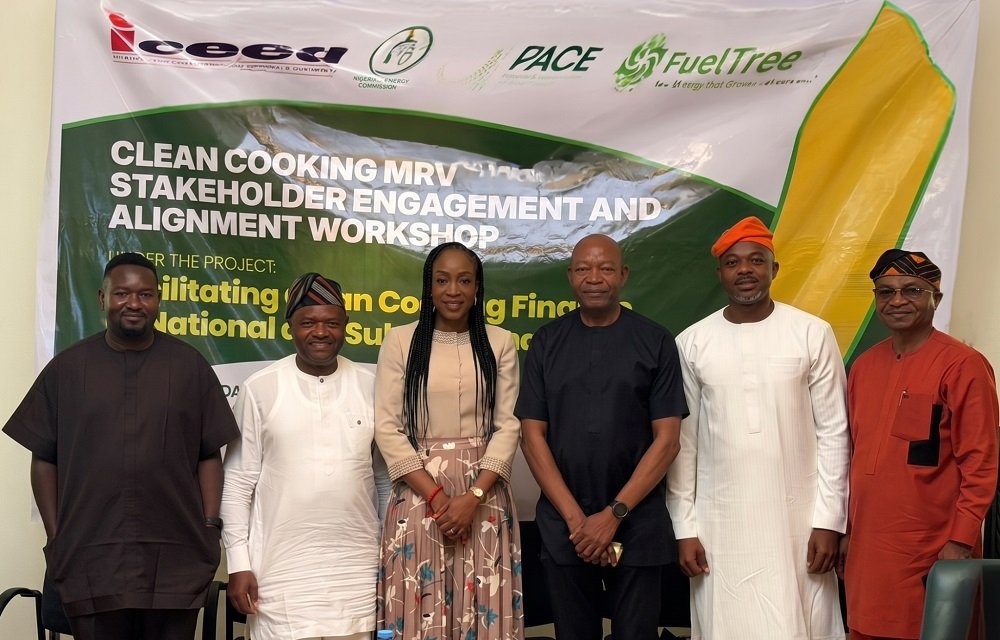
Efforts to position Nigeria as a major player in the emerging global carbon economy received a notable boost as industry stakeholders, regulators, investors and development partners converged in Abuja to chart a pathway toward a more credible and scalable monitoring, reporting and verification (MRV) framework for the country’s clean cooking sector.
The high-level Clean Cooking MRV Stakeholder Engagement and Alignment Workshop, was convened by FuelTree Limited in partnership with the Partnership for Agile Governance and Climate Engagement (PACE) and the International Centre for Energy, Environment and Development (ICEED).
Held at the Shehu Musa Yar’Adua Centre, Abuja, the engagement brought together a broad spectrum of stakeholders, including government agencies, standards organisations, clean cooking project developers, technology providers, renewable energy operators, carbon market practitioners, development partners and investors.
The discussions centered on the need for a coordinated national MRV framework capable of addressing longstanding bottlenecks that have constrained the growth of Nigeria’s carbon market and limited access to climate finance opportunities.
Participants agreed that fragmented reporting systems, inconsistent methodologies and weak institutional coordination continue to undermine investor confidence, delay project approvals and slow the issuance of carbon credits, reducing the ability of climate-focused projects to attract much-needed funding.
The workshop sought to address these challenges by advancing discussions around a practical Nigeria-aligned MRV coordination framework designed to strengthen transparency, improve accountability and create a more efficient pathway for climate finance mobilisation.
As global demand for verified carbon credits continues to rise, experts say countries with credible MRV systems stand to attract significant investment into climate mitigation and adaptation projects.
Speaking during the workshop, Chinonso Agbo, programme manager at PACE, described MRV as a critical bridge between climate ambition and investment.
“MRV is the missing link between projects and finance,” Agbo said, noting that accurate measurement and reporting systems are essential for converting environmental impact into investable opportunities.
The sentiment was echoed by Bekeme Olowola, chief executive officer of FuelTree and lead facilitator of the engagement, who stressed that confidence remains the currency upon which carbon markets operate.
According to Olowola, the future success of Nigeria’s climate finance ecosystem will depend largely on its ability to build trusted systems capable of generating reliable environmental data.
“Carbon markets ultimately run on confidence. Investors, regulators, buyers and communities must all trust that the impact being claimed is real. That trust does not begin with carbon credits. It begins with credible data, transparent systems and verifiable outcomes. If Nigeria gets MRV right, we can unlock climate finance at a scale that transforms both livelihoods and energy access,” she said.
Discussions focused on interoperability between technology platforms, alignment with national and international certification standards, gender inclusion considerations, onboarding pathways for project developers, e-cooking opportunities, offline functionality requirements and the cost implications of implementation.
One of the strongest themes to emerge from the engagement was the need to support indigenous innovation and ensure locally developed technologies can participate competitively within regional and international carbon markets.
Participants also emphasised interoperability as a cornerstone of any future national framework, arguing that technology providers and project developers must be able to integrate seamlessly into a common system capable of supporting market growth at scale.
Representing the Standards Organisation of Nigeria (SON), Ega Ijachi underscored the importance of standards in building trust across the ecosystem.
He noted that existing frameworks, including Nigeria’s biomass standards, could provide a foundation for broader convergence with continental and international quality management systems.
“Standards will play a critical role in helping build assurance across the ecosystem,” he said, adding that alignment with global best practices would be essential for attracting international participation and investment.
Stakeholders also highlighted the importance of strengthening institutional coordination among regulators, carbon registries, project developers and technology providers.
Several participants called for enhanced capacity-building initiatives to improve understanding of carbon market processes and strengthen the technical capabilities of both regulators and market participants.
Ewah Eleri, founder and chief executive officer of ICEED, said collaboration would remain indispensable to the development of a sustainable carbon market architecture.
“Nigeria has the opportunity to build a carbon market architecture that reflects our realities while meeting international expectations. Achieving that will require collaboration between regulators, project developers, standards bodies, technology providers and investors,” Eleri said.
He added that strong MRV systems should be viewed not merely as compliance requirements but as foundational elements that support market confidence, climate integrity and long-term economic growth.
The workshop attracted participation from key public and private sector institutions, including the Energy Commission of Nigeria (ECN), Standards Organisation of Nigeria (SON), Federal Ministry of Petroleum Resources, Federal Ministry of Environment, Federal Ministry of Women Affairs and Social Development, Renewable Energy Association of Nigeria (REAN), and the Shehu Musa Yar’Adua Foundation.
Industry participants included major clean cooking and renewable energy organisations such as BURN, UpEnergy, Solar Sister, Roshan Renewables, Femabol Energy and several carbon market developers and technology firms.
At the conclusion of the workshop, stakeholders reached broad consensus on a number of priority actions, including promoting interoperability, strengthening standards alignment, supporting local innovation, improving stakeholder knowledge and building the institutional structures required to sustain a vibrant carbon market ecosystem.