
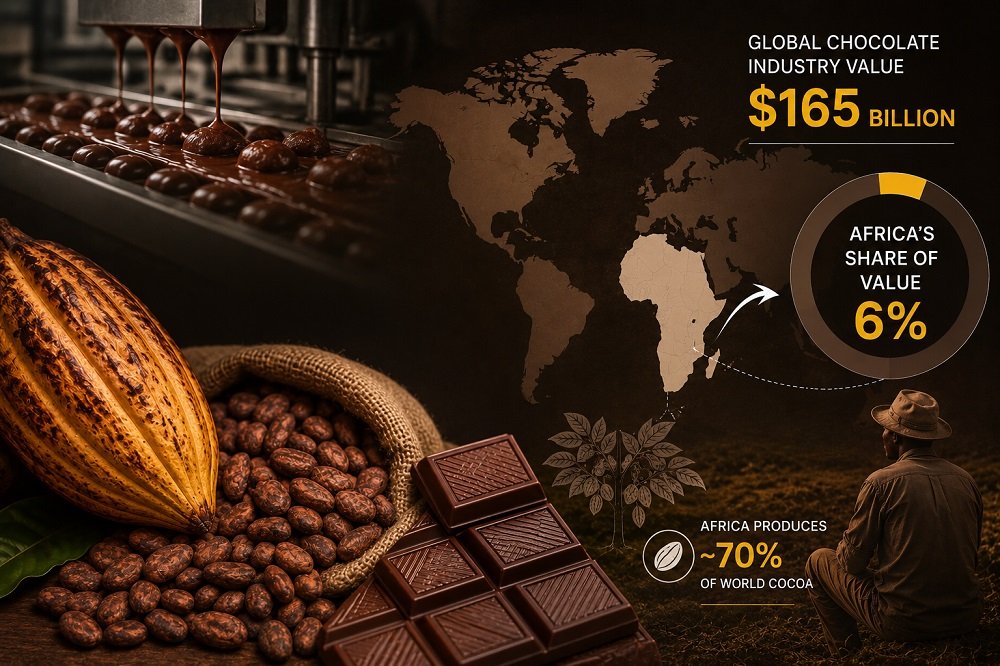
For more than a century, Africa has supplied the world with the beans that fuel one of its most profitable indulgences, yet the continent has remained a marginal beneficiary of the enormous wealth generated by chocolate. Every harvest season, millions of cocoa farmers across West and Central Africa painstakingly cultivate the crop that feeds a global confectionery industry valued at about $165 billion. Yet when the value chain is finally counted, Africa receives barely a fraction of the returns.
Determined to change that narrative, the Cocoa and Coffee Farmers Alliance Association of Africa (COCEFAAA) is championing the creation of a unified African cocoa producers’ bloc that would allow the continent to negotiate from a position of collective strength and exert greater influence over global cocoa pricing.
Rather than allowing commodity exchanges thousands of kilometres away in London and New York to continue determining the value of cocoa grown on African soil, the association believes the continent should establish a minimum floor price of no less than $6,000 per metric tonne while expanding existing producer cooperation into a continent-wide alliance.
From price takers to price makers
For decades, cocoa-producing countries have largely functioned as price takers in a global market where futures contracts traded on foreign exchanges have dictated the earnings of millions of farmers.
This pricing system has consistently exposed producers to market shocks largely beyond their control. Prices are influenced not only by supply and demand but also by speculative investments, currency movements, geopolitical uncertainties and hedge fund activities that often bear little relationship to conditions on cocoa farms in Africa.
The consequences have become increasingly evident over the past two years.
Global cocoa prices climbed to historic highs, briefly exceeding $11,000 per metric tonne before retreating. While consumers experienced rising chocolate prices, many African producers continued to struggle with uncertainty over farm-gate earnings, production planning and long-term investments. For cocoa-dependent economies, such dramatic price swings complicate national budgeting, export projections and rural development planning.
According to Adeola Adegoke, the COCEFAAA global president, the solution lies not in isolated national interventions but in collective continental action.
He argued that no commodity exchange outside Africa should continue determining the income of farmers producing cocoa on African land, stressing that fragmented national responses have weakened Africa’s negotiating strength for decades.
Building on the Ghana-Côte d’Ivoire experiment
The renewed push follows the successful hosting of the seventh Steering Committee meeting of the Côte d’Ivoire-Ghana Cocoa Initiative in Abidjan, an arrangement many industry observers consider the most ambitious producer alliance in modern cocoa history.
Together, Côte d’Ivoire and Ghana account for nearly 60 per cent of global cocoa production, giving them considerable influence over international supply.
The bilateral partnership has showcased that producer coordination can influence global conversations around sustainability, pricing mechanisms and farmer welfare.
However, analysts argue that limiting such cooperation to only two countries inevitably leaves significant volumes of cocoa outside coordinated market management.
Nigeria, Cameroon, Sierra Leone, Liberia and Togo collectively contribute substantial additional production that could strengthen Africa’s bargaining position if integrated into a broader alliance.
COCEFAAA believes expanding the existing framework into a continental producers’ bloc would create a more unified negotiating platform capable of engaging international buyers from a position of greater strength. Such coordination, they noted, could also reduce unhealthy competition among African producers, who often race against one another to secure export contracts while accepting unfavourable pricing conditions.
The economics behind the proposal
The call for a minimum floor price of $6,000 per metric tonne reflects growing concern that even periods of record global prices have failed to translate into proportionate prosperity for African farmers.
While futures prices reached unprecedented levels earlier this year, many producers remained constrained by marketing arrangements, forward contracts and government pricing systems established before the price rally.
The result has been a recurring disconnect between international market performance and household incomes in cocoa-growing communities.
Industry experts note that establishing a coordinated floor price would provide farmers with greater income certainty, encourage long-term investment in plantations and improve access to agricultural finance.
Banks are generally more willing to extend credit when commodity prices exhibit greater stability.
Stable earnings could also encourage younger Africans to remain in cocoa farming rather than abandoning agriculture altogether in search of urban employment.
The continent faces an ageing farming population, declining productivity in some producing regions and increasing pressure from climate change. Improving profitability may therefore become essential not only for farmer welfare but also for ensuring future cocoa supply.
Beyond exports: capturing more value
One of the most striking statistics cited by COCEFAAA is that Africa currently captures only about six per cent of the estimated $165 billion global chocolate value chain despite producing the overwhelming majority of cocoa beans.
While African countries export largely unprocessed cocoa beans, the highest-value activities, including processing, chocolate manufacturing, branding, retail distribution and intellectual property, remain concentrated in Europe and North America.
Consequently, countries that grow cocoa often earn significantly less than countries that transform it into finished consumer products.
Industry stakeholders argue that genuine transformation requires far more than higher farm-gate prices. According to the, it requires substantial investments in local grinding facilities, chocolate manufacturing plants, packaging industries, logistics infrastructure and export financing.
Developing these downstream industries, they assert, could generate thousands of skilled jobs while reducing dependence on raw commodity exports.
Lessons from OPEC
Although cocoa differs fundamentally from petroleum, comparisons with the Organization of Petroleum Exporting Countries (OPEC) have inevitably surfaced.
Like oil-producing nations before them, cocoa-producing countries possess a commodity for which global demand remains consistently strong.
Supporters of a cocoa producers’ bloc argue that coordinated production planning could reduce destructive market volatility while improving producer incomes.
However, economists caution that implementing such a strategy would require unprecedented political cooperation among African governments with differing economic priorities.
Unlike crude oil, cocoa production is dominated by millions of smallholder farmers rather than state-owned corporations.
Coordinating production volumes across multiple countries therefore presents significantly greater logistical complexity.
Moreover, individual governments may face pressure to maximise export revenues even if collective agreements require temporary production restraint.
Maintaining discipline within such an alliance would likely prove its greatest challenge.
Nigeria’s opportunity
For Nigeria, the proposal comes at a particularly significant time.
Successive governments have sought to diversify export earnings beyond crude oil while positioning agriculture as a major source of foreign exchange. Cocoa remains one of Nigeria’s leading non-oil export commodities.
A stronger continental alliance could provide Nigerian farmers with improved pricing certainty while encouraging renewed investment in ageing plantations.
Industry observers also believe Nigeria possesses considerable potential for expanding domestic cocoa processing given its relatively large manufacturing base. Such expansion is expected to align with industrialisation objectives while increasing export value.
Thus, the country could emerge not merely as a producer of cocoa beans but as a significant exporter of intermediate and finished cocoa products.
Obstacles ahead
Despite widespread recognition of the need for reform, several obstacles remain.
Differences in national marketing systems, export regulations and pricing mechanisms could complicate efforts to establish a unified framework. This is because some countries operate centralised marketing boards, while others rely more heavily on liberalised private-sector purchasing arrangements.
Financing mechanisms would also require careful consideration.
Maintaining a guaranteed minimum price during periods of weak international demand could place substantial financial pressure on governments unless supported by stabilisation funds or coordinated reserve mechanisms.
There is also the question of international trade rules. Major consuming countries and multinational chocolate manufacturers may closely scrutinise any arrangement perceived as artificially influencing global prices.
Nevertheless, supporters insist the objective is not market manipulation but correcting decades of structural imbalance that have consistently disadvantaged primary producers.
The debate extends beyond cocoa. Many analysts view the proposal as part of a wider movement among African commodity producers seeking greater influence over international value chains.
Whether in coffee, cashew, lithium, cobalt or critical minerals, governments are increasingly questioning why resource-rich countries continue to capture only modest portions of global value creation.
The conversation reflects a growing determination to shift from exporting raw materials toward building domestic industries capable of generating higher incomes and employment.
If successfully implemented, a cocoa producers’ alliance could become a model for agricultural cooperation across the continent.
The road ahead
The success of any continental cocoa bloc will ultimately depend on political commitment, institutional coordination and sustained trust among participating countries.
History shows that commodity alliances succeed only when members consistently prioritise collective interests over short-term national gains. Yet the economic rationale has rarely appeared stronger.
Global supply uncertainties, rising consumer demand for sustainably sourced cocoa and growing international attention on farmer welfare have created conditions that may favour deeper producer cooperation.
For millions of African farmers, the debate is not merely about commodity prices. It is about economic justice, equitable participation in global trade and securing livelihoods that reflect the true value of their labour.
COCEFAAA’s proposal therefore represents more than a pricing recommendation.
It is considered a challenge to an international commodity system that has historically rewarded processors and traders far more generously than producers.
Whether African governments embrace the proposal remains uncertain. What is increasingly clear, however, is that the continent’s cocoa sector is entering a decisive period in which the conversation is shifting from how much cocoa Africa can produce to how much value Africa can retain.
If that transition succeeds, the world’s largest cocoa-producing region may finally begin to earn rewards that more closely match its indispensable contribution to one of the globe’s most lucrative food industries.








This government must not raid investors’ money