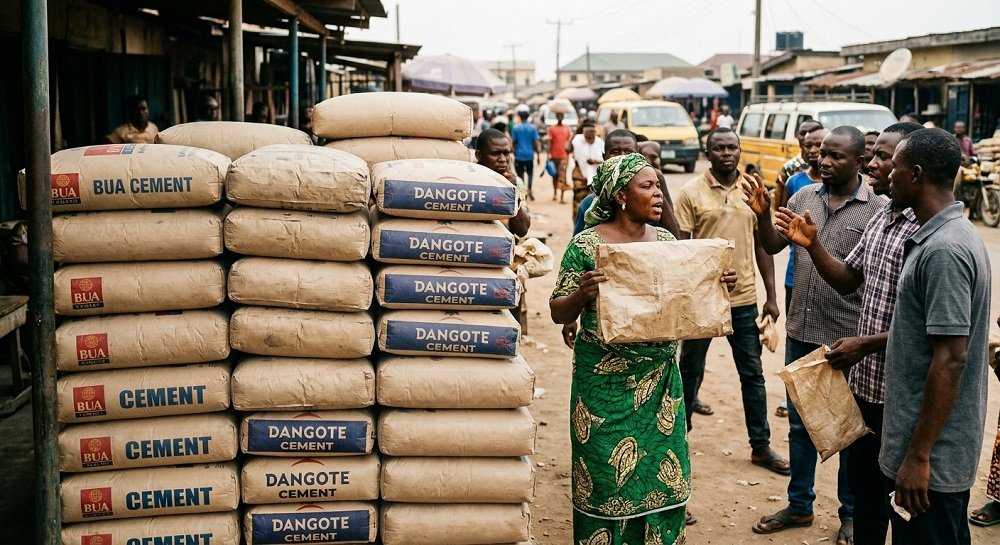
- Dangote, BUA, HBM add N700bn in H1’26
- Higher capacity than demand contradicts high cement prices
- FCCPC investigates price contradiction
A boom for cement producers is becoming a burden for the people who need cement most. Nigeria’s cement industry is delivering record revenues at a time when households, property developers and contractors are confronting some of the highest construction costs in years, creating a widening disconnect between the sector’s financial performance and the affordability crisis gripping the country’s housing and infrastructure markets.
The country’s three largest listed cement manufacturers generated a combined N3.2 trillion in Nigeria revenue in the first half of 2026, up 26.5 percent from N2.5 trillion a year earlier, as stronger demand, higher sales volumes and successive price increases lifted earnings. But while producers are benefiting from the resilience of construction activity, the rising cost of cement is adding to the financial strain on housing projects. The same price increases that have strengthened manufacturers’ top lines have pushed a 50kg bag of cement to N13,000-N15,000 in some markets, worsening housing affordability, squeezing developers and increasing the cost of public infrastructure.
Financial statements filed by Dangote Cement Plc, BUA Cement Plc and HBM Nigeria Plc, formerly Lafarge Africa, show that their combined Nigeria-only revenue rose 26.5 percent year-on-year to N3.2 trillion in H1 2026, from about N2.5 trillion in the corresponding period of 2025.
The increase was supported by higher cement prices, stronger sales volumes, construction activity, infrastructure projects and housing demand. But the speed at which revenues increased relative to volumes also points to the growing contribution of pricing to manufacturers’ top lines.
Dangote Cement generated N1.8 trillion from its Nigerian operations, representing a 25.2 percent increase from a year earlier. BUA Cement recorded N728.9 billion, up 25.6 percent, while HBM Nigeria posted N678.4 billion, representing the fastest growth among the three at 31.2 percent.
Combined, the three companies generated about N3.21 trillion, underlining the enormous economic weight of cement in Nigeria’s industrial and construction ecosystem.
The manufacturers’ performance showcases resilience under severe macroeconomic pressure, with higher volumes and pricing helping companies offset rising energy, financing and foreign-exchange costs. But that resilience comes with an economy-wide cost. As cement producers strengthen their revenues, developers, contractors and households are facing increasingly expensive construction inputs, making housing and infrastructure delivery more difficult.
The result is an increasingly uncomfortable question for policymakers and the industry: How can cement producers remain financially viable without making construction progressively unaffordable?
That question has now moved beyond boardrooms and construction sites to the offices of the Federal Competition and Consumer Protection Commission (FCCPC), which is investigating whether market forces alone can explain the sharp rise in Nigerian cement prices.
The first-half financial performance of the major cement producers showcase that demand for the product has remained relatively resilient despite the pressures confronting the economy.
Dangote Cement, BUA Cement and HBM Nigeria, added more than N700 billion to their combined Nigeria revenue compared with the first half of 2025.
The cement sector’s first-half earnings growth was underpinned by both volume expansion and pricing power, with revenue at each of the three major producers increasing faster than sales volumes.
However, the development indicates that stronger demand was only part of the story. Price increases contributed materially to the industry’s top-line expansion, as producers sought to absorb higher energy, foreign-exchange, logistics and other operating costs.
The pass-through has been increasingly visible in the retail market. A 50kg bag of cement, priced at N9,300-N9,700 at the start of the year, reached N10,500-N13,000 by mid-2026. In some locations, dealers were charging as much as N13,000-N15,000 by July.
The trajectory represents a worrisome increase from the N7,500 level recorded in the last quarter of 2024 and N9,000 in the third quarter of 2025.
Manufacturers have attributed the increases to higher energy costs, foreign-exchange pressures, imported inputs, logistics and other production and distribution expenses.
Emmanuel Ikazoboh, Dangote Cement chairman has explained that elevated energy and foreign-exchange costs have been passed through to consumers through pricing.
That explanation reflects the difficult operating environment confronting Nigerian manufacturers. But the size and persistence of the price increases have created growing concern among consumers, contractors, amongst others.
Three giants dominate the cement market
The concentration of Nigeria’s cement industry has intensified scrutiny.
Nigeria has installed cement production capacity of approximately 62.8 million metric tonnes per annum, according to the information cited in the industry analysis, compared with domestic consumption estimated at roughly 25-30 million tonnes.
The largest producer is Dangote Cement, with more than 35 million tonnes of annual capacity and a significant presence across several states.
BUA Group has a capacity of up to 20 million tonnes annually, with operations in Sokoto, Edo and Okpella.
HBM Nigeria, formerly Lafarge Africa, has nearly 12 million tonnes of annual production capacity, with facilities in Sagamu, Ewekoro and Calabar.
Publicly available estimates cited by the FCCPC indicate that the three major undertakings account for more than 90 percent of installed production capacity.
A concentrated market is not necessarily an uncompetitive market. Large producers may command dominant positions because their scale enables them to spread fixed costs, secure raw materials more efficiently, operate extensive distribution networks and sustain the capital expenditure required by cement manufacturing.
The concern, however, is that high concentration can amplify the economic impact of pricing decisions. Where a handful of companies account for most installed production capacity, movements in their prices can quickly filter through to contractors, developers, government infrastructure projects and households.
For the FCCPC, therefore, the issue is not simply the size of the producers, but whether the structure of the market allows competitive forces to constrain pricing.
FCCPC probes N13,000-N15,000 cement
Nigeria has limestone. It has cement factories. It has more production capacity than the market currently consumes. Yet cement keeps getting more expensive.
That contradiction has triggered a three-month investigation by the Federal Competition and Consumer Protection Commission, which says it has uncovered possible manipulation of cement prices.
The commission’s preliminary findings are contained in a 40-page field report prepared after its anticompetitive practices department conducted a cross-border study in response to complaints over soaring cement prices.
The regulator’s central question is why a market with substantial domestic capacity and apparent excess supply has failed to deliver the price competition normally expected when producers compete for customers.
“Of particular concern to the commission is that this level of production capacity has not resulted in the downward pressure on domestic prices that might ordinarily be expected in a competitive market with substantial excess capacity,” it said.
The commission has therefore moved beyond simply observing retail prices and is examining the mechanics behind them.
Major manufacturers were asked to provide information covering production costs, capacity utilisation, pricing methods, exports, domestic supply and commercial relationships.
The FCCPC said all major cement manufacturers except one have submitted the records required for its investigation.
The commission noted that it is probing possible producer coordination, abuse of market power, restrictions on domestic supply and anti-competitive distribution practices.
It has, however, stressed that no manufacturer has been found guilty of price fixing or any other prohibited conduct. The preliminary findings only establish grounds for further investigation.
Manufacturers could still show that higher prices reflect legitimate increases in energy, foreign-exchange, equipment, spare-parts and transportation costs. But evidence of coordinated conduct or market-power abuse could widen the impact of the investigation, with potential consequences for cement prices, construction costs, housing affordability and infrastructure delivery.
The FCCPC’s cross-border assessment has added another dimension to the recent development. Its preliminary comparison found that Nigerian cement prices were nearly twice those recorded in Kenya and Tanzania.
A 50kg bag was estimated at approximately N7,344 in Nairobi and N6,528 in Tanzania, compared with as much as N15,000 in parts of Nigeria.
Even Togo, which the FCCPC noted does not possess significant limestone deposits, recorded a retail price of about N9,180 per 50kg bag in the Commission’s comparison.
The comparison does not mean Nigerian prices should automatically converge with those in other countries. Production costs, energy availability, taxes, logistics, exchange rates, distribution distances and market structures differ from one country to another.
The price differential has strengthened the case for closer examination of Nigeria’s cement pricing structure, although it does not by itself indicate anti-competitive behaviour.
The regulator is particularly interested in the disparity because Nigeria combines extensive limestone reserves with substantial installed production capacity and is a net exporter of cement to neighbouring countries.
That creates an uncomfortable mismatch between supply fundamentals and consumer prices. A market with abundant raw materials and capacity to spare would ordinarily be expected to exert downward pressure on prices, yet Nigerian cement costs have risen sharply enough to attract regulatory scrutiny.
The housing crisis beneath the cement numbers
The consequences of higher cement prices extend far beyond the financial statements of manufacturers.
Cement is a basic input into virtually every major construction project, from private houses and residential estates to bridges, roads, schools, hospitals, factories and commercial buildings.
When cement rises, the effect spreads through the construction value chain.
Industry survey shows that blocks have increased from around N600 to N1,100. The price of 30 tonnes of sand has risen from approximately N165,000 to N250,000, while 30 tonnes of granite increased from about N530,000 to N780,000. The cumulative impact is substantial.
Miyise Fasinu, an estate surveyor and valuer, said the rising cost of building materials means constructing a modest residential house now requires almost twice the financial commitment that would have been necessary a few years ago.
For developers working with fixed budgets, the consequences are immediate. Contractors are revising estimates more frequently, developers are postponing projects and prospective homeowners are watching their savings lose purchasing power as construction costs rise.
The problem is compounded by financing costs. Developers who borrow to fund projects face elevated interest rates, meaning an increase in construction materials can simultaneously raise both the amount of capital required and the cost of financing that capital. That combination can make projects commercially unviable.
The cement price shock is also feeding into Nigeria’s already severe housing affordability problem.
Nigeria’s rent-to-income ratio is estimated at about 70 percent, more than twice the United Nations’ 30 percent benchmark.
In parts of Lagos, rents have reportedly risen by as much as 200 percent over two years, with two-bedroom apartments averaging about N2.5 million annually.
The squeeze is pushing households away from preferred locations and towards cheaper and more distant areas.
It is also changing the structure of housing demand, as more households seek smaller apartments and more affordable accommodation.
Knight Frank’s Africa Report 2026/27 describes affordability as the dominant constraint in Nigeria’s residential property market.
“Affordability remains the dominant market constraint,” the consultancy said, noting that tenants are increasingly prioritising cost over location in response to economic pressures.
The global real estate consultancy said prime residential properties in Nigeria now average approximately $3,000 per month, while limited formal housing supply continues to collide with strong underlying demand. The result is an increasingly polarised market.
Households with stronger incomes can absorb higher rents and property prices, while lower-income workers, young graduates, civil servants and artisans are pushed towards peripheral locations or smaller accommodation.
In cities such as Lagos, Abuja, Kano and Port Harcourt, the cost of living closer to employment centres is becoming increasingly difficult to sustain. For construction companies, meanwhile, the higher cost of cement and other materials is translating into project delays and postponements.
The pressure on housing affordability is occurring even as some analysts warn that the property market itself may be approaching a correction.
Bismarck Rewane, chief executive officer of Financial Derivatives Company, recently described developments in Nigeria’s housing market as a bubble that could eventually crash.
Speaking at the Financial Derivatives Company and Lagos Business School Breakfast Session in August 2026, Rewane said the market was experiencing a correction linked to a shift in the supply curve and excess inventory.
He pointed to rising rents, declining affordability, increasing delinquency and mortgage defaults as risks that could eventually trigger a sharp fall in property prices.
“Rents have kept rising, cutting affordability; the market is experiencing rising delinquency and mortgage defaults, and property prices fall sharply, triggering a crash,” he noted.
The housing market is facing a structural affordability problem. Rising prices for cement and other construction inputs are increasing the cost of new development at a time when rents are already elevated and formal housing supply remains inadequate.
The consequence is a growing divergence between housing demand and effective purchasing power. While the need for additional homes remains substantial, households are increasingly unable to translate that need into effective demand because their incomes have not risen sufficiently to absorb higher construction and rental costs.
According to analysts, without a meaningful reduction in construction costs or a corresponding increase in household purchasing power, the country could continue adding housing supply while leaving millions of households unable to access it.