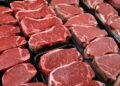
A meat import market worth nearly $8.7 million in 2025 is opening to greater competition after Nigeria approved wider access for U.S. beef and pork products, giving American suppliers a foothold in a market with strong long-term consumption prospects.
The market-access decision gives American suppliers an opportunity to compete in a meat market where beef consumption is projected to rise over the coming decades, while also increasing competitive pressure on existing foreign suppliers and domestic producers.
The Food and Agriculture Organisation (FAO) of the United Nations projects that Nigeria’s beef consumption will rise to 1.4 million metric tonnes by 2050, from 470,000 metric tonnes in 2015.
The long-term demand outlook comes against a market that is already reliant on imports to supplement domestic production.
Trade Map data show that Nigeria imported nearly $8.7 million worth of fresh and frozen red meat in 2025, with South Africa and several European Union countries, including Spain, France and Belgium, among the major suppliers.
Beef accounted for nearly 73 percent of Nigeria’s fresh and frozen red meat import bill in 2025, followed by sheep meat at 22 percent, while pork accounted for the balance.
The latest regulatory change potentially gives U.S. exporters access to a market where demand for beef and other animal proteins is expected to expand significantly.
The U.S. Meat Export Federation (USMEF) announced on August 21 that beef cuts were now eligible for export to Nigeria, alongside various pork cuts, although bone-in hams and other specifically restricted products remain excluded.
The decision represents an expansion of access for U.S. suppliers, who previously faced restrictions that effectively prevented most imports of fresh and frozen American red meat, apart from a limited range of processed products.
By removing the regulatory barrier, Nigeria has opened an additional channel for U.S. meat companies seeking to establish a presence in one of Africa’s largest consumer markets.
Existing suppliers from South Africa and Europe already have established commercial relationships and distribution channels, while Nigerian producers remain central to the domestic market.
Thus, U.S. exporters will need to secure Nigerian importers, build distribution networks and compete on price, quality, logistics and reliability before the new market access can translate into substantial sales.
Dan Halstrom, president and chief executive officer of USMEF, acknowledged that penetrating Nigeria’s retail and food-service sectors would take time and that exporters still faced challenges in establishing a commercial presence.
The market opening therefore represents the beginning rather than the end of the commercial process for U.S. meat companies.
The competitive dynamics could become more pronounced as Nigerian consumers’ demand for animal protein grows.
If domestic meat production does not expand at a pace sufficient to meet consumption, importers are likely to play a larger role in filling the supply gap.
That could create opportunities not only for U.S. exporters but also for existing suppliers seeking to defend or expand their market shares.
U.S. meat industry targets Africa
The Nigerian market opening also forms part of an extended drive by the American meat industry to improve access to African markets.
On June 1, USMEF urged the Office of the U.S. Trade Representative to use the African Growth and Opportunity Act (AGOA) to pursue improved market access in strategically important African countries, including Nigeria, South Africa, Angola, Kenya and Namibia.
The federation had specifically criticised Nigeria’s restrictions on fresh and frozen U.S. red meat and argued that Washington should consider trade penalties or suspension of Nigeria’s AGOA benefits if the restrictions remained.
Two months later, Nigeria’s market-access rules shifted in the direction sought by U.S. exporters.
However, available information does not establish a direct link between the USMEF campaign and Nigeria’s decision, according to a report by Ecofin.
USMEF instead attributed the opening to several years of discussions with Nigerian authorities, supported by the U.S. Department of Agriculture.
According to analysts, the increased availability of imported meat could also intensify competition for Nigerian livestock producers.
The commercial implications will depend partly on the ability of domestic producers to increase output, improve productivity and compete with imported products on price and quality.
In addition, Nigeria’s growing population and changing consumption patterns provide room for both domestic and international suppliers, but a widening import market could also increase pressure on local producers if imported meat becomes more competitive.
The development therefore presents a two-sided opportunity for Nigeria.
Consumers and food-service businesses could benefit from a wider range of meat products and potentially greater supply reliability.
Importers, distributors, restaurants, hotels and retailers could also gain access to new supply channels.
However, local livestock producers could face stronger competition, particularly if structural challenges affecting domestic production remain unresolved.
The projected increase in beef consumption creates an opportunity to establish commercial relationships early in a market where demand could expand substantially over the next two decades.
The country’s large consumer base and expanding food-service and retail sectors could provide opportunities across multiple channels, including supermarkets, restaurants, hotels, food processors and other commercial buyers.
However, converting projected demand into export revenue will depend on several factors, including Nigerian consumer purchasing power, exchange-rate conditions, import costs, cold-chain infrastructure and the ability of suppliers to establish efficient distribution networks.
The regulatory opening also does not guarantee that U.S. meat will immediately gain a significant share of the Nigerian market.
American exporters must still overcome logistics, pricing and market-development challenges, while competing against suppliers with existing relationships in Nigeria.
The longer-term question is whether Nigeria’s decision will remain a targeted opening for selected U.S. meat products or become part of a wider liberalisation of agricultural and food imports.
With beef consumption projected to nearly triple from 2015 levels by 2050, the commercial stakes in Nigeria’s meat market are set to rise, and the latest U.S. market opening puts American exporters in a position to compete for a larger share of that future demand.