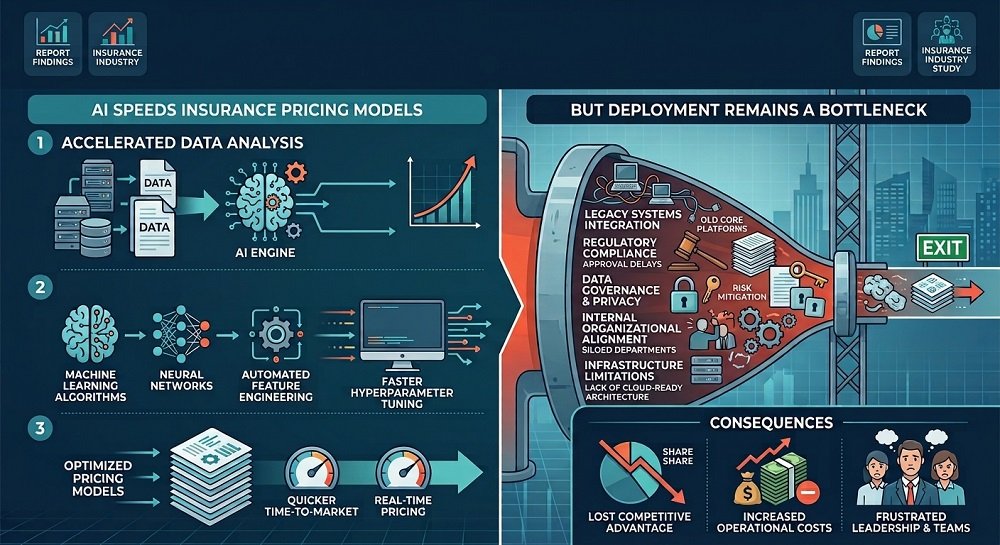
Artificial intelligence is helping insurers develop and recalculate pricing models faster, but lengthy validation, technology integration and governance processes are limiting how quickly those models can translate into decisions for policyholders, according to Earnix.
Mathieu Edmond, director at Earnix, an insurance technology company, said insurers could have a pricing model validated months before the resulting price is actually applied to customers, creating a gap in which market conditions, customer behaviour and portfolio performance may change.
Edmond, in an article published by Earnix, said the gap between technical validation and deployment is becoming an increasingly important factor in insurance performance as artificial intelligence and automation accelerate the production of models and analytical recommendations.
“A pricing model validated by the technical committee in February. A price effectively applied to the policyholder in October,” Edmond said, describing a pattern he has observed across different insurance organisations.
According to him, the model itself may not change during the period, but the business environment around it can, while the decision passes through several stages including validation, information technology integration, controls, testing and other operational requirements.
The development is shifting the focus of insurers from simply producing accurate models to their ability to turn those models into operational decisions quickly and within acceptable risk and governance boundaries.
Edmond said artificial intelligence is reducing the time required for some aspects of modelling, documentation and analysis, allowing insurers to test scenarios and generate recommendations faster. However, he noted that faster technical production does not remove constraints associated with data quality, regulatory approval, governance and deployment.
Data from the Earnix 2026 Industry Trends Report, based on a survey of 400 global insurance executives, illustrates some of those constraints. Only 30 percent of insurers surveyed said they could quickly obtain the information required to make business decisions, while 46 percent said their technology provided the speed needed for effective decision-making.
Poor data quality was also identified as a constraint, with two-thirds of respondents saying it was slowing decision-making and limiting the effectiveness of artificial intelligence.
The delays can occur after an actuarial model has been approved, as insurers still need to configure business rules, integrate systems, conduct compliance checks, test the changes and establish mechanisms for reversing or modifying decisions if necessary.
Edmond said pricing decisions are also rarely confined to actuarial departments. Changes can affect underwriting, distribution, customer communications, portfolio performance and regulatory reporting, meaning that several departments and governance bodies may need to participate before a new price reaches the market.
He said this is particularly relevant for insurers operating through multiple distribution channels, including agents, brokers, salaried networks and bancassurance arrangements, where pricing decisions can involve several competing commercial and prudential considerations.
While artificial intelligence can generate multiple scenarios within hours, the subsequent validation process can still take weeks, according to Edmond.
He argued that insurers seeking to reduce pricing time-to-market therefore need to examine the processes between model validation and production deployment, rather than focusing only on making modelling faster.
The challenge also extends to the governance of artificial intelligence. The Earnix survey found that 92 percent of insurers conduct formal reviews of their AI governance at regular intervals, but fewer than one-third of executives surveyed were fully confident that those reviews were sufficient to keep pace with changing regulatory requirements.
Regulatory and legal exposure was identified by 38 percent of respondents as their main ethical concern regarding AI deployment.
Edmond said the growing use of AI means insurers must be able to monitor model performance after deployment, detect changes in model behaviour, document decisions and determine when human intervention is required.
He cautioned that increasing the number of models without establishing effective oversight could add complexity through additional versions, variables, rules and recommendations that require monitoring and control.
The survey found that 56 percent of insurance executives favoured a gradual approach to AI adoption that retains human intervention for at least the next three years.
Edmond said this approach reflects the need for governance mechanisms to develop alongside insurers’ technical capabilities rather than a rejection of artificial intelligence.
He also pointed to the limitations of relying exclusively on historical data as insurers confront changing economic, regulatory and environmental conditions.
Factors such as sustained inflation, regulatory changes, climate risks and shifts in customer behaviour can make historical patterns less representative of future conditions, requiring insurers to combine model outputs with forward-looking scenarios and human judgement.
As a result, Edmond expects the actuarial profession to take on a broader role in the design and supervision of decision systems, alongside its traditional responsibilities for pricing, reserving and risk modelling.
He said actuaries would increasingly need to determine where automation can be used, establish thresholds for human intervention, explain decisions to regulators and business teams, and manage situations where commercial, regulatory and risk objectives conflict.
For insurers, the competitive advantage from AI may therefore depend less on how quickly a model can be produced and more on how efficiently the resulting recommendation can be converted into a controlled and explainable business decision.
Edmond said insurers that can connect modelling, deployment, governance and monitoring across the decision-making process will be better positioned to respond to changing market conditions while maintaining the controls required around automated decisions.