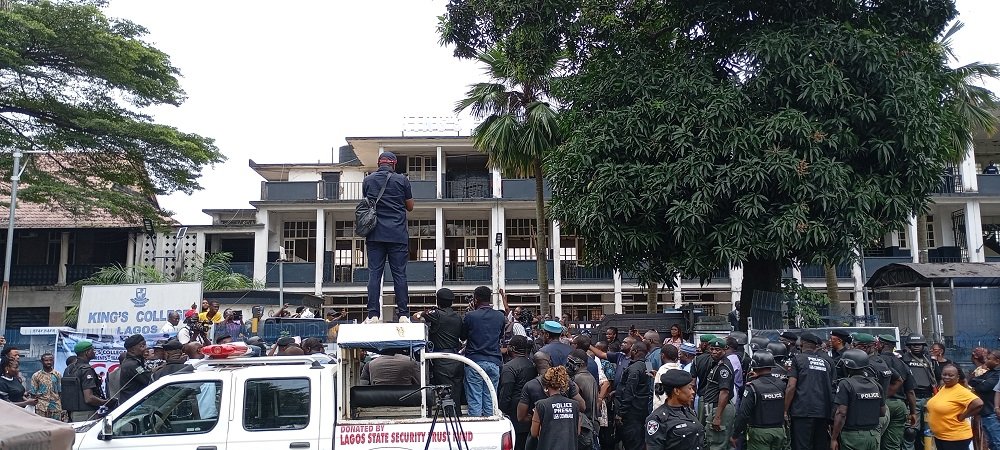
The federal government’s proposed concession of King’s College, Lagos, to an old boys-backed education trust came under renewed pressure on Tuesday as aggrieved parents blocked members of the King’s College Old Boys Association (KCOBA) from entering the school premises, deepening a dispute over the future ownership, management and financing of the 117-year-old institution.
The parents, who gathered at the main gate of the college, formed a human barricade and refused to allow KCOBA members into the premises despite the presence of policemen led by Tijani Fatai, the Lagos State Commissioner of Police.
Kashim Ibrahim-Imam, the KCOBA president, and other members of the association had arrived to brief journalists on the controversial management arrangement but were forced to address the media outside the school after repeated appeals by the police failed to persuade the parents to open the gate.
On its part, KCOBA has rejected suggestions that it is seeking to acquire King’s College, saying the association’s objective is to mobilise private resources and professional expertise to rehabilitate the school and improve its educational standards.
Femi Okunnu, chairman of the Board of Trustees of the King’s College Education Trust, described the proposed arrangement as a “rescue mission”, saying ownership of the institution would remain with the Federal Government.
“King’s College is not being sold. There is no sale. There is no transfer of ownership to KCOBA. The College remains, today and always, a public national institution,” Okunnu stated.
According to him, the proposed change concerns the framework for managing, financing, maintaining and modernising the institution rather than transferring its ownership.
KCOBA President Ibrahim-Imam similarly said the old boys had no intention of buying the school or making a commercial gain from it.
“The Federal Government is not selling King’s College to anybody. The old boys are not interested in buying King’s College. Our objective is to develop the college,” he said.
The association has proposed a development programme that includes a N100 billion endowment fund, scholarships for indigent students, rehabilitation of facilities, digital transformation, modern laboratories and libraries, improved hostels, STEM and robotics education and upgraded sporting facilities.
KCOBA has also said the initiative will not result in an increase in school fees and that teachers’ welfare will be prioritised.
Parents challenge concession
The parents’ action on Tuesday, however, showed that the assurances have not resolved the concerns surrounding the proposed transfer.
The parents’ opposition centres on the question of whether a public federal institution should have its management transferred to an alumni-backed trust and what safeguards would protect students, parents and workers under the new structure.
Their refusal to allow KCOBA officials into the school prevented the planned engagement from taking place within the college, turning the proposed briefing into an outdoor media encounter amid a heavy police presence.
KCOBA has sought to address the fee concern directly, with Ibrahim-Imam saying: “At no time did the old boys imply that we are going to increase school fees. Our objective is to develop the college.”
He said his personal objective was to restore the institution to the standard he experienced as a student.
“My own personal aspiration is very modest: to take the school forward, to take the school back to where I met it as a student,” he said.
Workers demand reversal
The parents’ resistance comes against the backdrop of opposition from federal education workers, who have rejected the concession model and insisted that Unity Schools should remain under government management and funding.
Andrew Emelieze, national coordinator, Federal Workers Forum, said workers viewed the proposed arrangement as a threat to public education.
“King’s College is not for concession. King’s College is not for sale. King’s College is not for privatisation. Unity schools are not for sale, and we are here to protest peacefully,” Emelieze said.
The workers have argued that the federal government has a responsibility to fund public education and should not transfer the management of federal schools to alumni or other private interests.
Emelieze also alleged that there was an attempt to gradually privatise public education and said workers would continue opposing the arrangement.
“Education should be a right. It should be prioritised. It should not be privatised,” he said.
The Federal Workers Forum has further argued that alumni who want to build educational institutions should establish new schools rather than assume control of existing federal institutions.
The old boys’ association, however, says the resistance overlooks the condition of the school and the need for substantial investment.
Okunnu alleged that King’s College had suffered from deteriorating infrastructure, weak maintenance, admission irregularities, overcrowding and student welfare challenges.
He claimed that the school had at one point accommodated more than 3,800 students against an estimated carrying capacity of about 1,200.
KCOBA also alleged that admission slots had in some cases been compromised by money and influence, including claims that state-based quotas were diverted to candidates from outside the relevant states.
These allegations have not been independently established in the material provided, but KCOBA says they underscore the need for reforms to the institution’s admission and governance systems.
“A national institution must remain a door open to every talented Nigerian child — never a gate that opens only to influence or wealth,” Okunnu said.
The association also raised concerns about ageing buildings, student welfare, substance abuse and the condition of some facilities, saying the proposed management model would provide the financial and managerial capacity required to address them.
Dispute over accountability
Another contentious issue is the management of revenue and other financial resources associated with the school.
Okunnu questioned the operation of the King’s College Victoria Island campus as a commercial car park, alleging that cash collections were not subject to sufficient transparent accounting and that the arrangement raised security concerns.
He also questioned the governance of PTA levies, which he said run into several hundred million naira, particularly where levy collection and contract awards are handled within the same structure.
“No single stakeholder should simultaneously control the collection of substantial levies and the award of contracts financed by those same funds, absent transparent safeguards,” he said.
Government ownership remains key fault line
The Federal Government and KCOBA have consistently maintained that the proposed arrangement does not transfer legal ownership of King’s College.
The government’s position, as presented in the statements, is that KCOBA would take responsibility for financing, rehabilitating, modernising, operating and maintaining the institution, while the Federal Government retains ownership and statutory oversight.
That distinction has become central to the government’s defence of the arrangement.
Opponents, however, argue that transferring operational control of a federal school to an external trust represents a significant change in how a public institution is governed, regardless of whether legal title remains with the government.
This distinction is at the centre of the current impasse, with supporters of the arrangement focusing on management, investment and rehabilitation, while opponents focus on public control, accountability and the government’s responsibility to fund education.
Teachers caught between competing models
The future of teachers and other workers is another major concern.
KCOBA has assured staff that their welfare would be prioritised and that teachers who do not wish to transfer under the new management arrangement would have options to remain within the federal government system.
Ibrahim-Imam said the Ministry of Education had indicated its willingness to accommodate workers who do not wish to come under the proposed structure, with their salaries and allowances protected.
The old boys have also promised improved remuneration and professional development for teachers as part of the proposed transformation.
Workers’ representatives remain sceptical, however, and have argued that the employment status of teachers and non-academic staff must be clearly protected before any management transition takes place.