Nigeria’s potential $50 billion offshore investment pipeline through 2030 is opening a new market for heavy-lift and specialised logistics companies, as oil and gas projects move closer to the execution stage.
The Nigerian Upstream Petroleum Regulatory Commission (NUPRC) has identified 22 major offshore projects expected to attract between $30 billion and $50 billion in investment over the next four years, while approved Field Development Plans carry more than $57 billion in associated investment potential.
The scale of the pipeline is creating demand beyond drilling, production and field development. As operators begin converting investment commitments into physical infrastructure, they will need to transport and install increasingly large equipment across ports, fabrication yards, industrial corridors and offshore locations.
That is positioning heavy-lift contractors and specialised transport providers for a bigger role in the next phase of Nigeria’s oil and gas investment cycle.
Sarens Buildwell, a Nigerian joint venture between global heavy-lifting company Sarens and local engineering and logistics firm Buildwell, is expanding its operating capacity from Lagos and Port Harcourt to meet the expected demand.
The company has added an XCA500L8_1 crane with a 500-tonne lifting capacity, alongside other specialised lifting and transport equipment, as it seeks to strengthen its capacity for large-scale energy and industrial projects.
Its operating strategy is based on placing cranes, self-propelled modular transporters (SPMTs), rig-move equipment and engineering teams closer to major project hubs, with the aim of reducing reliance on fragmented subcontracting arrangements.
The expansion comes as Nigeria seeks to attract fresh capital into its upstream sector and increase activity across an industry that remains important to government revenues and foreign exchange earnings.
But converting the investment pipeline into producing assets will require more than financing and regulatory approvals. Large offshore components must first be moved from fabrication sites and ports to staging areas before being installed in technically demanding environments.
Sarens Buildwell has already handled projects illustrating the scale of this requirement.
At the BUA LNG project in Ajaokuta, the company was involved in transporting and installing equipment for a gas plant. It also supported the expansion of the Escravos-Lagos Pipeline System (ELPS), transporting oversized equipment and pipe cargo for LEE Engineering and NNPC.
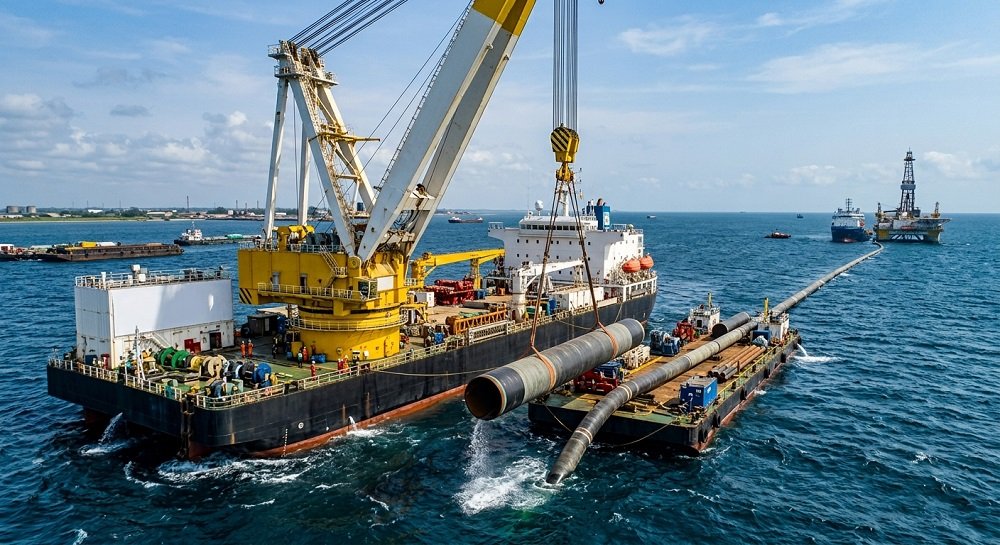
In the offshore segment, the company transported a 330-tonne jacket for the Nkuku Ikong Field Development Project in Akwa Ibom State. The structure was moved from its fabrication area and loaded onto a 6,000-tonne ballastable barge using 40 axle lines of SPMTs.
The operation illustrates the engineering complexity behind offshore logistics, where moving a single component can require route planning, specialised transport, barge operations, heavy lifting and detailed engineering coordination.
Emile Abou Habib, chief executive officer of Sarens Buildwell, said Nigeria is entering an important phase of its energy development and that the anticipated offshore investment would require stronger technical and operational capabilities.
He said “technical capacity, safety, and operational precision” would be critical to delivering the projects.
The emerging opportunity also extends beyond crude oil. Nigeria has about 36 billion barrels of proven crude oil reserves and 5.7 trillion cubic metres of natural gas reserves, providing a substantial resource base for future upstream and gas developments.
Demand for heavy-lift services is also being generated by downstream and industrial projects.
At the Indorama fertiliser complex in Eleme, Rivers State, Sarens Buildwell undertook heavy transportation and installation work as part of the Train III expansion.
The company has also reported the haulage and installation of two heat recovery steam generator modules weighing more than 150 tonnes each at the facility, using a 330-tonne crawler crane.
For the broader energy industry, the emerging project cycle presents a parallel infrastructure challenge: ensuring that oversized equipment and structures can move efficiently from fabrication yards and ports to their final destinations without creating costly project delays.
As billions of dollars of offshore projects potentially move from planning into execution before the end of the decade, access to heavy cranes, SPMTs, specialised transport and engineering expertise could become an increasingly important factor in project delivery.
For Sarens Buildwell, the strategy is to build that capacity ahead of the anticipated project wave and position its Nigerian operations to serve a wider industrial base spanning conventional upstream developments, gas, fertiliser, LNG and other projects supporting the country’s evolving energy landscape.