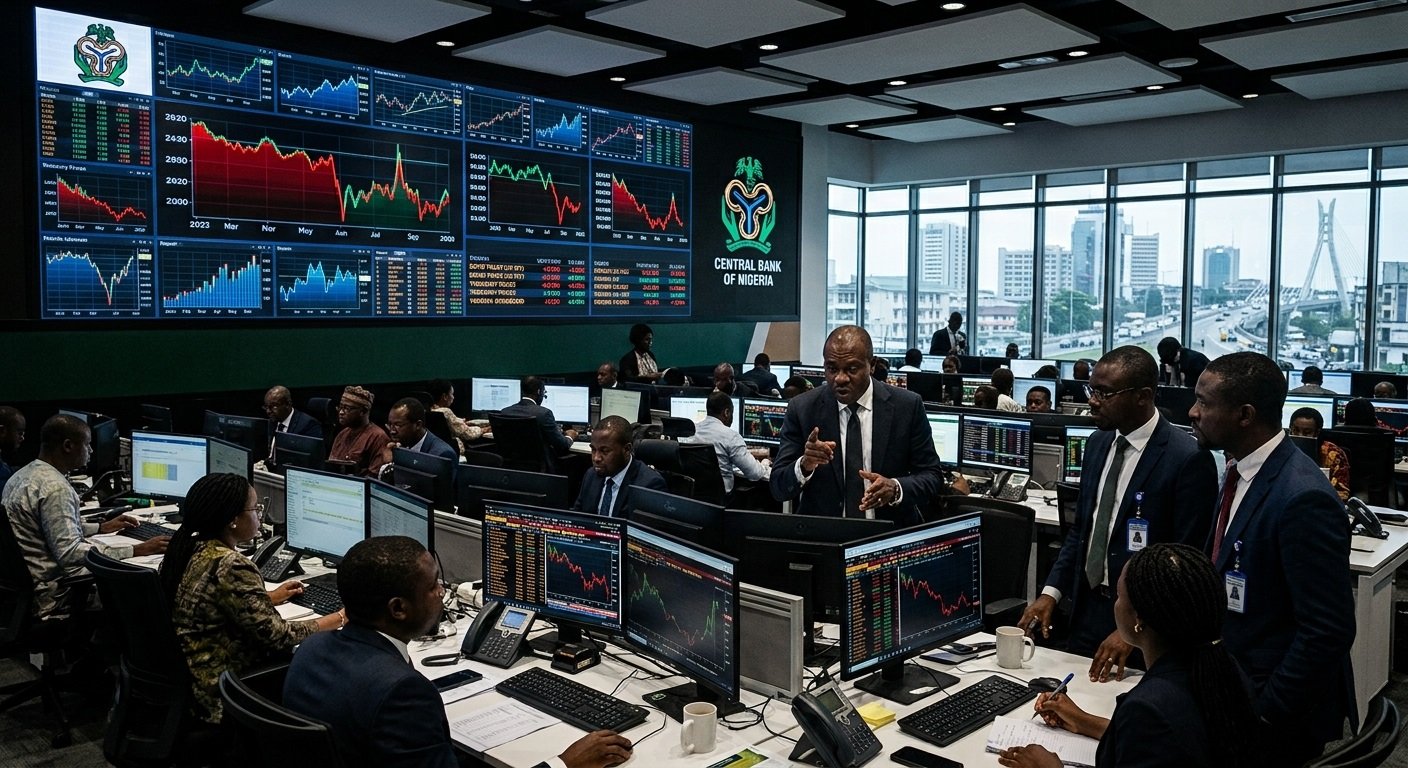
The global bond market is sending a warning to Nigeria: the era of cheap money may be ending just as the country begins to enjoy the first meaningful benefits of monetary easing.
The warning goes beyond the latest rise in US Treasury yields.
It goes to the cost of financing Nigeria’s next phase of growth.
As major bond markets reprice borrowing costs, investors are demanding more compensation for holding government debt. For Nigeria and other African economies that still need vast amounts of capital for infrastructure, industry and investment, the question is no longer simply where interest rates are headed.
It is how much growth can be financed if money stays expensive.
That is the significance of the warning from Nigel Green, chief executive of deVere Group, who has described the recent global bond turmoil as a synchronised repricing of borrowing costs.
Green argues that high government debt, persistent inflation, rising oil prices and tougher central-bank policy have combined to unsettle sovereign debt markets. His second warning is that the current pause may be temporary, with another shock potentially producing a sharper sell-off.
The forecast of another violent market move remains an investor view, not an established outcome.
But the underlying shift is harder to dismiss.
The world is repricing the cost of capital. And for Nigeria, that matters.
Why Lagos should care about US Treasuries
The transmission mechanism is straightforward.
When yields on US government debt rise, dollar assets become more attractive. Investors can demand greater returns for taking risk elsewhere. Emerging-market borrowers may then have to offer higher yields to remain competitive.
That can put pressure on currencies, raise refinancing costs and constrain monetary-policy choices.
For governments, the arithmetic is unforgiving: higher interest payments leave less money available for infrastructure and other productive investment.
For companies, higher financing costs can make projects that once looked viable harder to justify.
For investors, the hurdle rate for emerging-market assets rises.
In simple terms:
Higher global yields → tighter financial conditions → more expensive capital → less fiscal and investment space.
That does not mean every rise in US yields automatically translates into a Nigerian financial shock.
Markets differentiate between economies. They look at inflation, reserves, fiscal credibility, debt structure, currency stability and growth prospects.
But that is precisely why Nigeria’s domestic economic performance matters more when global money becomes expensive.
Nigeria cuts rates as the world turns cautious
The timing is striking.
The Central Bank of Nigeria has just cut its Monetary Policy Rate by 350 basis points, from 26.5 percent to 23 percent — its biggest single rate cut in the current cycle. The decision came as inflation continued to ease, with headline inflation falling to 15.39 percent in August.
For businesses and households that have endured exceptionally high borrowing costs, the move offers welcome relief.
But it creates a difficult question:
Can Nigeria continue making money cheaper at home while the global market is making capital more expensive?
The answer will depend on more than the CBN’s policy rate.
It will depend on the naira, foreign-exchange liquidity, inflation expectations, domestic bond yields and foreign investor appetite for Nigerian assets.
It will also depend on whether the rate cut translates into cheaper credit for productive businesses rather than simply higher prices for financial assets.
That is where the global bond story becomes a Nigerian story.
The debt burden makes the price of money matter
Nigeria does not simply need to manage its existing debt. It needs to borrow and invest for growth. That creates the central fiscal challenge.
The federal government spent ₦3.14 trillion servicing domestic debt in the first quarter of 2026, according to figures from the Debt Management Office, with interest payments accounting for about 95 percent of the total.
That is why the question is not merely whether Nigeria’s debt is sustainable.
It is at what cost Nigeria can continue financing the growth it needs.
Every increase in borrowing costs changes the fiscal arithmetic.
A larger interest bill competes with infrastructure spending. More expensive refinancing raises the cost of rolling over obligations. Higher yields demanded by investors can make new borrowing more expensive.
And if the global cost of capital stays high, the pressure does not disappear simply because Nigeria’s own inflation is falling.
This is the point at which the bond-market story stops being about bonds.
It becomes a story about the price of development.
Oil: Nigeria’s cushion and complication
Then comes oil. For Nigeria, higher crude prices should ordinarily be good news.
More expensive oil can mean higher export earnings, stronger foreign-exchange inflows and improved government revenues.
But the current oil shock comes with a complication.
Global oil prices have surged amid Middle East tensions, pushing Nigerian petrol prices to around ₦1,400 a litre in Lagos and Abuja, with prices reaching ₦1,500 in parts of the north, according to Business a.m. fuel stations monitoring. Diesel prices have also risen above ₦2,000 a litre.
So Nigeria can benefit from higher oil revenues while simultaneously facing higher domestic energy costs.
That is the paradox. The same oil shock can strengthen Nigeria’s external finances while making inflation harder to tame.
And if higher oil prices keep inflation elevated globally, major central banks may have less room to cut interest rates.
That could keep global bond yields higher for longer.
Nigeria would then be receiving an oil windfall while operating in a more expensive international financial environment.
That is why “higher oil is good for Nigeria” is too simple.
The more important question is why oil prices are rising — and what the shock does to inflation, interest rates and capital flows.
Africa’s bigger problem
The implications extend well beyond Nigeria. Africa needs capital on a scale that governments alone cannot provide.
The continent needs investment in electricity, transport, ports, housing, manufacturing, technology and businesses capable of absorbing a rapidly growing workforce.
But all of those ambitions depend on financing. And financing is now being repriced globally.
This does not mean Africa is heading for another uniform debt crisis. African economies remain highly differentiated, with different fiscal positions, currencies, reserves, debt structures and investor perceptions.
That divergence is important. It means the global bond shock will not affect every African country in the same way.
It also means domestic credibility becomes more valuable.
Countries with stronger fiscal positions, credible monetary policy, adequate external buffers and deeper domestic capital markets are better placed to absorb higher global funding costs.
Those with weaker buffers have less room to manoeuvre.
The IMF and World Bank’s recent decision to revise the debt-sustainability framework for low-income countries reflects how much the global debt environment has changed. The IMF says about 14 percent of low-income countries are already in debt distress and another 33 percent are at high risk.
The message for Africa is not that a crisis is inevitable. It is that the cost of economic mistakes is rising.
The African “so what?”
For Africa, the danger is not simply that US Treasury yields are rising.
It is that the world may be entering a period in which capital is structurally more expensive.
That changes the development equation.
A government trying to finance a major infrastructure project faces a higher hurdle.
A manufacturer deciding whether to expand must reassess its financing costs.
A company dependent on foreign capital must compete against increasingly attractive dollar assets.
And a sovereign refinancing debt must do so in a market where investors can demand more for risk.
The paradox is stark:
Africa needs more capital at precisely the moment the world may be making capital more expensive.
That is the real “so what?” behind the bond-market turmoil.
Nigeria’s test is resilience, not prediction
Nigeria cannot control the US Treasury market.
It cannot determine what the Federal Reserve does next. It cannot dictate the global price of oil.
What it can determine is how vulnerable the Nigerian economy is to those forces.
That means using periods of stronger oil revenue to build fiscal and external buffers rather than treating windfalls as permanent.
It means making borrowing work harder by directing more capital towards investments capable of expanding productive capacity.
It means deepening Nigeria’s domestic capital market.
It means maintaining confidence in monetary and foreign-exchange policy.
And it means ensuring that lower interest rates eventually translate into productive investment and cheaper credit for businesses.
The CBN’s 350-basis-point rate cut gives the economy some breathing space. But it does not repeal the global price of capital.
That price is being shaped by forces far beyond Abuja or Lagos — US government borrowing, global inflation, oil prices, central-bank policy and investors’ willingness to finance risk.
Nigeria cannot control those forces. But it can control how exposed it is when they turn against it.
That is the real warning coming from the global bond market.
It is not simply that yields may rise again.
It is that the world may be settling into a period in which money remains expensive even when markets are calm.
For Nigeria and Africa, the consequence is profound.
The global bond market is not merely repricing government debt. It is repricing the cost of ambition.
And for economies that still need to build, invest and grow, that is the risk that cannot be ignored.