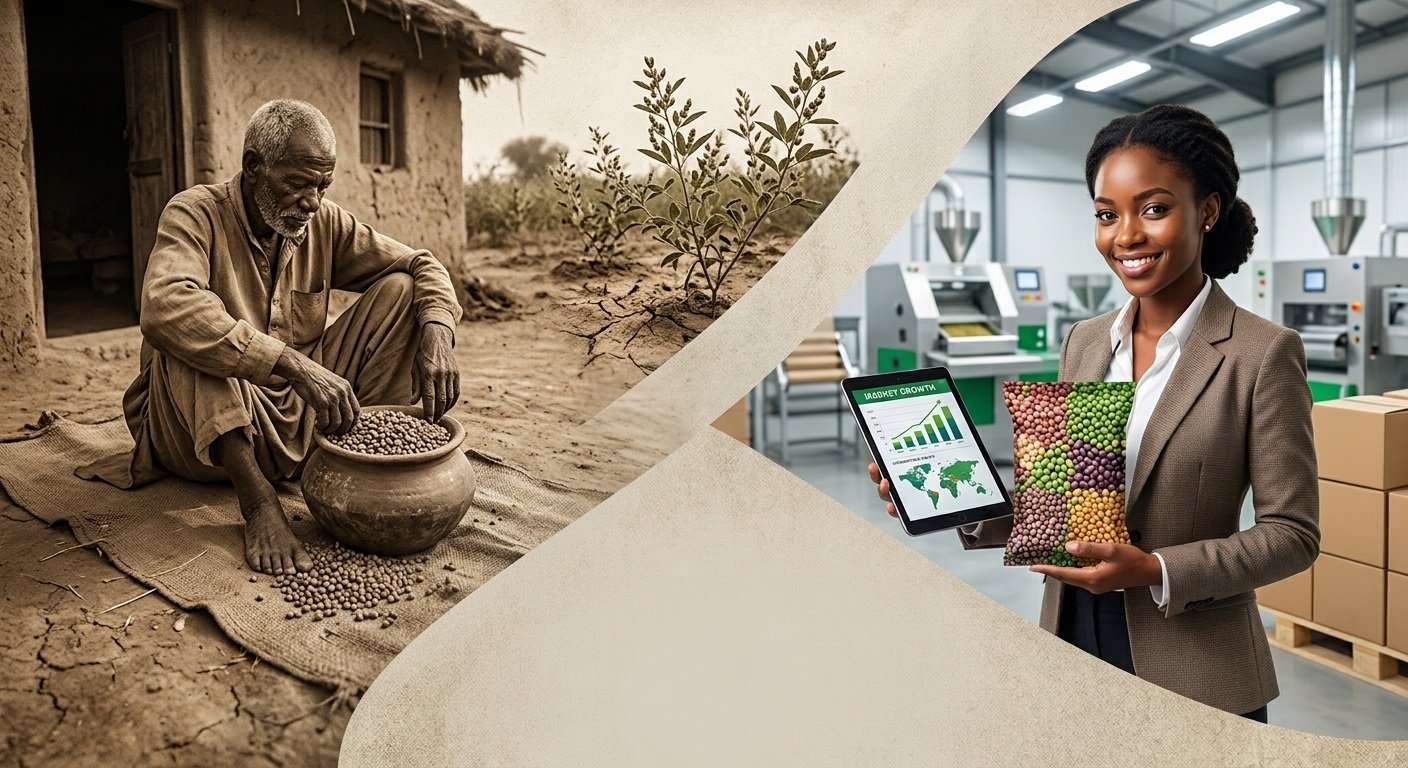
Pigeon pea has long been a familiar crop without a corresponding place in Africa’s commercial agriculture story.
While traditional consumers have kept the legume alive, investment, research and processing have largely followed bigger commodity crops. That pattern, however, is beginning to shift as pigeon pea emerges among Africa’s underutilised crops with potential for new agribusiness opportunities.
Pigeon pea, identified by the Food and Agriculture Organization (FAO) and the Forum for Agricultural Research in Africa (FARA) among 100 underutilised African food commodities, is increasingly being viewed not simply as a traditional pulse but as a crop with potential across food processing, livestock production, soil management and climate-resilient agriculture.
The commercial question is therefore shifting from whether pigeon pea can be grown to whether Africa can build the infrastructure, markets and investment required to turn it into a scalable value chain.
“Pigeon pea belongs to the second category,” wrote Whitney Asor Adade and Shaquille Pennaneach, FARA researchers, in their assessment of the crop, referring to foods that have not disappeared completely but have increasingly been overshadowed by more commercially dominant commodities.
That distinction is important for agribusiness investors. Unlike an entirely new crop requiring consumers to develop a market from scratch, pigeon pea already has established food uses. What remains underdeveloped is the industrial architecture around it.
From grain to multiple revenue streams
Pigeon pea can enter the market in several forms, creating opportunities beyond the sale of raw grain.
Farmers can market immature pods as vegetables or mature grain for household consumption. Processors can mill the grain into flour for use in food formulations, including cereal-legume blends and complementary foods. The crop can also contribute to livestock feeding systems through its foliage and residues.
“That combination gives pigeon pea a rare kind of versatility for a single crop,” the researchers observed.
For processors, that versatility creates room for product differentiation.
Instead of relying on bulk commodity sales, businesses can develop cleaned and packaged grains, composite flours, fortified food products and other processed formats. Such models potentially shift more value from the farm gate into aggregation, processing, packaging and distribution.
FAO’s work on forgotten foods similarly highlights value-chain development, investment and commercialisation as necessary steps if underutilised crops are to move beyond niche consumption and become meaningful components of African food systems.
The climate-resilience proposition
Climate pressure is giving pigeon pea another reason to move up Africa’s agricultural value chain.
The crop can perform under relatively difficult growing conditions, requires fewer external inputs in some production systems and can improve soil fertility through nitrogen fixation. Its compatibility with cereals and other crops also makes it useful in diversified farming systems.
The result is a crop with more than one commercial identity.
“It is not simply an oilseed. It is not only a pulse,” the FARA researchers wrote.
For farmers, pigeon pea offers an additional crop that can fit into existing production systems. For agribusinesses, however, the bigger opportunity may be in turning that production into a structured market for seed, aggregation, processing, livestock feed and food products.
The missing link: building the pigeon pea market
According to the research, the biggest obstacle to turning pigeon pea into a commercially viable crop may not be its agronomic performance, but the absence of the infrastructure needed to support a functioning market.
A competitive pigeon pea value chain would require reliable seed systems, organised aggregation, storage facilities, quality standards, processing capacity, market information, packaging and dependable off-takers.
Without these links, increased production does not necessarily translate into higher farmer incomes. Farmers have little incentive to expand acreage when markets remain fragmented and buyers are uncertain.
The challenge mirrors a wider problem confronting Africa’s underutilised crops. FAO and FARA have identified limited research and investment, weak value chains and inadequate market development as barriers to bringing these crops into mainstream agrifood systems.
The result is an agricultural investment gap: the crop exists, but the commercial ecosystem required to turn production into scalable business remains underdeveloped.
Pigeon pea’s nutritional profile provides another potential route into the formal food industry.
The crop supplies protein and dietary fibre alongside minerals and folate, making it relevant to the growing market for affordable, nutrient-dense food products. But its commercial proposition is stronger when nutrition is combined with functionality, processing potential and agricultural resilience.
“The result is not a miracle food. It is something more practical: an ingredient capable of making an ordinary meal more nutritionally substantial,” ,Adade and Pennaneach wrote.
That distinction matters. The opportunity is not to create an exaggerated health narrative around pigeon pea, but to position it as an ingredient that can be incorporated into products already consumed by African households.
From forgotten crop to investable value chain
The bigger opportunity may therefore sit beyond the farm.
A scaled pigeon pea industry could create demand for improved seed, farmer aggregation, warehousing, primary processing, flour production, food manufacturing, animal-feed applications, logistics and retail distribution.
That means value could be distributed across multiple businesses rather than concentrated in primary production.
FAO’s forgotten-food initiative argues that bringing underutilised crops back into food systems can support jobs, industrial growth, local trade and more resilient agricultural systems.
The commercialisation of pigeon pea presents a value-chain investment opportunity rather than a conventional commodity expansion.
For food manufacturers and investors, the potential lies in creating an integrated supply ecosystem capable of delivering reliable volumes, consistent quality and commercially viable processed products. That requires investment beyond the farm in aggregation, storage, processing, logistics, market development and distribution.
The absence of these capabilities remains a constraint on scale. Fragmented production and predominantly traditional consumption limit visibility of demand, making it harder for businesses to justify significant investment in downstream capacity.
Yet the strategic environment is becoming more favourable. Africa’s food-import dependence, climate exposure and industrialisation agenda are increasing pressure to diversify domestic production and capture more value locally. FAO has similarly highlighted the need for investment and stronger agrifood systems to bring underutilised crops into mainstream markets.
Pigeon pea is therefore considered less a new crop than an unfinished business proposition.