The $866 million question confronting Nigeria’s fisheries industry is not whether Nigerians want fish. It is why the country is paying foreign producers to satisfy a market that domestic businesses could potentially supply.
Nigeria’s frozen fish and seafood imports reached $866 million in 2025, up from $606 million in 2023, according to Thaddeus Udofia, director-general of the International Maritime Institute of Nigeria.
Behind that rising bill is an industry caught between enormous demand and inadequate productive capacity.
Nigeria has the consumers, the coastline, inland waters and aquaculture potential. What it lacks is a sufficiently developed commercial ecosystem to turn those resources into a competitive seafood industry.
That ecosystem is missing critical links including commercial fishing capacity, modern aquaculture, finance, cold storage, processing, logistics, specialised port infrastructure and effective enforcement against illegal fishing.
The result is an industry in which Nigeria captures only a fraction of the economic value generated by its seafood demand.
Udofia raised the issue at the 2026 National Conference on Sustainable Fishing organised by the Maritime Correspondents’ Organisation of Nigeria (MARCON), saying Nigeria was effectively exporting demand and scarce foreign exchange to overseas seafood suppliers.
“Ironically, Nigeria remains one of the largest importers of seafood in Africa,” Udofia said, noting that the country spends hundreds of millions of dollars annually to bridge its domestic supply deficit.
The problem, however, extends beyond the fishing boats themselves.
Weak links across Nigeria’s seafood value chain are limiting the sector’s ability to convert natural resources into economic value. From access to fishing grounds and aquaculture finance to landing sites, cold-chain infrastructure, processing, logistics and ports, investment gaps continue to constrain production and commercialisation.
The consequence is an expensive disconnect between resource availability and market supply: Nigeria possesses substantial fisheries potential, but still turns to foreign suppliers to satisfy a sizeable share of domestic seafood demand.
A market waiting for investment
The growing seafood import bill points to a potentially large domestic market for investors.
Nigeria’s expanding population, demand for affordable protein, urbanisation and changing consumer preferences are creating opportunities beyond the sale of fresh fish. Processing, packaging, cold-chain logistics, aquaculture, fish feed, storage, distribution and export-oriented seafood businesses could all form part of a larger industrial value chain.
The market is also shifting towards value-added products, including smoked and processed fish, ready-to-eat seafood and convenience-oriented packaging, creating room for businesses that can combine production with modern distribution.
But investment has remained fragmented, particularly among artisanal fishers and small-scale aquaculture operators, while inadequate infrastructure continues to raise costs and generate post-harvest losses.
Ismail Aniemu, president of MARCON, said the economic importance of fisheries needed to be recognised within Nigeria’s broader blue-economy strategy.
“Fish itself is part of our national economy. We can’t be discussing blue economy and keeping fish in isolation,” Aniemu said.
“You can have the waters, but when you are not fishing it means you are not reaping the value of those waters,” he added.
For investors, that gap represents both a challenge and an opportunity: Nigeria needs to move from simply having fisheries resources to building an industry around them.
The infrastructure missing between sea and market
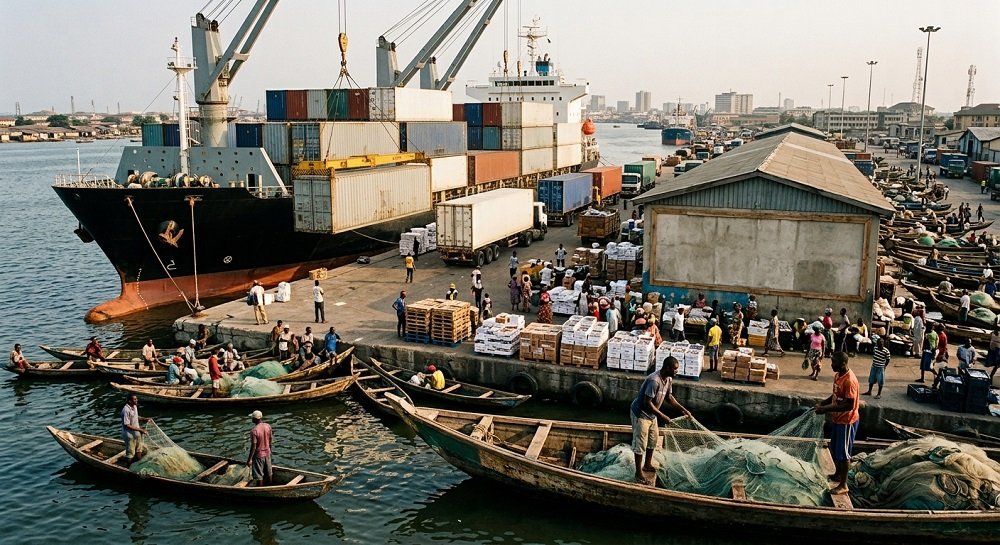
One of the biggest barriers is what happens after fish is caught.
Fish is highly perishable, meaning that weak landing facilities, insufficient ice production, inadequate cold storage and poor transport connections can destroy value before products reach consumers.
The Nigerian Ports Authority believes specialised fishing terminals could help address some of these bottlenecks.
Abubakar Dantsoho, managing director of the NPA, represented by Adebite Adewunmi, assistant general manager, corporate and strategic planning, said dedicated fish terminals would need cold-storage facilities, ice plants, processing infrastructure, navigational channels and efficient loading and unloading facilities, supported by road, rail or inland-waterway connections.
The NPA has already designated a special terminal as a dedicated fish terminal, with cold-storage and export-processing facilities available to operators.
The model points to an important shift in thinking: fisheries infrastructure should not be treated simply as a government responsibility, but as part of the commercial infrastructure required to build an investible seafood industry.
Spain, Dantsoho noted, offers an example of how specialised port infrastructure can be organised around different cargo categories, including fish.
The cost of empty nets
Infrastructure investment alone will not solve the problem if Nigeria’s fish stocks continue to deteriorate.
Udofia identified aggressive overfishing, climate change and illegal, unreported and unregulated fishing as major threats to the sector.
Particular concern has been raised over foreign industrial trawlers operating in Nigeria’s Exclusive Economic Zone, which stakeholders say are putting additional pressure on marine resources and artisanal fishing communities.
The consequences are economic as much as environmental.
When artisanal fishermen return from the sea with smaller catches, coastal household incomes fall, domestic fish supply tightens and consumers become more dependent on alternative, including imported, sources of protein. That creates a chain reaction running from depleted fish stocks to lost livelihoods, weaker domestic production and higher import dependence.
From conservation to commercialisation
The emerging debate therefore goes beyond protecting Nigeria’s waters.
It is increasingly about whether the country can turn marine-resource management into an engine of production, employment and investment.
Udofia called for a coordinated strategy involving regulation, scientific research, technology, investment and community participation. He also advocated stronger cooperation among maritime security agencies, economic regulators and fisheries authorities to combat illegal fishing.
Crucially, he argued that decisions on catch limits, closed seasons and marine protected areas should be based on credible scientific assessments of fish stocks rather than short-term exploitation.