For years, the dominant question in African finance has been deceptively simple: Where will the money come from?
Governments need money for infrastructure. Businesses need money to expand. Banks need long-term funding. Pension funds need investible assets.
So the policy conversation has understandably focused on attracting capital.
But the latest turbulence in global bond markets suggests that another question deserves equal attention:
Once the capital arrives, who carries the risk?
That is the more interesting implication of Nigel Green’s warning about the changing global debt order.
France’s borrowing costs are rising. Britain is facing elevated long-term yields. US borrowing costs remain under pressure. Argentina, meanwhile, is trying to rebuild investor confidence after years of sovereign stress.
The common thread is not that these economies are becoming alike.
It is that investors are becoming increasingly conscious of the price of risk.
For Nigeria, that should strengthen the case for continuing to deepen the financial infrastructure around government borrowing.
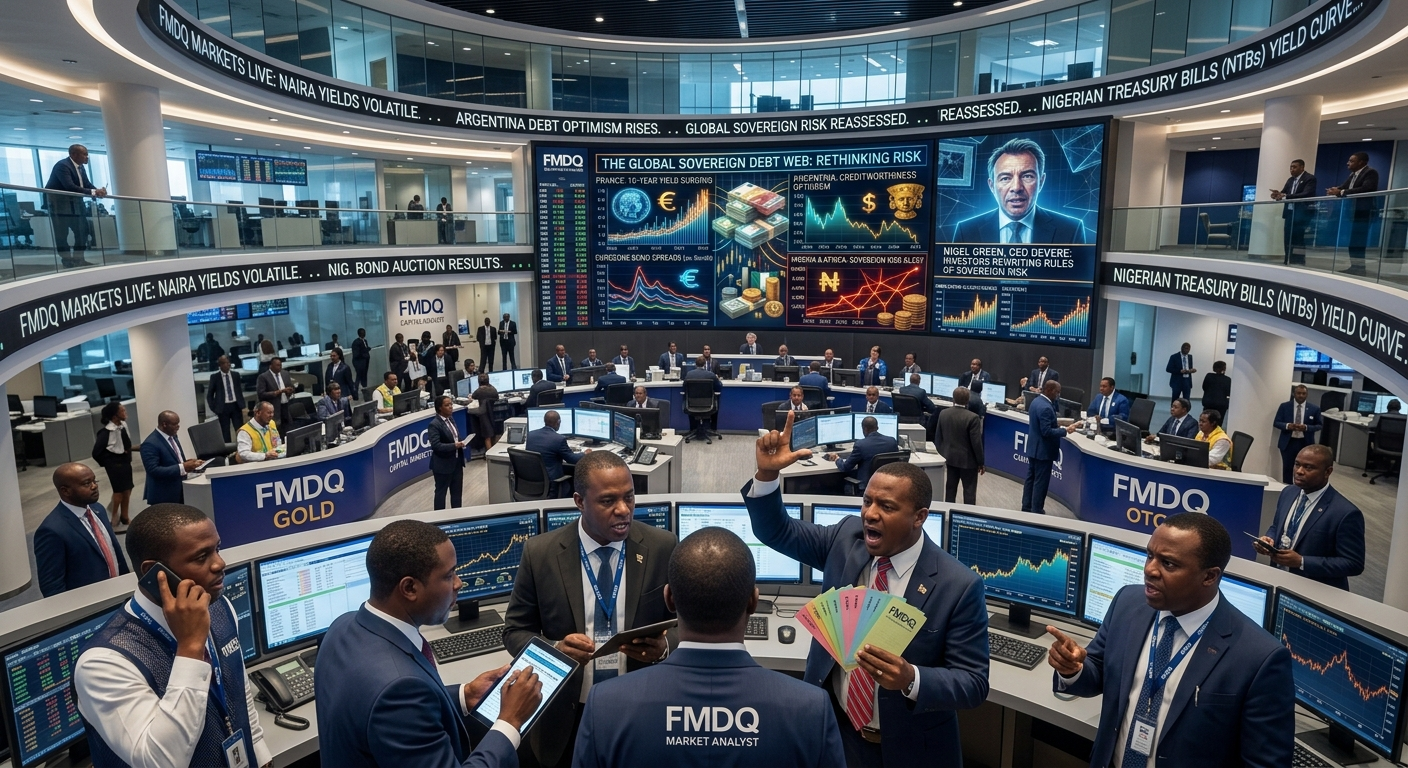
Nigeria already has FGN bond futures and naira-settled FX futures on FMDQ Exchange. That is more important than it may appear.
A mature financial system is not simply one in which governments can issue bonds.
It is one in which investors can buy those bonds, trade them, finance them, hedge them and understand their risks.
That distinction matters because Nigeria’s fiscal challenge is increasingly about the cost of money.
The IMF projects FGN interest payments at 53.7 percent of federal government revenue in 2026.
In such an environment, even relatively small changes in borrowing costs can have meaningful fiscal consequences.
The answer cannot be to depend indefinitely on ever-cheaper financing. It has to include better management of the risks surrounding financing.
This is where derivatives can play a role. They can give investors ways to manage currency exposure.
They can give financial institutions ways to manage interest-rate exposure; they can make it easier for different classes of investors to participate in the market according to their risk appetite.
And, over time, they can contribute to better price discovery.
But there is an important distinction that should not be lost in the enthusiasm for financial innovation.
Derivatives are risk-management tools, not substitutes for economic management.
They cannot compensate for weak revenues; they cannot cure excessive deficits; they cannot create dollars; they cannot transform an unsustainable debt trajectory into a sustainable one.
What they can do is make the financial system better equipped to absorb volatility.
That matters for Africa because the continent’s debt structure is changing.
African governments have increasingly turned towards domestic markets, with local-currency debt becoming a much larger component of public financing. The shift reduces some exposure to foreign-currency debt but also increases dependence on domestic financial institutions and exposes governments to domestic refinancing costs.
The IMF’s recent work on the sovereign-bank nexus makes the implication clear: the closer the connection between governments and banks becomes, the more important financial stability becomes when sovereign conditions deteriorate.
That means Africa needs more than larger bond markets.
It needs better-functioning bond markets; it needs deeper investor bases; it needs longer maturities; it needs transparent debt data; it needs credible fiscal frameworks; it needs effective clearing and settlement.
And it needs instruments that allow institutions to hedge the risks they take.
Nigeria has an opportunity here. A deeper derivatives market could eventually make Nigerian assets more accessible to investors who are comfortable with the country’s economic prospects but less comfortable carrying all the currency or interest-rate risk themselves.
That could broaden the investor base. It could improve liquidity. It could make price discovery more efficient.
And, over time, it could support a more sophisticated allocation of capital.
But that opportunity will only be realised if the market grows alongside the institutions needed to supervise it.
The lesson from France should therefore not be that Africa has somehow overtaken the developed world in fiscal credibility. It has not. The lesson is more useful.
Markets can change their minds.
They can change their assessment of a government; they can change the price they demand; And when they do, yesterday’s assumptions about cheap money can become tomorrow’s fiscal problem.
Nigeria should therefore prepare for a world in which investors ask harder questions.
Not simply: What yield are you offering? But: What is the risk behind the yield? Can I hedge it? How liquid is the market? What happens under stress?
Those are the questions of a mature financial market.
Africa’s next financial frontier may therefore not be another race to borrow.
It may be the development of markets sophisticated enough to let investors take risk intelligently, hedge it transparently and price it accurately.
That would turn the global debt repricing from merely a warning into an opportunity.
Because if the world is indeed entering a period in which governments have to pay a more realistic price for their promises, Nigeria’s competitive advantage should not be the promise of cheap risk.
It should be the ability to make its risk understandable, tradable and manageable.