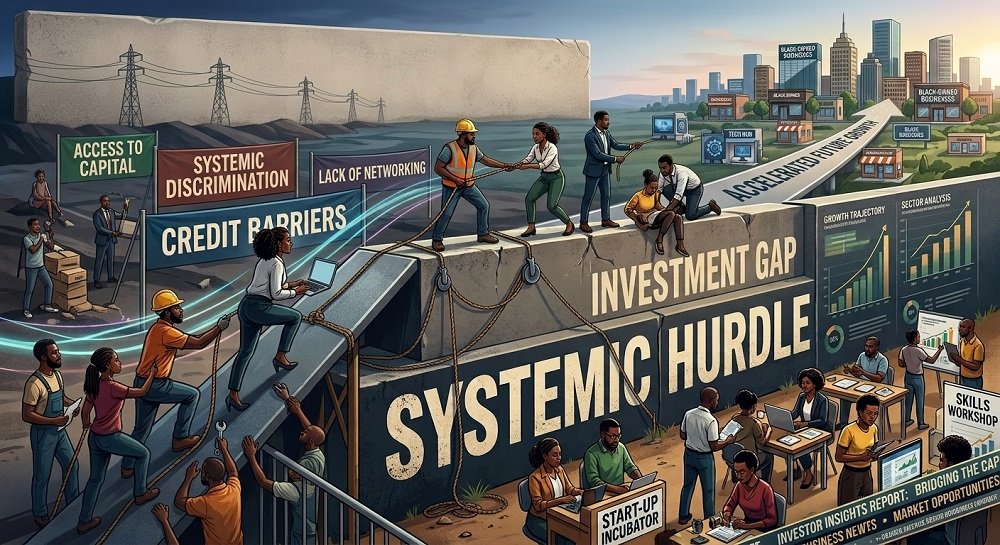
Black-owned and Black-led businesses account for between 89 percent and 99 percent of small businesses across five African markets, yet their access to the capital needed to grow into larger enterprises remains severely constrained, leaving them with a combined financing gap of $209 billion.
The disparity between their dominance at the small-business level and their declining representation among larger firms points to a structural weakness in the financing ecosystem. In Nigeria, where the funding deficit stands at $131 billion, representing 63 percent of the combined funding gap identified in Nigeria, South Africa, Kenya, Senegal and Côte d’Ivoire.
The challenge is particularly pronounced, according to a new report commissioned by British International Investment (BII) and Swedfund. The findings expose a critical bottleneck in the continent’s private sector, where businesses that dominate the small-enterprise landscape remain underrepresented among larger firms, limiting their ability to attract investment, expand production and create jobs.
The report, titled “Understanding the Investment Gaps in Black-Owned and -led Businesses in Sub-Saharan Africa”, was commissioned by British International Investment (BII), the United Kingdom’s development finance institution and impact investor, and Swedfund, and conducted by Open Capital Advisors. It combines quantitative market analysis with stakeholder consultations to assess the representation of Black-owned and Black-led businesses, their financing needs and the structural barriers restricting access to capital.
The research forms part of BII’s Black Ownership and Leadership for Development (BOLD) initiative, established in 2022 to increase the flow of capital to Black-owned and Black-led businesses across sub-Saharan Africa. Across the five markets examined, BOLD businesses account for between 89 per cent and 99 per cent of small businesses. Yet their representation declines as companies grow, falling to 40 per cent of larger businesses in Kenya and 35 per cent in South Africa.
The financing gap is equally pronounced. BOLD businesses account for an estimated $209 billion shortfall across the five markets,four times the gap recorded for non-BOLD businesses. Across sub-Saharan Africa, the overall financing gap for these businesses is estimated at $1.842 trillion.
Nigeria has the largest shortfall at $131 billion, followed by South Africa at $45 billion and Kenya at $23 billion. Senegal and Côte d’Ivoire recorded gaps of $5.7 billion and $4.6 billion, respectively, underscoring the scale of the challenge in both large and smaller African markets.
Chris Chijiutomi, managing director and head of Africa at BII, said the inability to secure adequate growth financing leaves businesses operating without the resources needed to increase their economic contribution.
“If these businesses aren’t getting capital for growth, they’re just plateauing. They’re still working as businesses, but they’re not able to grow,” Chijiutomi said.
He attributed Nigeria’s substantially larger financing gap, in part, to the size of its population and the volume of businesses operating in its economy.
“Nigeria has 200 million-plus people,” he said, adding that some of the challenges identified in the research were more pronounced in Nigeria because of the number of businesses in the country.
Nigeria’s $131 billion financing shortfall, which surpasses the combined gaps in the other four countries studied, points to a major constraint on the expansion of indigenous enterprises. Without sufficient growth capital, businesses may struggle to increase production, invest in productive assets, enter new markets and strengthen their competitiveness, potentially limiting their wider contribution to economic activity and employment.
Chijiutomi said Black-owned and Black-led businesses are a driving force behind African economies, but persistent barriers to finance continue to limit their ability to realise their full potential.
“Expanding opportunity for these businesses can help reduce inequalities, contributing to SDG 10, while unlocking their potential to drive growth, create jobs and foster innovation. This research gives us a clearer picture of the barriers that constrain funding and shows us how to take action,” he said.
Although the financing shortfall is evident across all five countries, the report finds that the factors restricting access to capital vary by market, making a uniform investment strategy unlikely to address the problem effectively.
In Kenya, stakeholders identified limited access to investor networks and early-stage capital as significant constraints. In Nigeria, access to hard-currency financing emerged as a more prominent challenge.
The findings show that businesses may struggle to secure funding not only because capital is scarce or expensive, but also because they lack the relationships, financing structures and institutional support necessary to connect with suitable investors.
Limited investment readiness is another obstacle. Investors providing substantial growth capital typically expect businesses to maintain reliable financial records, showcase sound corporate governance, present credible business plans and show that they can manage additional funding effectively.
However, some enterprises lack the financial resources, technical expertise and internal structures required to meet these expectations. This can prevent otherwise viable businesses from demonstrating their commercial potential and securing investment on terms that support sustainable expansion.
The report also identifies the potential influence of bias among capital providers, particularly where investors do not share the social or ethnic backgrounds of the entrepreneurs seeking funding. Such dynamics can compound the difficulty of establishing investor relationships and accessing financing.
The problem is particularly severe for businesses moving beyond the earliest stages of development. Microfinance, grants and conventional bank loans may help smaller enterprises establish or sustain their operations, but businesses seeking larger investments can struggle to find products suited to their expansion plans.
This creates a financing gap between the relatively modest amounts available to establish and operate small businesses and the larger investments needed to expand production, acquire equipment, enter new markets and strengthen operational capacity.
Chijiutomi said institutions such as BII would need to make their funding more accessible to Black-owned and Black-led businesses and establish specific targets to increase financing for the category.
Such measures could help address structural barriers that prevent viable enterprises from obtaining the capital required to grow. However, the size of the financing gap shows that meaningful progress would require coordinated action by a broad range of investors and financial institutions rather than reliance on individual funding initiatives.
Swedfund links investment to reducing inequality
Kitanha Toure, regional director for West Africa at Swedfund, said the findings reinforce the institution’s commitment to reducing inequality by expanding access to investment and strengthening local ownership.
“For Swedfund, the insights from this research are directly linked to our institutional commitment to contribute to SDG 10, reduced inequalities. Our strategy focuses on increasing investment in low-income markets, improving access for the underserved, and strengthening local ownership and decision-making,” Toure said.
According to Toure, expanding local ownership is central to efforts to ensure that more businesses participate in and contribute to Africa’s economic development. However, without access to appropriate financing, many enterprises may struggle to move beyond small-scale operations and build the capacity required to support broader economic transformation.
The Swedfund regional director noted that the challenge across the five countries is to establish financing mechanisms that respond to businesses’ changing needs, from early-stage funding to the larger investments required for expansion and increased production.
Closing the gap, he stated, could strengthen productive capacity, improve efficiency, support job creation and deepen domestic value chains. He added that it could also enable more locally owned businesses to integrate into larger commercial networks, increasing their contribution to economic activity.
Alternative finance offers new route to tackling Africa’s SME funding gap
Africa’s persistent SME financing deficit is prompting renewed interest in funding models that leverage commercial transactions and supply chain relationships to improve businesses’ access to capital.
Afreximbank has identified factoring and supply chain finance as important instruments for complementing conventional bank lending, easing working-capital constraints and strengthening value chains across the continent.
Speaking at the bank’s annual Factoring Workshop in Abidjan, Côte d’Ivoire, Kanayo Awani, executive vice-president for Intra-African Trade and Export Development at Afreximbank and a member of the FCI executive committee, said Africa’s factoring market had expanded significantly but remained below its potential.
Factoring allows a business to sell its unpaid invoices to a third-party financial institution, known as a factor, at a discount in exchange for immediate cash. The arrangement can improve working capital by allowing businesses to receive funds before customers settle their invoices, while potentially transferring some collection responsibilities and credit risk to the factor.
According to Awani, Africa’s factoring volumes more than doubled from €21.6 billion in 2017 to €50 billion in 2024, while nearly 200 factoring companies were operating across the continent. Despite this progress, she said the scale of activity remained insufficient relative to the financing needs of African businesses.
According to Awani, SMEs account for more than 90 per cent of Africa’s businesses and over 60 per cent of employment and gross domestic product, yet they continue to face an estimated annual financing gap of $300 billion.
“To catalyse SME-led growth, Africa must scale factoring volumes to at least €240 billion, equivalent to about 10% of the continent’s GDP,” Awani said.
“Achieving this will require increased financing, deeper legal reforms, expanded training and strong industry partnerships,” she added.