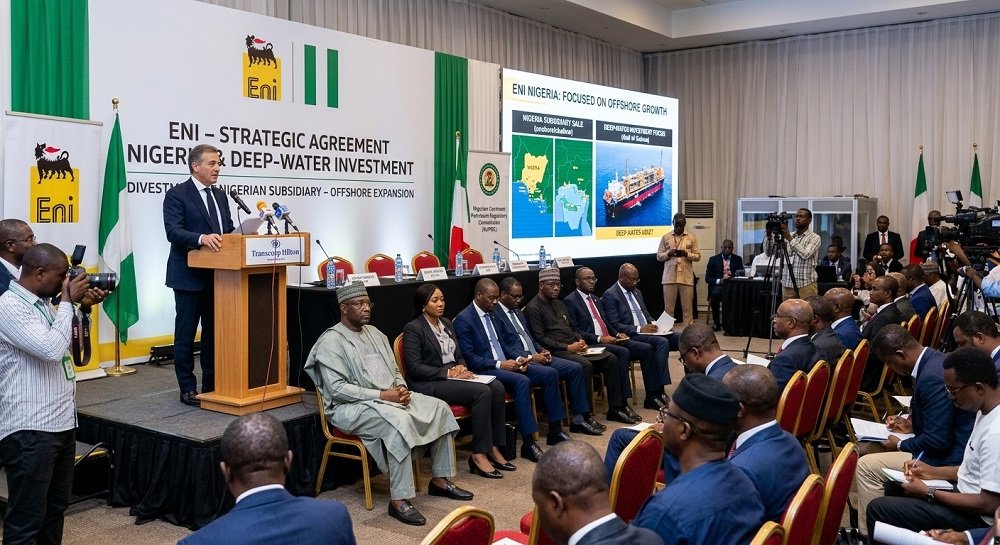
Italian energy company Eni has divested its onshore and shallow-water assets in Nigeria under the Agip Energy and Natural Resources (AENR), in a move to rebalance upstream portfolio, according to a statement by the global energy company.
The oil major which is one of the eight major oil companies, said it has completed the sale of AENR, its Nigeria-based subsidiary, as it directs its focus to deep-water assets in the African nation.
In the alternative, the oil major says it is directing its focus to deep-water assets in place of onshore assets it had operated for decades in Nigeria.
Eni said in a statement days ago that, it sold its Agip Energy and Natural Resources (AENR) division to Apex Global Energy, a company owned by Sterling Oil, one of Nigeria’s leading onshore operators, according to Upstream.com.
The Italian energy company did not disclose the financial terms of the transaction.
Eni is among the world’s eight major oil companies (Aramco, BP, Shell, Equinor, TotalEnergies, Eni, Chevron, and ExxonMobil) that have made record earnings from oil sales leading to almost doubling their combined profits ($93 billion by the second quarter of 2026, from just below $50 billion in the second quarter of 2025, following the U.S.-Israeli attack on Iran and the subsequent blockage of Strait of Hormuz.
The disruption due to the near-halt in tanker traffic through the Strait of Hormuz, the world’s most vital energy chokepoint on Earth, produced what the International Energy Agency (IEA) describes as the biggest supply disruption in the history of the global oil market.
Strait of Hormuz is the critical, narrow waterway connecting the Persian Gulf to the Gulf of Oman and the Arabian Sea, with roughly 20 percent of the world’s petroleum and liquefied natural gas passing through its narrow shipping lanes daily.
Checks by Business A.M. indicate that AENR is engaged in onshore and shallow-water exploration and production in Nigeria. It also holds a 5 percent interest in the Renaissance joint venture.
According to Eni, the transaction is in line with its strategy to optimise its upstream activities by rebalancing the portfolio and divesting non-strategic assets.
Eni chief executive Claudio Descalzi, is leading the Italian oil giant in calculated but steady Nigeria divestment surge by the international oil companies (IOCs).
The divestment from Nigeria’s oil industry by IOCs is a major structural shift where multinational energy giants—including Shell, ExxonMobil, TotalEnergies, and Eni—are selling off their ageing onshore and shallow-water oil and gas assets to local indigenous Nigerian companies.
Key details of the divestment trend involve the IOCs leaving onshore and shallow-water fields in the Niger Delta while retaining high-value deepwater offshore operations and natural gas projects (such as Nigeria LNG).
Major transactions so far include: Shell selling its onshore subsidiary, the Shell Petroleum Development Company (SPDC) to the Renaissance consortium. ExxonMobil struck a deal to sell its Mobil Producing Nigeria assets to Seplat Energy. TotalEnergies completed the sale of its 10 percent interest in the Renaissance JV licences to Vaaris for $800 million. The latest is the Eni sell of its onshore Agip Energy and Natural Resources unit to Apex Global Energy.
At least five major IOCs have completely or partially divested from Nigeria’s onshore and shallow-water assets. Financially, these specific asset asset transfers have actually unlocked over $15 billion in transaction value, though historical regulatory delays surrounding the process cost Nigeria an estimated $34 billion in lost oil output.
Energy industry watchers adduce the primary drivers of the ongoing IOCs Nigeria divestment to: persistent crude oil theft, pipeline vandalism, and community unrest in the Niger Delta. Others are high operational security and maintenance costs, global corporate portfolio shifts toward cleaner energy alternatives and deeper, safer offshore plays, and regulatory and fiscal updates under the Nigerian Petroleum Industry Act (PIA) of 2021.