
THE AYRE INDEX: 56 COMMONWEALTH COUNTRIES
Published ranking, out of 100. The study’s readiness benchmark is 53 points, between Nigeria (15th) and Seychelles (16th).
| Rank | Commonwealth country | Index score | Scoring coverage (of 102) | Data Gap Index (of 100) |
| 1 | Singapore | 77.6 | 75 | 37.7 |
| 2 | Malta | 75.0 | 68 | 41.4 |
| 3 | Australia | 71.0 | 76 | 26.2 |
| 4 | United Kingdom | 70.8 | 84 | 20.1 |
| 5 | Canada | 70.2 | 76 | 31.8 |
| 6 | Malaysia | 69.0 | 72 | 29.0 |
| 7 | Cyprus | 67.4 | 74 | 34.1 |
| 8 | Mauritius | 64.4 | 61 | 49.4 |
| 9 | New Zealand | 63.9 | 55 | 50.1 |
| 10 | Brunei Darussalam | 62.3 | 57 | 56.3 |
| 11 | India | 60.6 | 80 | 20.7 |
| 12 | Fiji | 56.9 | 60 | 47.9 |
| 13 | South Africa | 56.8 | 75 | 32.0 |
| 14 | Trinidad and Tobago | 56.5 | 58 | 56.6 |
| 15 | Nigeria | 54.5 | 82 | 17.4 |
| 16 | Seychelles | 51.8 | 39 | 73.1 |
| 17 | Ghana | 51.2 | 73 | 31.7 |
| 18 | Jamaica | 50.7 | 61 | 51.2 |
| 19 | Sri Lanka | 49.9 | 54 | 52.7 |
| 20 | Zambia | 48.8 | 65 | 40.5 |
| 21 | Bangladesh | 48.7 | 84 | 14.4 |
| 22 | Kenya | 48.7 | 66 | 42.9 |
| 23 | Uganda | 47.0 | 61 | 50.0 |
| 24 | Pakistan | 46.4 | 84 | 15.7 |
| 25 | Tanzania | 45.5 | 63 | 41.0 |
| 26 | Gabon | 45.3 | 43 | 67.1 |
| 27 | Antigua and Barbuda | 45.2 | 41 | 70.6 |
| 28 | Maldives | 44.9 | 41 | 71.4 |
| 29 | Cameroon | 44.9 | 54 | 53.9 |
| 30 | The Bahamas | 44.7 | 35 | 78.5 |
| 31 | Guyana | 44.5 | 49 | 65.5 |
| 32 | Papua New Guinea | 44.1 | 38 | 67.9 |
| 33 | Sierra Leone | 43.6 | 64 | 46.5 |
| 34 | Barbados | 43.0 | 43 | 70.5 |
| 35 | Belize | 42.8 | 50 | 65.2 |
| 36 | Namibia | 42.7 | 52 | 56.2 |
| 37 | Togo | 42.6 | 58 | 51.8 |
| 38 | Grenada | 41.7 | 45 | 66.2 |
| 39 | Nauru | 41.6 | 44 | 69.2 |
| 40 | Dominica | 41.3 | 37 | 75.1 |
| 41 | Samoa | 41.0 | 47 | 65.1 |
| 42 | Saint Vincent and the Grenadines | 39.5 | 38 | 72.1 |
| 43 | Saint Kitts and Nevis | 39.0 | 37 | 75.1 |
| 44 | Mozambique | 38.9 | 53 | 58.1 |
| 45 | Botswana | 38.9 | 63 | 53.8 |
| 46 | Kiribati | 38.4 | 44 | 66.9 |
| 47 | Rwanda | 38.1 | 60 | 50.2 |
| 48 | Tonga | 37.9 | 49 | 62.8 |
| 49 | Saint Lucia | 37.5 | 52 | 61.6 |
| 50 | The Gambia | 37.3 | 63 | 41.9 |
| 51 | Vanuatu | 37.1 | 48 | 64.7 |
| 52 | Eswatini | 36.9 | 51 | 62.7 |
| 53 | Solomon Islands | 32.0 | 36 | 75.6 |
| 54 | Tuvalu | 31.6 | 42 | 69.1 |
| 55 | Lesotho | 27.8 | 55 | 54.9 |
| 56 | Malawi | 26.3 | 59 | 53.0 |
Scoring coverage is the number of the 102 scored indicators with a usable value, including permitted estimates. The Data Gap Index is a separate weighted measure of missing qualifying evidence across all 111 indicators.
Nigeria could unlock an additional $5.234 billion in gross domestic product (GDP) over the next decade through artificial intelligence (AI), according to a Commonwealth-wide study that places the country among 15 nations meeting a benchmark for youth AI readiness.
The projection presents a significant opportunity for Africa’s largest economy as it seeks to diversify its productive base, attract technology investment and harness its youthful population for participation in the expanding global digital economy.
But beneath the promising economic outlook is a contradiction that could determine whether Nigeria captures the potential benefits of the technology: approximately 90 per cent of young Nigerians surveyed expect to use AI for education or work within the next year, yet the country scores just 0.8 out of 10 on the study’s selected measures of digital, data, media and AI capability.
The findings, contained in The Ayre Index: The 2026 Commonwealth Youth AI Readiness Index, suggest that Nigeria’s challenge is no longer simply encouraging AI adoption, but developing the technical capabilities, commercial infrastructure and investment environment required to translate growing interest into productive economic activity.
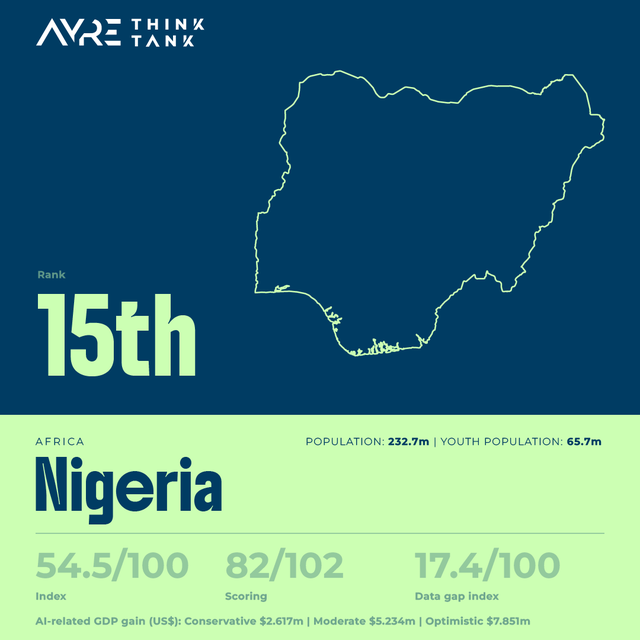
Nigeria ranked 15th among 56 Commonwealth countries, scoring 54.5 out of 100 against the study’s readiness benchmark of 53. It is one of only three African Commonwealth countries above the threshold, alongside Mauritius, which ranked eighth with 64.4 points, and South Africa, which placed 13th with 56.8 points.
The ranking places Nigeria ahead of Ghana, which scored 51.2, Kenya at 48.7, Uganda at 47.0 and several other African economies. However, its position as the last country above the readiness benchmark suggests that its competitive advantage remains relatively narrow.
The $5.2bn economic opportunity
The potential economic implications are significant for Nigeria, where approximately 65.7 million people are aged between 15 and 29, according to the research.
Applying scenarios developed by the International Monetary Fund (IMF) to national GDP figures, the Ayre Think Tank estimates that AI could increase the level of Nigeria’s GDP by $5.234 billion after ten years under its moderate scenario.
The conservative scenario puts the potential increase at $2.617 billion, while the optimistic case reaches $7.851 billion.
These projections provide an indication of the potential economic scale of AI adoption, particularly as businesses increasingly explore automation, predictive analytics, intelligent customer services and other applications capable of improving productivity and reducing operating costs.
However, the figures require careful interpretation. They are illustrative scenarios based on the IMF’s estimated effects for broad economic groups, applied by researchers to World Bank national GDP figures for 2025. The moderate scenario represents the midpoint of the conservative and optimistic estimates.
They are not Nigeria-specific economic forecasts, annual GDP growth projections or cumulative gains over the ten-year period. Nor do they establish how much of the potential additional output would translate into higher incomes, employment or returns for Nigerian businesses.
That distinction is important because the economic value of AI will depend not only on how widely the technology is adopted, but also on who develops it, who owns the intellectual property, who finances its deployment and which parts of the domestic economy capture the resulting productivity gains.
For Nigeria, the opportunity therefore extends beyond the use of imported AI applications. It includes building locally relevant products, developing technology enterprises, strengthening digital services exports and improving productivity across established industries.
Youth enthusiasm confronts a skills deficit
One of the most striking findings in the Ayre Index is the strength of young Nigerians’ interest in artificial intelligence.
Approximately 90 percent of Nigerian respondents expected to use AI for education or work within the following year, the highest reported proportion among the 56 Commonwealth countries.
Nigeria also scored 8.7 out of 10 on the study’s motivation and confidence pillar, while 67.8 percent of respondents said they felt confident controlling their interactions with the technology.
Its performance in work-based learning was similarly encouraging. Approximately 84 out of every 1,000 young Nigerians were recorded in apprenticeships, internships or traineeships, the highest rate among the 31 Commonwealth countries with comparable data.
In a separate international survey of university students aged 18 to 29 who already used ChatGPT, 47.8 percent of Nigerian respondents said they often or always used the platform to find information for research papers, again the highest share among the countries included in that comparison.
These findings point to an emerging generation increasingly comfortable with AI-assisted learning, research and productivity.
Yet the country’s 0.8 out of 10 capability score highlights the difference between enthusiasm for using technology and the technical foundations required to build, deploy and commercialise it.
The study acknowledges that this particular score relies substantially on conventional computer-skills indicators, including installing software and writing computer programmes, rather than directly testing young people’s current ability to use AI. It should therefore not be interpreted as evidence that Nigerian youths are generally incapable of using AI tools.
Nevertheless, the Index identifies wider structural weaknesses, including widespread informal employment and relatively few young people aged 25 to 29 working in high-skill occupations.
This presents a challenge for employers, investors and policymakers. Without stronger technical education, industry exposure and pathways into formal employment, rising AI adoption may not translate into the skilled workforce and enterprise development needed to generate substantial economic returns.
Government programmes seek to bridge the gap
Nigeria has begun developing initiatives aimed at strengthening its digital talent pipeline and expanding opportunities for technology entrepreneurship.
The federal government’s 3 Million Technical Talent (3MTT) programme is one of the central interventions, targeting the development of technical skills across areas including artificial intelligence and machine learning, software development, data science, cybersecurity and cloud computing.
The programme’s ambition is to develop a larger pool of technical professionals capable of serving domestic businesses and competing in international technology markets.
In August 2026, the government also partnered with Meta, the 3MTT programme and Robotics and Artificial Intelligence Nigeria to launch AI Academy Nigeria, an initiative designed to expand practical AI training and startup innovation.
The partnership combines AI skills development, technical boot camps and startup support, with the objective of helping participants move beyond foundational learning towards developing AI-powered products.
Another development is the National AI Innovation Challenge, launched in September 2026 to encourage Nigerian developers, universities and startups to build practical applications using N-ATLAS, the country’s open-source multilingual large language model.
N-ATLAS supports Yoruba, Hausa, Igbo and Nigerian-accented English, alongside automatic speech recognition capabilities.
The initiative could have commercial implications for businesses seeking to develop AI services that reflect Nigeria’s linguistic diversity and address local market requirements.
Applications in financial services, education, agriculture, customer support and public administration could expand access to digital services, particularly among populations underserved by conventional technology platforms.
However, the ultimate measure of success will not be the number of people trained or the number of AI initiatives launched. It will be the extent to which these programmes produce commercially sustainable businesses, employable technical talent, competitive products and measurable productivity improvements.
The challenge is to establish stronger connections between training institutions, technology companies, employers, venture capital providers and the wider business community.
Where the investment opportunities lie
For investors and established businesses, Nigeria’s AI opportunity extends across several important sectors.
Financial services could benefit from AI applications in fraud detection, credit assessment, risk management, customer service and operational automation. Banks and fintech companies could use these technologies to improve efficiency, strengthen customer engagement and develop more sophisticated financial products.
Agriculture offers opportunities in precision farming, weather intelligence, crop monitoring, agricultural financing and supply-chain management. AI-enabled tools could help farmers and agribusinesses make better decisions, manage production risks and improve market access.
In education, AI-assisted learning platforms could support personalised instruction, improve access to learning materials and help address gaps in educational delivery.
Healthcare also presents opportunities in administrative automation, medical information management and clinical decision-support applications, subject to appropriate professional oversight and safeguards.
For small and medium-sized enterprises, affordable AI tools could reduce the cost of routine business operations, improve marketing, support customer engagement and enable smaller firms to compete more effectively.
These opportunities could attract investment into software development, data infrastructure, cloud services, AI applications and specialised technology training.
But the investment environment must address persistent constraints, including unreliable electricity, broadband affordability, computing infrastructure, access to finance and the availability of high-quality datasets.
There is also the question of value capture.
If Nigerian businesses rely almost entirely on foreign-developed platforms without developing local intellectual property and technical expertise, a substantial share of the economic value generated by AI adoption could accrue to overseas technology providers.
Developing indigenous solutions, supporting technology transfer and creating an environment in which local startups can scale will therefore be important to ensuring that Nigeria captures a meaningful share of the emerging AI economy.
Nigeria’s Commonwealth position is an opportunity, not a guarantee
The Commonwealth ranking provides a useful indication of Nigeria’s position relative to other member countries.
Singapore leads the Index with 77.6 points, followed by Malta at 75.0, Australia at 71.0 and the United Kingdom at 70.8.
India ranks 11th with 60.6 points, while Mauritius is the highest-ranked African country at eighth place.
Nigeria’s 54.5 points put it 2.7 points ahead of Ghana and just above the study’s readiness benchmark. Seychelles, which ranks 16th, scores 51.8.
The relatively narrow difference between Nigeria and countries immediately below the benchmark suggests that its current position should not be interpreted as a permanent competitive advantage.
The Index identifies five priorities for governments and development partners: affordable and reliable access to technology; education that develops practical skills; stronger pathways from training into employment and enterprise; AI tools suited to local languages and needs; and safeguards that enable young people to question automated decisions.
Justin Robinson, a professor of corporate finance, and the pro vice-chancellor and campus principal of the University of the West Indies, Five Islands Campus, argues that young people must become more than consumers of AI products developed elsewhere.
He said the next generation should have the capacity to question AI systems, improve them and build alternatives suited to their own needs.
His position reinforces a wider debate about technological sovereignty and whether emerging economies can participate meaningfully in designing, governing and commercialising technologies increasingly shaping global production and commerce.
For Nigeria, the stakes extend beyond maintaining its position among the Commonwealth’s 15 countries above the youth AI readiness benchmark.
The country’s ability to convert its large youth population into a productive technology workforce could influence its competitiveness in financial services, manufacturing, agriculture, creative industries and international trade.
The $5.234 billion GDP opportunity offers a compelling economic proposition. But realising it will require more than enthusiasm, training programmes and the availability of AI tools.
It will depend on sustained investment in infrastructure, stronger technical education, commercially viable innovation and a business environment capable of supporting technology companies from early-stage development to international expansion.
Nigeria has demonstrated that its young people are willing to participate in the AI economy. The next challenge is ensuring that the country’s businesses, institutions and investment ecosystem are ready to turn that willingness into productivity, enterprise growth, better jobs and rising incomes.







New dimensions to adequate housing in the world