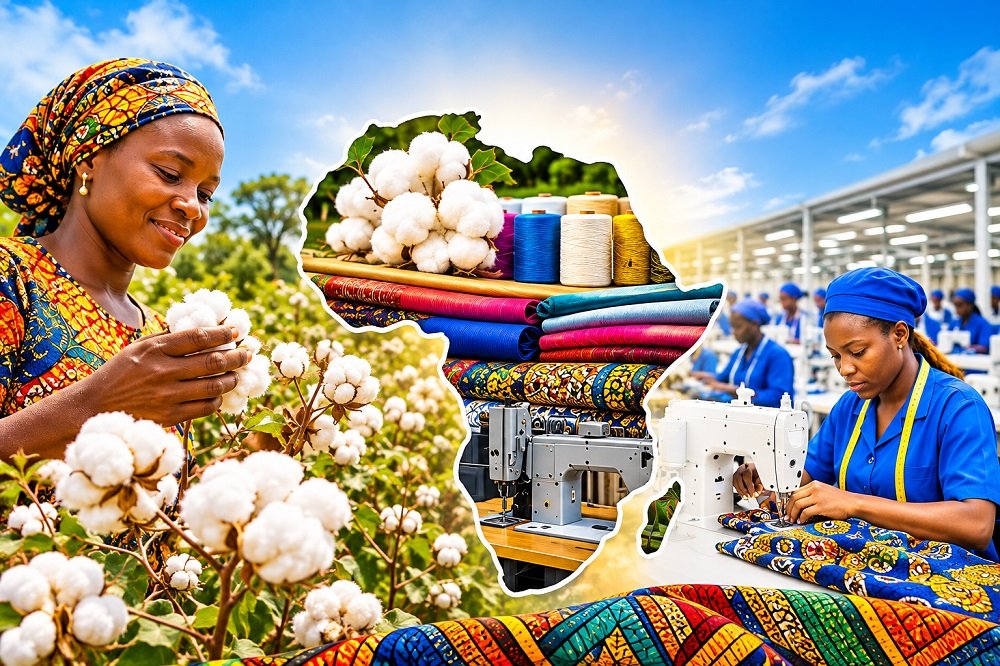
Africa is stepping up efforts to reverse one of the continent’s most persistent industrial and trade imbalances, with a new campaign seeking to transform its cotton economy from a largely raw-material export business into a fully integrated manufacturing industry capable of generating an estimated $34bn in annual gross domestic product (GDP).
The initiative, spearheaded by Africa Made It, comes amid renewed calls for African economies to move beyond the export of unprocessed commodities and build domestic manufacturing capacity that captures more value from their natural resources.
Launched at the Creative Africa Nexus (CANEX) recently in Lagos, Nigeria, the campaign, tagged Power, Protect and Purchase, is targeting structural weaknesses in Africa’s cotton-to-garment value chain, where the continent produces substantial quantities of raw cotton but remains heavily dependent on imported textiles and finished apparel.
Africa exports as much as 98 per cent of its raw cotton overseas, retaining only about two per cent of the total value generated from the commodity, according to research cited by Africa Practice. The continent also incurs an estimated $35 billion annual trade deficit associated with the cotton and textile value chain.
For Africa Made It, the challenge is therefore no longer simply about increasing cotton production or expanding agricultural output. It is about retaining the economic value generated from cotton through local processing, manufacturing, distribution and retail.
The organisation estimates that developing the continent’s capacity to spin, weave and manufacture garments from locally produced cotton could contribute approximately $34 billion annually to African GDP, generate nearly two million permanent industrial jobs and inject about $33 billion directly into domestic household incomes.
These projections place the cotton industry at the centre of a debate about Africa’s industrial sovereignty, particularly as governments seek new sources of employment, foreign exchange earnings and economic diversification beyond extractive industries.
The campaign is also calling for approximately $1.8bn in capital allocation towards critical infrastructure and structural enablers required to establish a competitive fibre-to-fashion ecosystem across the continent.
Rather than treating cotton farming, textile production and garment manufacturing as separate economic activities, the initiative is advocating an integrated industrial model in which value is created and retained at every stage of the production chain.
The missing industrial middle
Africa’s cotton economy showcases the structural weakness of the continent’s manufacturing sector.
Cotton farming is established across several African countries, supporting smallholder farmers and rural communities. However, the absence of adequate processing facilities, textile mills and garment factories has limited the capacity of many producing countries to capture the full economic benefits of the commodity.
The traditional production chain begins with farmers cultivating cotton, followed by harvesting and ginning, where seeds are separated from the fibres. The lint is subsequently processed through spinning into yarn, weaving or knitting into fabric, and eventually converted into garments and other textile products.
Each stage generates additional economic value, employment opportunities and business activity.
Yet, where domestic processing capacity is inadequate, raw cotton is exported to countries with established textile industries, processed into fabrics and garments, and subsequently sold back into African markets.
This creates a situation in which African economies bear the costs of producing the raw materials but surrender much of the higher-value manufacturing activity, industrial employment and commercial margins to overseas producers.
Africa Made It believes closing this gap could fundamentally change the continent’s position in the global textile and apparel market.
Marie Wilke, the initiative’s editor-in-chief,argued that Africa’s growing cultural influence in fashion and creative industries has not translated into corresponding economic returns because the continent lacks the manufacturing infrastructure needed to support its creative potential.
“African culture, design, and storytelling influence global fashion, music, and media like never before. Yet, without domestic manufacturing infrastructure, Africa’s creative authority yields very little economic return,” Wilke said.
She explained that connecting cotton production directly to local processing would ensure that intellectual property, commercial margins and industrial employment remain within African economies.
Why the $1.8bn investment matters
The proposed $1.8bn capital allocation is central to the campaign’s ambition, reflecting the infrastructure-intensive nature of textile manufacturing.
Unlike agricultural production, which can be expanded through access to land, seeds, fertilisers and farm machinery, industrial textile processing requires substantial investments in machinery, electricity, water supply, industrial facilities, logistics and technical expertise.
Power supply is particularly important. Spinning, weaving and garment production require reliable electricity to sustain machinery, maintain production schedules and meet the quality requirements of domestic and international buyers.
For African manufacturers operating in countries with high energy costs and unreliable electricity supplies, power infrastructure can determine whether locally produced textiles are commercially competitive against imported alternatives.
This is why Africa Made It has placed affordable industrial energy at the centre of its Power, Protect and Purchase campaign.
The initiative argues that without competitive energy costs, investments in textile factories could struggle to achieve the economies of scale required to compete in regional and international markets.
The protection pillar addresses another major concern: competition from imported finished garments and textiles.
African manufacturers frequently face pressure from cheaper imported products, including goods that may benefit from larger production economies, established supply chains and, in some cases, unfair pricing practices.
The third pillar, purchase, recognises that manufacturing capacity alone cannot guarantee industrial success.
Domestic textile and garment producers need reliable markets for their products. Consumers, retailers, fashion houses, public institutions and corporate buyers must be willing to support locally manufactured apparel.
Without sufficient demand, new factories could face low capacity utilisation, weak cash flows and difficulties servicing investment capital.
The campaign therefore seeks to connect industrial policy with consumer behaviour, positioning the purchase of African-made clothing as an economic decision with implications for employment, domestic investment and industrial development.
Nigeria’s textile revival becomes a critical test
For Nigeria, the campaign presents an opportunity to revisit an industrial sector that once played a significant role in the country’s manufacturing economy.
Before the oil boom of the 1970s, cotton was an important agricultural commodity, while textile manufacturing supported a substantial network of industrial establishments and employment across the country.
The decline of domestic textile production, however, weakened the relationship between cotton farmers and manufacturers.
The closure and reduced operations of textile mills, inadequate investment in processing infrastructure, high production costs and growing competition from imported fabrics and garments contributed to the erosion of the industry.
As local demand became increasingly dependent on imported textile products, the commercial incentive for farmers to maintain cotton cultivation also weakened.
The consequences extended beyond manufacturing to agriculture, as farmers lost access to reliable industrial buyers for their produce.
This is one of the structural problems that industry stakeholders now want to address through backward integration.
Nola Ade, managing director of House of Dockers Integrated Services and National Coordinator for the Cotton Cooperative Society in Nigeria, has argued that rebuilding the cotton economy requires a coordinated approach that begins with the seed and extends to finished garments.
Nigeria also has agricultural advantages that could support the recovery of the sector.
The country’s cotton-producing areas possess considerable potential, while its long-staple cotton varieties have been identified by industry stakeholders as having the quality characteristics to compete with premium cotton varieties from established producing countries.
Ade has also highlighted the need for financing mechanisms that reach genuine farmers, particularly through engagements involving the Federal Ministry of Industry, Trade and Investment and the Bank of Agriculture.
Access to affordable financing is essential because cotton farming requires investment in quality seeds, land preparation, labour, farm inputs, harvesting and post-harvest handling.
Without predictable access to finance, farmers may be unable to expand production or meet the quality and volume requirements of industrial processors.
Another challenge is to rebuild confidence across the entire value chain.
Farmers need assurances that their cotton will be purchased at commercially viable prices. Ginners need sufficient volumes to justify investment in processing equipment. Textile mills require reliable supplies of quality lint, while garment manufacturers need competitively priced fabrics and access to large consumer markets.
This interconnectedness means that the revival of any single segment cannot guarantee the success of the industry.
Omowumi Helen Oduyemi, a farmer and agribusiness advocate, has similarly argued that large-scale cotton production could stimulate economic growth across Nigeria’s Southwest if supported by modern agricultural practices and stronger value-chain infrastructure.
She noted that the region once played a significant role in cotton production, but the collapse of processing facilities and weak connections between agriculture and manufacturing discouraged many farmers from continuing cultivation.
The absence of functional ginneries and processing facilities, she explained, reduced farmers’ confidence in cotton as a commercially attractive crop, prompting some to move into other agricultural activities.
The employment and gender dividend
Beyond its contribution to industrial output, the proposed transformation could have significant implications for employment, household incomes and poverty reduction.
Africa Made It estimates that developing domestic cotton processing and garment manufacturing capacity could sustain nearly two million permanent industrial jobs.
The employment potential is particularly important given the labour-intensive nature of garment production, which can create opportunities for workers with different levels of formal education and technical expertise.
Garment factories require operators, machine technicians, pattern makers, quality-control personnel, production supervisors, designers, packaging workers and logistics professionals.
The expansion of the industry could also stimulate employment in supporting businesses, including transport, warehousing, equipment maintenance, agricultural input distribution and retail.
A global market that Africa cannot ignore
The global cotton industry provides a substantial market opportunity for African producers and manufacturers.
The Food and Agriculture Organisation estimates that approximately 24 million farmers grow cotton globally, supporting about 125 million jobs across the value chain.
Global cotton production is estimated at approximately 26 million tonnes, with cotton remaining one of the world’s most important natural textile fibres.
Countries such as China, India and Brazil have established significant positions in cotton production and textile manufacturing, supported by extensive processing infrastructure, industrial investment and integrated supply chains.
Their experience showcases that agricultural production alone does not determine competitiveness in the global cotton economy.
The ability to process raw materials efficiently, manufacture quality textiles and deliver finished products at competitive prices is equally important.
For Africa, developing this capacity could strengthen the continent’s participation in international apparel trade while reducing dependence on imported finished goods.
The African Continental Free Trade Area (AfCFTA) also provides an opportunity to expand the market available to manufacturers by strengthening intra-African trade and encouraging regional production networks.
Rather than requiring every country to establish an entire textile value chain independently, African economies could develop complementary industrial capabilities.
One country could specialise in cotton cultivation and ginning, another in spinning and weaving, while others concentrate on garment manufacturing, finishing, design and distribution.
Such regional specialisation could create economies of scale and reduce the cost of building individual national production systems.
However, this would require greater coordination of customs procedures, rules of origin, product standards, infrastructure development and cross-border trade policies.
It would also require governments to address persistent barriers to industrial competitiveness, including expensive logistics, inadequate transport infrastructure, inconsistent regulations and limited access to long-term industrial financing.