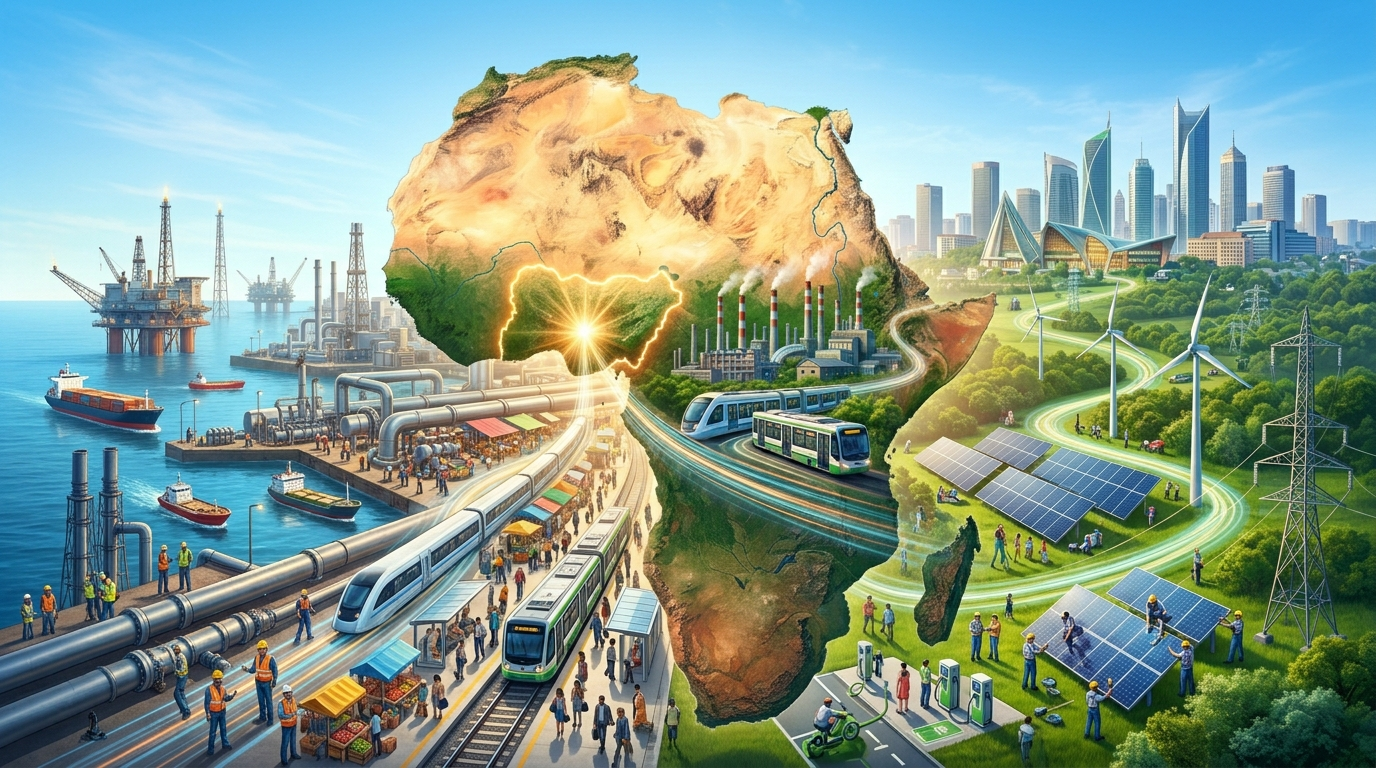
The global energy transition is entering a more complicated phase, one in which the ambition to decarbonise the world economy increasingly competes with the realities of energy security, affordability, industrial development and geopolitical rivalry.
While governments and energy companies continue to invest in renewable energy, electrification and low-carbon technologies, oil and natural gas remain integral to the global energy system. Their future, however, will increasingly depend on changing consumption patterns, investment economics and the pace at which alternative energy sources become commercially competitive.
This is the central message of the TotalEnergies Energy Outlook 2026, which examines possible developments in the global energy system through 2060.
The report presents three scenarios – Trends, Momentum and Rupture – reflecting different assumptions about government climate policies, technological progress, international cooperation and the speed of energy transformation.
For Africa, the projections raise an important economic question. While developed economies are increasingly focused on replacing existing energy systems, much of the continent is still struggling to provide sufficient and affordable electricity for households, businesses and industries.
For Nigeria, the challenge is even more complicated. The country depends substantially on petroleum-related earnings but possesses considerable natural gas resources and renewable energy potential. Yet persistent electricity shortages, infrastructure constraints and weak domestic industrial capacity continue to limit the economic benefits of its energy endowment.
The emerging challenge is therefore not simply how to prepare for a world with less dependence on fossil fuels. It is how to transform existing energy resources into productive economic assets before global markets and investment priorities change further.
The global energy transition: A longer journey than anticipated
TotalEnergies’ three scenarios offer different perspectives on how the global energy system could evolve over the next 34 years.
The Trends scenario assumes that existing public policies, technological developments and consumer behaviour largely continue along their present trajectories.
Momentum assumes stronger decarbonisation efforts, while Rupture considers a more ambitious pathway towards limiting global warming to below 2°C, requiring substantially greater international cooperation.
The distinction between the scenarios is significant.
Under Trends, global demand for petroleum products is expected to increase and reach a plateau during the 2030s before beginning a gradual decline. Natural gas demand is projected to continue growing before stabilising in the 2040s.
The scenario also anticipates that fossil fuels will retain a substantial position in the global primary energy mix, even as renewables and electrification expand.
However, this should not be interpreted as evidence that the energy transition is losing momentum.
Rather, it illustrates the difficulty of transforming an energy system that supports transportation, manufacturing, electricity generation, agriculture and international trade.
The report also highlights the consequences of insufficient climate action. Its Trends scenario projects global warming of approximately 2.6–2.8°C by 2100, while Momentum projects 2.3–2.4°C. The more ambitious Rupture scenario produces a lower projected warming range of 1.8–1.9°C.
These are scenario outcomes, not guaranteed forecasts.
The commercial implication is that oil and gas producers may continue to find markets for their products, but the nature of competition will change. Production costs, operational efficiency, emissions intensity and access to capital will increasingly determine which projects remain attractive.
For Nigeria, this distinction is particularly important. The country cannot assume that the continued relevance of oil and gas translates automatically into guaranteed future export earnings.
Electricity becomes the next major energy battleground
One of the strongest messages from the outlook is the growing importance of electricity in the global economy.
Electrification is extending beyond conventional household and industrial applications into transportation, heating, manufacturing and digital infrastructure.
Artificial intelligence and data centres are also creating additional demand for reliable electricity.
This is changing the structure of global energy investment.
Competition is increasingly moving beyond the ownership of petroleum reserves towards the ability to generate, transmit, store and distribute electricity efficiently.
Solar power, wind energy, batteries, nuclear power and other low-carbon technologies are becoming increasingly important components of national energy strategies.
China’s position in clean-energy manufacturing illustrates the scale of this transformation. Its integrated industrial ecosystem gives it significant influence across solar panels, batteries and other technologies required for electrification.
For developing economies, the challenge is to avoid becoming merely consumers of technologies manufactured elsewhere.
Africa, in particular, must consider how its mineral resources, renewable energy potential and emerging electricity markets can support industrial development.
The transition could create new opportunities for manufacturing, mineral processing, electricity trading and regional infrastructure development. But without deliberate industrial policies, much of the value could continue to accrue outside the continent.
Africa’s energy access crisis changes the transition debate
Africa’s energy transition cannot be assessed solely through the lens of carbon reduction.
The continent faces an enormous electricity access deficit that distinguishes its development circumstances from those of more industrialised economies.
The International Energy Agency’s 2025 report, Financing Electricity Access in Africa, estimates that nearly 600 million people across the continent lack access to electricity.
The IEA’s subsequent 2026 energy access assessment places the number of people without electricity in sub-Saharan Africa above 560 million, underscoring the scale of the challenge.
This is not simply an infrastructure problem. It is a development constraint affecting education, healthcare, manufacturing, agriculture and the competitiveness of African businesses.
The situation creates a difficult policy balance.
African governments must expand electricity access, support industrialisation and attract investment while responding to international climate commitments.
For countries with significant natural gas reserves, gas can provide an important source of dispatchable electricity and industrial feedstock, alongside renewable energy.
However, this argument requires economic discipline.
Gas projects involve substantial capital expenditure, infrastructure requirements and long investment horizons. Their commercial viability must be assessed against future demand, competing technologies, environmental obligations and the possibility of changing international financing conditions.
Renewable energy, meanwhile, offers opportunities to expand electricity access through grid-connected solar installations, mini-grids and stand-alone systems.
The most effective strategy is unlikely to be a uniform technology prescription for every African country.
Instead, national energy strategies should reflect resource availability, infrastructure requirements, affordability and the development priorities of individual economies.
The financing question: Why Africa could lose the investment race
Even where the economic case for energy investment is strong, African countries face a significant disadvantage in the cost of financing.
The OECD’s Africa’s Development Dynamics 2025 estimates the weighted average cost of capital for infrastructure projects in Africa at approximately 13 per cent, compared with 10 per cent in developing Asia and 8 per cent in OECD economies.
This difference has direct consequences for energy development.
Higher financing costs can make renewable electricity projects, transmission infrastructure and industrial investments more expensive, reducing their competitiveness and delaying implementation.
The problem is particularly important for solar and wind projects, whose economics depend heavily on initial capital expenditure.
It also helps explain why Africa’s abundant renewable energy resources have not automatically translated into large-scale deployment.
The continent needs more than international declarations of support. It requires financing structures that reduce currency risks, improve access to long-term capital and attract private investors without placing unsustainable obligations on governments.
Development finance institutions, commercial banks, pension funds and institutional investors all have roles to play.
Regional electricity markets and infrastructure partnerships could also help create larger investment opportunities and improve project economics.
For African governments, the priority should be to establish transparent regulatory frameworks, credible power-purchase arrangements and predictable investment conditions.
Without these, the continent risks entering the next phase of global energy competition with substantial resources but inadequate financial capacity to exploit them.
Nigeria’s petroleum advantage: An opportunity with a shrinking margin for complacency
Nigeria occupies a strategic position in Africa’s energy landscape, but its petroleum advantage must be understood against the changing structure of global demand.
The country continues to depend on oil and gas for export earnings and public revenue. Yet its ability to translate these resources into sustained economic development has been constrained by production challenges, inadequate infrastructure, insecurity and investment uncertainty.
There are, nevertheless, signs of improvement in upstream performance.
According to the Nigerian Upstream Petroleum Regulatory Commission, Nigeria’s average crude oil production, excluding condensates, reached 1.53 million barrels per day in September 2026.
The regulator reported that the country had met or exceeded its OPEC production quota for five consecutive months, reflecting improvements in production stability and crude evacuation.
The same September report recorded a peak single-day production level of 1.84 million barrels, including condensates.
These figures indicate an improving production environment, although sustained performance will depend on continued investment, operational efficiency, security and infrastructure reliability.
Nigeria’s petroleum reserves also remain substantial.
The NUPRC’s official reserves position as of January 1, 2026, places the country’s combined crude oil and condensate reserves at 37.01 billion barrels and natural gas reserves at 215.19 trillion cubic feet.
The gas figure is particularly significant because it reinforces Nigeria’s potential to participate in a global energy market that will continue to require natural gas for decades under some of the scenarios examined by TotalEnergies.
But reserves should not be confused with economic output.
The value of petroleum resources depends on the country’s ability to produce them competitively, process them efficiently and generate sufficient domestic and export revenues.
This is where Nigeria’s energy strategy requires a stronger focus on value addition.
Oil revenue remains important, but diversification is becoming more urgent
Nigeria’s fiscal dependence on petroleum makes the future of global energy markets a matter of national economic security.
The World Bank’s April 2026 Nigeria Development Update provides an important perspective on the country’s revenue structure.
Its data show that gross Federation Account revenues increased from N29.451 trillion in 2024 to N37.443 trillion in 2025.
Oil and gas revenues contributed N14.574 trillion in 2025, compared with N13.044 trillion in 2024.
The figures demonstrate that petroleum remains a major contributor to public finances, even as non-oil revenues have become increasingly important.
The World Bank data also show that non-oil and gas revenues rose to N22.869 trillion in 2025 from N16.407 trillion in 2024.
This is an important development for Nigeria’s fiscal resilience.
However, the figures should not be interpreted as evidence that the economy has already escaped its dependence on hydrocarbons. Oil and gas remain central to export earnings, foreign exchange availability and the wider economic environment.
The Central Bank of Nigeria’s second-quarter 2025 economic report, for example, showed that crude oil, gas and refined petroleum products accounted for 84.23 percent of merchandise export earnings during the quarter.
This illustrates the continuing concentration of Nigeria’s export structure.
The policy implication is clear: Nigeria needs to use its petroleum earnings to build a broader productive economy rather than perpetuate a system in which public finances and external stability remain highly exposed to commodity-market movements.
A more diversified export base, stronger manufacturing capacity and competitive agricultural and industrial sectors are essential to reducing this vulnerability.
Natural gas: The opportunity Nigeria cannot afford to waste
If oil provides Nigeria with an established source of export revenue, natural gas could provide a stronger foundation for domestic industrialisation.
The country’s 215.19 trillion cubic feet of proven gas reserves represent a considerable resource advantage.
However, the central challenge is not simply how much gas remains underground. It is how efficiently Nigeria can develop the infrastructure and commercial arrangements required to deliver it to the market.
Gas shortages continue to affect electricity generation, while inadequate pipeline infrastructure and weak commercial arrangements limit domestic utilisation.
This represents a significant economic contradiction: a country with substantial gas reserves still struggles to provide reliable electricity to businesses and households.
The opportunity extends beyond power generation.
Natural gas can support fertiliser production, petrochemicals, methanol, ammonia and other industrial applications.
It can also provide feedstock for manufacturing and support the development of industries that require reliable and competitively priced energy.
The expansion of the Dangote Refinery and other domestic refining investments provides an additional opportunity to deepen the country’s downstream industrial capacity.
But refining should not become the endpoint of Nigeria’s industrial ambition.
The greater opportunity lies in building integrated value chains that connect petroleum production with petrochemicals, fertilisers, manufacturing, logistics and export-oriented industries.
For this to happen, Nigeria needs predictable gas pricing, reliable supply obligations, commercially viable pipelines, adequate processing infrastructure and credible payment arrangements.
The government must also ensure that gas investment decisions take account of the changing global energy landscape.
Natural gas can support the transition, but it is not automatically a low-risk investment. Long-lived projects must be evaluated against the possibility of slower demand growth, methane emissions regulation and competition from renewable electricity and storage technologies.
The objective should be to develop gas assets that deliver economic value within realistic investment and demand horizons.
Electricity remains Nigeria’s most immediate industrial constraint
The biggest contradiction in Nigeria’s energy economy is that its substantial petroleum resources have not translated into an electricity system capable of supporting its industrial ambitions.
The Nigerian Electricity Regulatory Commission’s 2025 quarterly reporting illustrates the scale of the infrastructure challenge.
In the first quarter of 2025, the average available generation capacity of the country’s grid-connected power plants was approximately 5,366.88 megawatts.
By the fourth quarter, NERC reported average available generation capacity of approximately 5,400.38 megawatts.
Although this indicates a slight improvement over the first quarter, it remains a modest electricity supply base for a country with Nigeria’s population and industrial ambitions.
The problem is not simply the number of installed power plants.
Gas supply constraints, inadequate transmission infrastructure, distribution bottlenecks, maintenance challenges and weaknesses in the electricity market all affect the amount of electricity ultimately delivered to consumers.
The consequences are significant.
Manufacturers and other businesses frequently incur additional costs through self-generation, while households face unreliable supply and increased energy expenditure.
This undermines competitiveness and limits the country’s ability to attract energy-intensive industrial investment.
Nigeria therefore needs to treat electricity infrastructure as a strategic economic priority.
Gas-fired generation will remain important, but it must be complemented by investments in solar power, hydroelectricity, battery storage, transmission and distribution networks.
The Electricity Act 2023 provides an institutional framework for a more decentralised electricity market, creating opportunities for state governments and private investors to develop additional generation and distribution capacity.
The challenge is to translate these regulatory opportunities into actual electricity supply improvements.
Renewable energy and battery storage: A new investment frontier
Nigeria’s renewable energy potential offers another opportunity to address its electricity deficit.
Solar power is particularly attractive because of the country’s geographical conditions and the growing demand for alternative electricity solutions.
Commercial and industrial consumers could benefit from solar installations supported by battery storage, reducing dependence on expensive diesel generation and improving the reliability of electricity supply.
Mini-grids and stand-alone solar systems also offer opportunities to extend electricity access to communities that are difficult to connect economically to the national grid.
The investment case is increasingly relevant as battery technology improves and distributed energy solutions become more commercially accessible.
However, the expansion of renewable energy will depend on financing, equipment availability, technical capacity and appropriate regulatory arrangements.
There is also a need to build domestic capabilities in installation, maintenance, energy management and component supply.
Otherwise, Nigeria could develop a growing renewable energy market without securing significant domestic industrial benefits.
This is where the country’s energy transition policy should be linked more directly to manufacturing and skills development.
The Dangote factor and the changing economics of domestic refining
Nigeria’s expanding refining capacity introduces another dimension to the energy outlook.
The Dangote Refinery represents a major development in the country’s downstream petroleum industry, with implications for domestic fuel supply, imports, foreign exchange demand and regional petroleum product trade.
Its commercial significance extends beyond the production of refined fuels.
A functioning domestic refining industry could create opportunities for petrochemical development, industrial feedstock production and supporting manufacturing businesses.
However, refining profitability will depend on crude supply arrangements, feedstock costs, product demand, financing, operational efficiency and competition from international refiners.
Nigeria must also avoid confusing increased domestic refining capacity with complete energy independence.
The long-term competitiveness of the sector will depend on its ability to operate efficiently, access suitable crude grades and supply products at prices that remain commercially sustainable.
More importantly, the country should use the development of its refining industry as a platform for deeper industrial integration rather than simply replacing imports with locally processed petroleum products.
The critical minerals question: Will Africa manufacture the technologies of the future?
The energy transition is also creating demand for minerals required in batteries, electric vehicles, electricity networks and renewable energy equipment.
Africa possesses significant resources of minerals such as cobalt, lithium, copper and graphite.
These resources could provide the foundation for new industrial opportunities as global demand for energy storage and electrification technologies increases.
But the continent must avoid repeating the historical pattern in which raw materials are extracted locally while the higher-value processing and manufacturing activities take place elsewhere.
For Nigeria, the opportunity lies in developing credible mineral-processing and industrial policies while recognising that successful battery manufacturing requires more than access to mineral deposits.
It requires technical expertise, reliable electricity, financing, infrastructure, specialised supply chains and access to markets.
The country should therefore pursue selective industrial opportunities where it can establish commercially competitive value chains, rather than make unrealistic promises about immediate dominance in global battery manufacturing.
The wider African opportunity is to use regional cooperation to develop processing facilities, manufacturing partnerships and integrated supply chains.
The African Continental Free Trade Area could support this ambition by improving market access and encouraging regional industrial collaboration.
What Nigeria must do differently
The implications of TotalEnergies’ outlook point to several priorities for Nigeria’s energy and economic policymakers.
First, the country must sustain improvements in oil and gas production while strengthening the commercial environment for long-term investment.
This means addressing operational disruptions, improving infrastructure security, reducing project delays and ensuring predictable regulatory conditions.
Second, gas development must be connected directly to industrial policy.
Investment in gas production and processing should support electricity generation, fertiliser production, petrochemicals and manufacturing rather than remain concentrated on resource extraction.
Third, electricity reform must move beyond policy announcements.
The country needs stronger transmission and distribution networks, improved generation availability, financially sustainable market arrangements and greater private-sector participation.
Fourth, renewable energy investment should be accelerated through commercially viable projects, particularly in distributed generation and battery storage.
Fifth, Nigeria must strengthen its non-oil export base and reduce the fiscal vulnerability associated with international petroleum-market volatility.
Finally, the country needs a financing strategy capable of attracting domestic and international capital into energy infrastructure and industrial development.
These priorities are interconnected. Without reliable electricity, manufacturing cannot expand competitively. Without industrial development, energy resources will continue to generate less domestic value than they potentially could. Without a stronger fiscal base, governments will struggle to finance the infrastructure required for long-term economic transformation.
The investment question: Where will the next wave of value emerge?
For investors, the energy outlook suggests that opportunities will increasingly extend across the entire energy value chain.
Traditional upstream oil and gas investments will remain relevant where projects offer competitive costs and credible returns.
However, opportunities are also emerging in gas processing, electricity generation, renewable energy, battery storage, transmission infrastructure, refining, petrochemicals and mineral processing.
In Nigeria, the strongest investment opportunities are likely to emerge where energy development addresses an identifiable economic constraint.
Gas infrastructure that supplies industrial consumers, electricity projects with credible payment structures, distributed solar systems serving commercial businesses and processing facilities linked to established mineral or agricultural value chains all offer potential.
The key consideration is commercial sustainability.
Investors will assess regulatory certainty, currency risks, infrastructure availability, market demand and the ability of projects to generate predictable returns.
For policymakers, this means creating an environment in which investment decisions are driven by transparent commercial conditions rather than changing administrative priorities.
Africa’s energy future will depend not only on its natural resources but also on its capacity to mobilise capital and deploy technology efficiently.
Beyond 2060: The real measure of energy leadership
TotalEnergies’ Energy Outlook 2026 offers a useful perspective on the competing forces shaping the global energy industry.
Its scenarios suggest that the transition will be gradual and uneven, with oil and gas remaining relevant even as electricity, renewables and low-carbon technologies gain greater prominence.
For Africa, the report reinforces the need for an energy strategy that recognises the continent’s development priorities and infrastructure realities.
For Nigeria, it presents an even more immediate challenge.
The country has oil, gas, solar resources and significant opportunities in refining and industrial development. What remains unresolved is its capacity to convert these advantages into reliable electricity, competitive manufacturing and sustainable economic growth.
The danger is not simply that global demand for fossil fuels could eventually decline.
It is that Nigeria could lose valuable opportunities to diversify its economy while concentrating too heavily on the export of commodities.
By 2060, energy leadership may be measured less by the size of a country’s petroleum reserves and more by its ability to generate affordable electricity, develop competitive industries, manufacture energy technologies and participate in emerging global value chains.
For Nigeria and Africa, the race is therefore not merely to adapt to the global energy transition.
It is to ensure that the transition becomes a platform for industrialisation, investment and economic independence rather than another chapter in the continent’s long history of resource dependence.