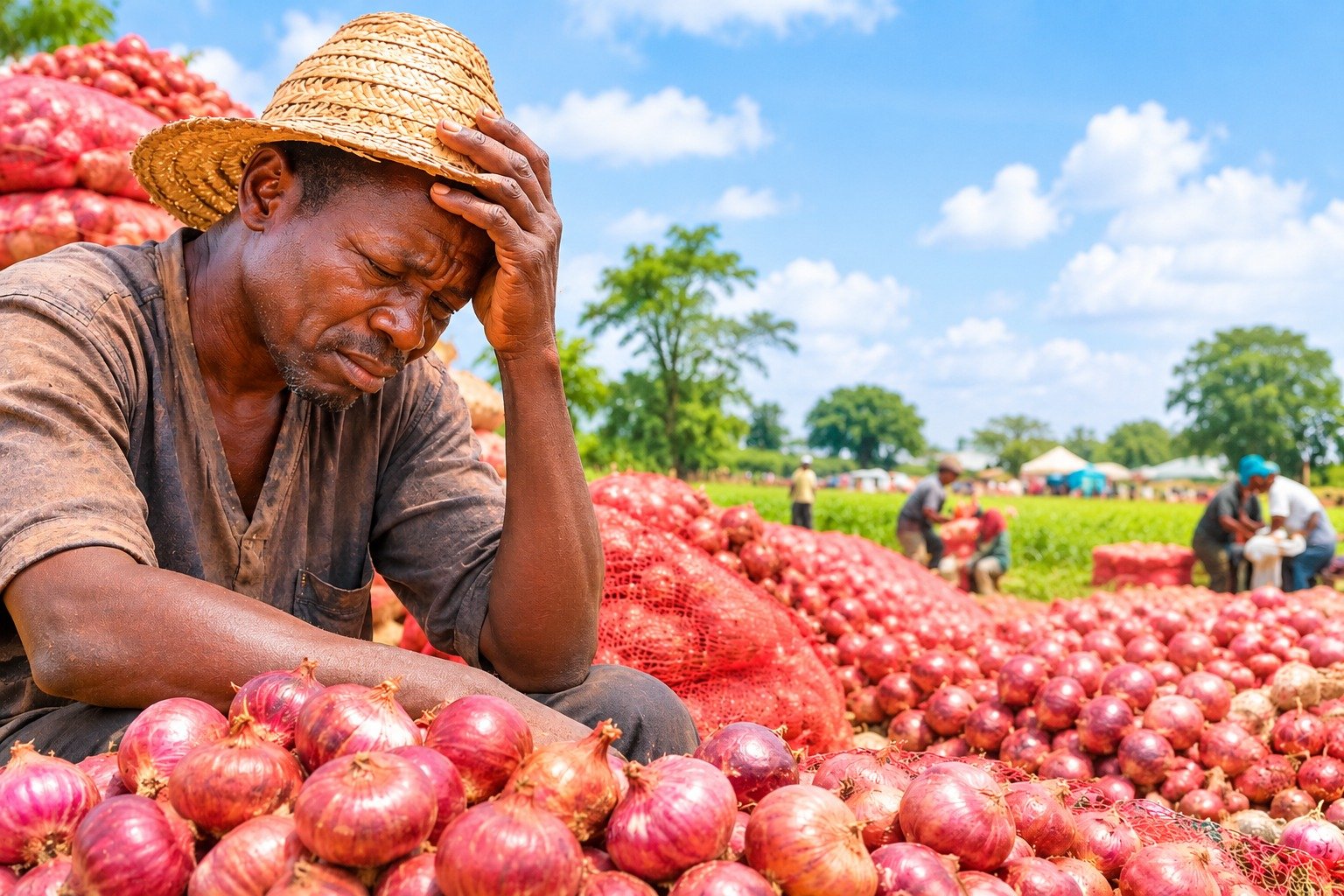
Onion farmers are increasingly exposed to a profitability crisis in which the cost of harvesting and marketing their produce can exceed the returns available from the market, creating supply risks that are now reflected in soaring consumer prices.
The price of a bag of onion, which sold for between N25,000 and N30,000 in April, has climbed to as high as N380,000 in Lagos, according to the National Onion Producers, Processors and Marketers Association of Nigeria (NOPPMAN). The association attributed the increase to a combination of reduced farm activity, post-harvest losses and disruptions at major aggregation centres.
The association estimates that Nigeria produces approximately 2.2 million metric tonnes of onions annually, enough, according to its president, Aliyu Maitasamu, to meet domestic demand. Yet more than half of that output is reportedly lost before it reaches the consumer, largely because of inadequate storage and processing facilities.
Maitasamu, who disclosed the situation during a television interview, said the current price movement reflected the consequences of poor returns to farmers during the previous production season, when some growers were unable to recover even the labour costs associated with harvesting their crops.
He said farmers had abandoned some onion farms last year because the market value of the produce was insufficient to cover harvesting expenses.
“Some onion farmers were abandoning their farms just because the value of the onion that they were going to harvest would not even pay the labour of harvesting that onion,” he said.
The experience shows that production decisions are influenced not only by the availability of land, seeds, fertiliser and water, but also by the likelihood that farmers will recover their costs when the crop is ready for the market.
When prices collapse during harvest periods, farmers may be unable to sell their produce at commercially viable rates. Where storage facilities are unavailable, they have limited ability to hold the crop until market conditions improve. For a perishable product such as onion, delaying sales without appropriate storage can simply increase the risk of further losses.
The consequence is that farmers can be discouraged from investing in subsequent production cycles, creating supply risks that become visible months later through higher prices.
The sharp increase in onion prices is drawing attention to a structural weakness in the agricultural value chain: Nigeria’s ability to produce food has not been matched by sufficient capacity to preserve its output and manage fluctuations in supply.
Maitasamu said more than 50 per cent of the country’s annual onion production was lost before reaching consumers, pointing to inadequate storage and processing facilities as major contributors to the problem.
Such losses represent more than a physical waste of agricultural produce. They also mean that land, labour, irrigation, seeds, fertiliser, crop protection chemicals and other production resources invested in growing the crop fail to generate their potential economic returns.
The scale of the reported losses also raises questions about the efficiency of Nigeria’s agricultural investment. If the country produces about 2.2 million metric tonnes of onions annually but loses more than half before consumption, increasing farm output alone may not deliver the expected improvement in food availability.
Instead, investment in storage, processing, transportation and market infrastructure could play an equally important role in improving the quantity of produce that reaches consumers.
The onion association president identified fire outbreaks at onion aggregation centres in Sokoto and Kano states as additional factors affecting supply. These centres serve an important role in bringing produce together for storage, trading and distribution, meaning that disruptions can affect the movement of onions from producing areas to major consumption markets.
The reported fire incidents have compounded the consequences of inadequate storage, adding another layer of vulnerability to a supply chain already struggling with insufficient preservation infrastructure.
Maitasamu said a report from Wadata Musa, the association’s vice chairman in charge of the onion section, showed that a bag of Goronyo onion was selling for N380,000 in Lagos, while Gada onion was selling for N370,000.
The association described the increase from April’s price range of N25,000 to N30,000 per bag as approximately 1,000 per cent.
The figures underline the exposure of consumers and businesses to volatility in a market where supply can be disrupted by production decisions, storage failures and incidents at aggregation points.
For food vendors, restaurants, processors and other businesses that depend on onions as a regular input, such price movements can translate into higher operating costs. Businesses may respond by adjusting prices, reducing the quantity used or absorbing part of the increase through lower margins.
Households also face the possibility of higher food expenditure as the cost of a widely used cooking ingredient rises.
Storage capacity falls short of production needs
The shortage of storage infrastructure is emerging as one of the most important constraints on the commercial development of Nigeria’s onion industry.
Maitasamu said Kano, one of the country’s major onion-producing and trading locations, had storage capacity of only about 10,000 metric tonnes.
Against annual national production estimated at 2.2 million metric tonnes, the figure highlights the limited scale of the storage capacity identified by the association.
The association president said a new facility being developed in Sokoto by the Ministry of Finance Incorporated and a private firm was expected to provide additional storage capacity.
The first phase of the project is expected to accommodate about 500 metric tonnes.
While the facility could contribute to improving preservation capacity, its initial storage volume remains modest relative to the scale of the country’s annual onion production. Its wider impact will therefore depend on whether further phases are developed and whether similar investments are made across other production and aggregation centres.
Maitasamu called for increased investment in storage and processing facilities, arguing that the development of onion flakes, powder and paste could help reduce losses and create additional commercial opportunities for the sector.
Rising production costs threaten farmers’ investment decisions
The supply crisis is also being reinforced by the rising cost of producing onions, particularly the cost of irrigation.
Maitasamu said fuel expenses were putting considerable pressure on smallholder farmers, explaining that fuel worth N30,000 could not power his irrigation pumping machine for a full day.
By contrast, he said converting the machine to gas would allow the same amount of money to last approximately three days.
The challenge is particularly important for smallholders, who may have limited access to affordable financing and may be unable to invest in more efficient irrigation equipment.
Higher production costs also increase the minimum price farmers need to receive to make cultivation worthwhile. When market prices fall below that threshold, farmers face the possibility of operating at a loss.
Maitasamu said production inputs for one hectare of onion cost about N1.08 million under the Bank of Agriculture’s EOP arrangement, excluding labour, services and fuel.
He put the average yield at approximately 24 metric tonnes per hectare.
Government intervention and the challenge of price stability
Maitasamu said the absence of government intervention to guarantee farmers minimum returns when market prices fell below production costs had contributed to the difficulties experienced by growers.
A policy framework that addresses only production may leave these problems unresolved. More attention would need to be given to post-harvest management, market coordination, access to finance, storage investment and mechanisms that reduce the exposure of producers to severe price fluctuations.
The association president said the Ministry of Agriculture had contacted NOPPMAN to obtain information on the inputs required for the next production cycle, indicating that discussions on government support were under way.
He said farmers needed seeds, fertiliser and crop protection chemicals in November to enable them to establish nurseries and transplant in December.
According to him, onions require approximately 90 days in the field and low temperatures during December, January and February to develop properly, while rising temperatures in March could affect bulb formation.
The timing of input delivery is therefore considered important to the success of the next production cycle. Delays could affect farmers’ ability to establish nurseries and transplant within the appropriate seasonal window.
The association is also seeking increased government investment and subsidies to reduce production costs.
Maitasamu argued that food security should be treated as a national security priority, saying: “The greatest weapon to security in any country is food.”