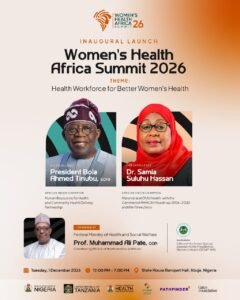
Nigeria and Tanzania are stepping up efforts to reposition women’s healthcare as an economic development and investment priority, with both countries set to co-host the inaugural Women’s Health Africa Summit (WHAS) 2026 in Abuja on December 1.
The summit, scheduled to hold at the State House Banquet Hall, is expected to bring together approximately 300 high-level participants, including heads of state, first ladies, health and finance ministers, African Union (AU) officials, development finance institutions, philanthropists and health innovators.
Held under the theme, “Health Workforce for Better Women’s Health,” the gathering is designed to move Africa’s women’s health agenda beyond political declarations towards concrete financing commitments, stronger healthcare delivery systems and measurable implementation outcomes.
The initiative reflects growing recognition that persistent gaps in women’s healthcare have implications beyond public health, affecting labour productivity, household incomes, economic resilience and the continent’s long-term development prospects.
Unlike programmes that focus predominantly on maternal and reproductive health, WHAS is positioning women’s health across the entire life course as a development and economic priority. Its agenda covers maternal, reproductive and gynaecological health, noncommunicable diseases and menopause.
The summit comes against the backdrop of renewed continental efforts to strengthen health systems, address shortages of skilled healthcare professionals and improve access to quality healthcare, particularly for women and girls.
Nigeria, as founding convener, is bringing its political leadership and health workforce agenda to the initiative, while Tanzania is contributing its continental mandate on maternal and child health. The partnership links two AU champion-led priorities in an attempt to improve coordination between political leadership, workforce investment, sustainable financing and frontline healthcare delivery.
President Bola Ahmed Tinubu, who serves as AU Champion for Human Resources for Health and Community Health Delivery Partnership, provides the Nigerian political framework for the initiative. The summit is anchored nationally in the Federal Ministry of Health and Social Welfare, led by Coordinating Minister Muhammad Ali Pate, with presidential facilitation through the Office of the Senior Special Assistant to the President on Women’s Health.
Tanzania’s participation is anchored on President Samia Suluhu Hassan’s AU Champion mandate for Maternal and Child Health, particularly the Continental Roadmap on Reproductive, Maternal, Newborn, Child and Adolescent Health (RMNCAH) 2026-2030.
The roadmap is built around three targets: zero home delivery, zero preventable maternal and newborn deaths, and zero unvaccinated children.
Speaking ahead of the summit, Pate said the platform would provide an opportunity for African leaders, practitioners, academics, advocates and financiers to identify gaps, mobilise resources and strengthen collaboration across countries.
He stressed that African governments must take ownership of their health priorities rather than depend exclusively on external leadership or financing.
“Ultimately, responsibility lies with us as leaders on the continent. We must take ownership of our health priorities,” Pate stated.
Ummy Ally Mwalimu, Special Adviser to President Samia Suluhu Hassan on Maternal and Child Health and head of the Secretariat of the AU Champion for Maternal and Child Health, said cooperation between the two countries’ AU champion mandates was essential to delivering measurable results.
She said the three-zero targets under the continental RMNCAH roadmap depended on competent and adequately supported frontline health workers, functional referral systems and effective community outreach.
Mwalimu identified coordinated investment in the health workforce, community health delivery, sustainable financing and accountability as critical to avoiding fragmented interventions and ensuring that continental commitments translate into country-level outcomes.
The summit’s emphasis on workforce development is particularly significant given the central role played by healthcare professionals in maternal and reproductive health services, specialist gynaecological care, early diagnosis and the management of noncommunicable diseases.
Beyond expanding the number of health workers, the initiative is expected to draw attention to the availability, distribution, training and support of frontline and specialist professionals needed to deliver quality care across different stages of women’s lives.
Pathfinder International, the summit’s lead technical partner, is supporting programme design, technical content development and strategic partnerships, while working to connect political leadership and financing with country-led implementation.
The organisation is also expected to support practical follow-up mechanisms beyond the summit, an important consideration for an initiative seeking to establish accountability rather than produce another set of continental declarations.
Adanna Steinacker, Senior Special Assistant to the President on Women’s Health, said the summit was intended to challenge the traditional treatment of women’s health as a secondary policy issue or one confined to a narrow phase of life.
She said bringing governments, capital and innovators together would help position women’s health as a core pillar of Africa’s social and economic future.
WHAS 2026 will be structured around three pillars: innovation, financing and delivery.
Under innovation, the discussions are expected to explore approaches capable of improving access, quality and efficiency in women’s healthcare. Financing will focus on mobilising public and institutional capital to support sustainable health programmes, while delivery will examine the workforce and systems required to translate investment into services.
A key expected outcome is an initial set of country and institutional commitments, including accelerated action on neglected gynaecological conditions.
The organisers also intend to establish an enduring framework for African-led collaboration and post-summit accountability, potentially giving the initiative a role beyond its inaugural gathering.
The December summit will be preceded by a Joint Roadmap Dialogue in Addis Ababa on November 24, 2026, with a Political and Delivery Dialogue scheduled as part of the Abuja programme on December 1.