MARKETING

As online platforms become cluttered with ads, marketers are challenged to find new ways to connect with their customers. One rising trend they should pay attention to is “influencer marketing,” or using the power of popular people to reach your target market, according to this opinion piece by Aprajita Jain, a brand marketing evangelist at Google.
You are in your mid-30s, single, sipping a coffee at your favorite coffee shop. Suddenly a stranger approaches your table and asks if he can sit with you. Instinctively drawing your purse a little closer, you make an excuse and leave. A month later your best friend tells you about someone she wants you to meet and gives you a very unbiased opinion on his virtues and vices. Knowing your friend has the best of intentions, you agree to meeting this person. As you walk into the restaurant you see the coffee shop guy sitting at a table waiting for you! This time your guard is down because you have the endorsement of someone you deeply trust.
Brands are learning from this real-life psychological hack. Instead of getting in your face with their own message about their greatness they are letting ‘influencers’ — people you trust — tell you why you should pay attention to their products and services through a voice that sounds far more authentic. The influencer is that mutual friend between a brand and their consumers. Influencers are well-connected. They are authoritative. They have active minds and they are trendsetters.
Why are influencers so much more effective for marketing than self-promotion by a company? Let’s examine the trifecta of good influencer marketing:
Attention equals currency. Influencer marketing allows targeted exposure to the right kind of consumer, one who is already interested in a category that you operate in and will likely pay attention. In a world where TV ads have become background noise and consumers are becoming immune to traditional digital advertising, being on-target is crucial. Just take a look at the rampant rise of ad blockers — last year alone, usage surged by 30% globally (PageFair 2017 Adblock Report). Only 6% of display ads are ever clicked on. Further proliferation of mobile phones, video content and social media, are turning influencers into constant companions of your audience. To get their attention, brands have to work with the people they listen to.
Creativity and organic content has become the expectation. Remember Jared Fogle, the ‘the Subway guy?’ He served as the brand’s spokesperson for 15 years until his fall from grace. Today, it is no longer enough to hire a spokesperson and have them endorse your brand. While there is some overlap between celebrity endorsements and influencer marketing campaigns, the latter are designed to speak to an existing community of highly engaged followers. Influencers are the masters of their niches, and have established a high level of trust and two-way communication with their followers. They know how to incorporate a brand’s products and services into content people are watching and they do it very seamlessly, instead of taking away attention from what they really want to watch. The reason their followers keep coming back to them is because they regularly offer new and creative content to them. Followers have come to expect that. Over are the days of hammering the same message into your consumers’ heads for months, maybe even years.
“Influencers are the masters of their niches, and have established a high level of trust and two-way communication with their followers.”
Social media has no prime time window — it is prime time. Any consumer behavior study worth its ink will tell you that consumers are shifting towards social at the cost of TV. While marketers chased prime time spots on TV in the past, social is prime time 24/7. The truth is, when a social media personality you follow day in and day out wears something, drinks something, shows you something, you pay attention to it. And the key word here is attention. How to win your customer’s attention is quickly changing, and the brands that fail to adapt are going to get left in the dust by their competitors.
In God we trust. Everyone else bring data. Why should you believe me when I say that influencer marketing is on the rise and more effective than many other popular marketing channels?
- A poll conducted by Tomoson found that 59% of marketers are planning to increase their influencer marketing budgets year-over-year. It is also the most cost-effective and fastest-growing online customer acquisition channel, outpacing organic search, paid search and email marketing.
- In an advertising landscape where returns on ad spend (ROAS) of $2 for every $1 spent are considered a success, influencer marketing delivers an average return of $6.50, with the top 13% of marketers making $20 or more.
- It’s not just about the quantity, quality matters too — 51% of marketers believe customers acquired through influencer marketing are of better quality because they spend more money and are more likely to spread the word to family and friends.
- According to a Think with Google study, 70% of teenage YouTube subscribers say they relate to YouTubers more than to traditional celebrities — and you can bet that is not just happening on YouTube.
Casey Neistat versus Jennifer Aniston for Emirates. This is the story of a brand that had a few hit videos last year — Emirates Airline. It launched a campaign to show off the airline’s luxurious amenities and decided to spend $5 million of their total $20 million budget to hire Hollywood actress Jennifer Aniston to play the part of world traveler. The company made a series of short ads for YouTube with her that did quite well. Here is one of the videos they made together, which debuted last October. To date, this video has more than 6 million views. Not bad at less than $1 per view.
However, let us compare the Aniston spot to this video. An incredibly smart person over at the Emirates marketing team decided to give mega-YouTuber/influencer Casey Neistat premiere status on their airline, for free. They didn’t ask anything in return but hoped that if he enjoyed his flight he would share it with his fans. And he did. Twice, in fact. In addition to this first video, he also (of his own accord) created a second video that to date has another 11.5 million views — 52 million views — for free. Find me a marketer who doesn’t love free advertising.
Casey caters to a younger audience but he is also a technology startup founder followed by many entrepreneurs aspiring to be the next Mark Zuckerberg or (Snap CEO) Evan Spiegel. While it’s hard to immediately measure the direct ROAS on a splashy campaign like this, Emirates had its brand featured in best-in-class media outlets such as GQ, Maxim, Adweek, Mashable and the Huffington Post. In addition to all the free press, the brand also got amplified on social media through Casey’s posts that received thousands of likes and retweets. Not only did Emirates raise awareness among a new demographic and received lots of free PR, they positioned their brand as forward-thinking and digital-first.
Pretty Little Thing, a fashion company built on pop-culture, created a global clothing and accessories brand mimicking what influencers and celebrities are wearing. In fact, while they closely work with influencers, they essentially have taken the influencer marketing model and flipped it on its head — which more and more companies are likely to follow. Instead of going to an influencer and asking them to make a certain piece of clothing popular, they watch what these influencers are already wearing and then create matching, cost-effective products. They boast a solid 1.9 million followers on Instagram and have rapidly expanded from shipping from 20 orders per week four years ago to more than 20,000 orders per day today. Last December, the founder sold a 66% stake of his holdings to a larger fashion brand for 3.3 million pounds sterling with revenue quickly approaching 20 million pounds.
‘My Tales of Whisky’
The most mind-boggling example of influencer success comes from beverages giant Diageo, the parent company of Scottish whiskey brands Lagavulin and Oban. One of its video spots was awarded a Shorty Award for Best Influencer Marketing Campaign for this video starring NBC’s “Parks and Recreation” TV sitcom star Nick Offerman. The one-shot video called “My Tales of Whisky” shows Offerman sitting by a crackling fireplace — called a yule log according to European Christmas tradition — ironically in complete silence, staring broodingly into the camera for 45 minutes, and occasionally savoring a sip of his drink. Thanks to the simple seasonal premise and Offerman’s unique brand, the video was a viral hit.
“According to a Think with Google study, 70% of teenage YouTube subscribers say they relate to YouTubers more than to traditional celebrities.”
On the day of launch, ‘yule log’ was a trending topic on Facebook and more than 175 stories were written about it, earning the brand a lot of free media mentions. As the campaign rapidly gained momentum in social conversations and got further amplified by streams through Sony, Tumblr and GoDaddy, the team behind it created a 10-hour loop for holiday gatherings. In the first two days alone, the video garnered 1.1 million YouTube views, growing to 2 million in just one week before any paid media was activated. The brand’s channel subscribers skyrocketed from 5,500 to 23,000.
Adding More Juice
Influencer marketing isn’t just for the big brands. It is quite popular because companies of any size can benefit from it. Naked Juice, a smaller juice and smoothie company that started in the 1980s in Santa Monica, Calif., collaborated with young influencer Beth Norton. They sought her out on Instagram to promote their juices and smoothies to people on the go, whether they are running errands or planning projects. They also entered the beauty, fashion, and health scene on Instagram with help from lifestyle blogger Kate La Vie, who shares sponsored posts featuring images of her daily outfits and beauty essentials — including a strategically placed Naked Juice in the mix.
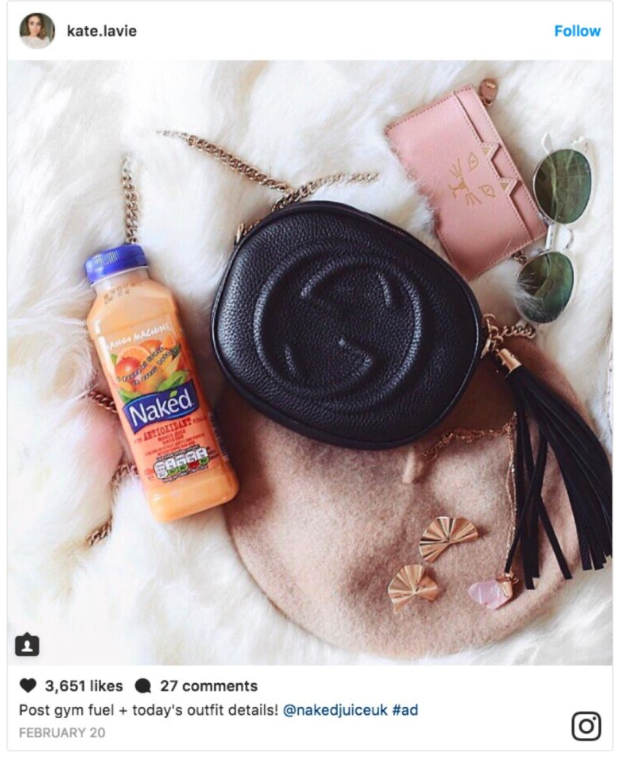
Accompanied by other marketing channel strategies, this influencer campaign allowed Naked Juice to defend its position in the premium juice category by establishing itself in the minds and hearts of their core audience — known as ‘Bare Believers.’ Naked Juice now commands a market share of 58%, far ahead of any competitors, and saw an eight-fold increase in consumer social engagement.
Taking Action
How does one get started in this form of marketing? How do you find influencers and measure the impact of your efforts?
Eighty-four percent of marketers manually search social media platforms to find influencers that may be right for their brand. Many rely on recommendations, social media monitoring tools or attending events and conferences. It is one of the most challenging and time-consuming steps to take as you are getting started with this new medium of advertising, but today there is a plethora of influencer marketplaces that can make this much easier, such as Famebit by YouTube. These online platforms can be used to quickly search for influencers based on specific criteria (follower count, demographics, interests, etc.), to negotiate deals with them as well as give them a clear brief to stay ‘on brand.’ A marketplace makes it easier to not only negotiate a fair price but also find influencers that you may have not heard of before.
First, consider these three criteria when choosing influencers:
- Context: Who has the largest overlap between their followers and your target audience? Keep in mind this is one of the very few — if not the only — type of advertising that works in an ‘opt-in’ model. Influencers don’t force themselves on their audience. Their audience actively subscribes to them. As a result, the audience is far more engaged than on other channels.
- Reach: How large is their following? Just like you choose a TV ad spot based on its reach, you can look at how many followers a certain influencer caters to.
- Actionability: This is the influencer’s ability to cause action and likely the most subtle, yet important, selection criteria to get right. The more skilled an influencer is at convincing their followers to take action related to your product or service the higher your conversion rate will be.
“Influencer marketing delivers an average return of $6.50 (per dollar spent), with the top 13% of marketers making $20 or more.”
Second, decide which pricing model is the best fit for your brand. The four most common pricing models are:
- Pay-per-post or flat-rate pricing: This is the most common method, with 68% of marketers choosing it. The influencer is paid a flat fee per piece of sponsored content they create, whether it’s a photo, tweet, pin, video or blog post. Depending on who you are working with, prices can range from as little as $50 per piece to as much as $250,000 for top-tier influencers.
- Product compensation: Some influencers can be wooed with free products or services. This type of compensation is commonly used by travel brands as influencers can creatively endorse their personal travel stories. This model is ideal for smaller campaigns or for brands looking to establish a brand ambassador group.
- Pay-per-click: In this model, influencers are compensated for how well their content performs. The key metric is number of clicks to a brand’s site. Because influencers rely a lot more on audience interaction in this performance-based model, they are motivated to create larger volumes of content.
- Pay-per-acquisition: Here, influencers are rewarded for the number of purchases, actions or sign-ups driven by their content. It is the least common payment model because consumers rarely purchase or sign up for something the first time they get introduced to a product or service. Often, repeat exposure is required. The first introduction usually needs to be followed up by discovery, research and validation before resulting in a purchase or conversion.
Lastly, know what success means by defining your measurement criteria. Half of all marketers see sales increases and lead generation as the top goals of influencer marketing. Forty percent look for brand engagement such as clicks and social shares. However, success can also be correlated with spikes in web traffic or higher conversions in concurrent ad campaigns. A little less measurable, yet very effective, is the value of earned media as you saw with Emirates. Also, marketers often forget to take into account less tangible metrics, such as overall brand sentiment. Look at the whole picture and — as with all things in digital marketing — don’t ignore the cross-channel impact of influencer marketing on other channels.
Influencer marketing is clearly here to stay. Its impact is palpable. Brands are using it to establish credibility in the market, create a social conversation around their brand and drive online and in-store sales. The brands that make this part of their always-on strategy are the ones that win the most desired eyeballs.