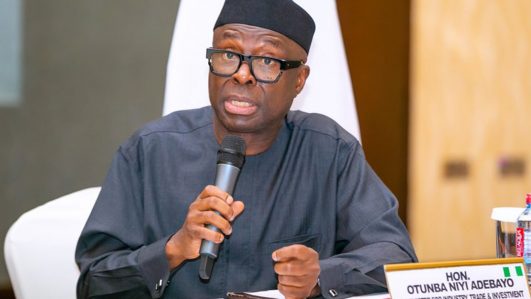
In a rare but queer move recently, Mr. Adeniyi Adebayo, Nigeria’s minister of industry, trade and investment, told the House of Representatives committee on public accounts, that several African countries were lobbying companies registered and operating in Nigeria to relocate to their countries. The minister who led other agencies under his ministry to appear before the committee to respond to queries from the auditor-general of the federation, said the Nigerian government was doing everything possible to ensure that such companies in Nigeria do not leave again. Mr Adebayo named some of the countries, alleging that they had increased their capital allowances to companies and have taken away lots of investment from Nigeria, adding that “what is keeping some companies in the country today is Nigeria’s population.”
The minister said the government was looking for ways of increasing the level of new investment in the country and sustaining existing ones, adding that “our duty is to support investment growth in Nigeria. It is public knowledge that getting this investment is increasingly becoming difficult today.” And we ask: Who else should know better? Coming from Adebayo, a largely taciturn but blunt technocrat, the verdict that Nigeria has lost all attractions to investment “except her population” is indubitable, but worrisome; hence, “getting investment is becoming increasingly difficult.” This ministerial acknowledgement implies that Nigeria has virtually lost all its competitive and comparative advantages and attractions, except its large but mostly impoverished population. In other words, to serious businesses, Nigeria is rather an environment to flee from.
Apparently underscoring this scary perception too, Bismarck Rewane, an economist and member of Muhammadu Buhari’s Presidential Economic Advisory Committee (PEAC), in a recent paper titled, “Distracted Leaders and Conflicted Policymakers”, lamented that existing “businesses are gasping under high energy cost, rise in logistics costs, rise in cost of importing raw materials and capital goods, multiple taxation, new taxes, shortage in forex supply and parallel market rate hikes.” The economy, Rewane says, also suffers “investment drag due to rising uncertainties, kidnapping, banditry, protests, secessionists agitations; supply chain disruptions, infrastructural decays, tax inefficiencies, forex hassles, among other structural difficulties.” The list is really endless!
It goes without saying that the underlying substratum to this gory reality is the high level of insecurity that is permeating all spheres of life and geography in Nigeria. From north to south, east to west, no part of the country is entirely free from banditry, terrorists’ attacks, kidnappings, brigandage and motely social upheavals. Indeed, Nigeria is in a Hobbesian state of nature: there are no longer enforceable criteria of right and wrong; and human life has become “solitary, poor, nasty, brutish and short.” This reflects in massive corporate and human exodus from the country; high human and business mortality rate; worsening misery index accentuated by fast-spreading poverty and shrinking livelihoods.
Today, whether in the oil and gas sector, aviation, manufacturing, mining, agriculture or transportation/logistics industry, operating companies are fleeing the country in droves. Indeed, the continuing exodus of international oil companies (IOCs) from Nigeria is already threatening the continued economic viability of the country, as the nation’s oil production keeps dropping to dangerously low levels. Although the lingering Russia-Ukraine war has, via a ripple effect, driven up the prices of crude oil in the international market to unprecedented high levels, this has unwittingly brought gloom and doom upon the country. Although the Organisation of Petroleum Exporting Countries (OPEC), of which Nigeria is a key member, has graciously raised the nation’s production/export quota to as high as 1.7 million barrels per day, Nigeria is able to come up with only about 1.4 million barrels per day. And proceeds from this export are almost entirely being spent on fuel subsidy and public debts servicing — debts that are fast ballooning into perpetual ‘trap’ for the country.
In the aviation sector, for instance, acute scarcity and skyrocketing prices of aviation fuel (Jet-A1) in recent months unleashed an avoidable crisis in the industry, such that airlines operators opted to dabble into importation of the commodity themselves to save their businesses from imminent collapse. At the same time, attacks by terrorists and bandits on some airports forced many of the airlines to shut down their operations at the affected airports in the country.
This turn of insecurity in the land is yet to abate. It is also noteworthy that the aviation sector in Nigeria has been one of the worst hit by the harsh operating environment in recent times. This is why today, virtually every available space in the airports nationwide is dotted by ‘carcases’ of disused and abandoned aircraft of various makes and shapes.
In point of fact, Adebayo, the industry, trade and investment minister, was actually not saying anything new when he posited that, “it is public knowledge that getting this investment is increasingly becoming difficult today.” Really, investment inflow into Nigeria has been consistently dropping progressively in recent years. The National Bureau of Statistics (NBS) figures show, for instance, that foreign direct investment (FDI) in 2019 in Nigeria stood at $3.3 billion; it dipped to $2.4 billion in 2020, and crashed to a mere $698.7 million in 2021—the lowest level in a decade. Ten years earlier—in 2011—according to UNCTAD data, Nigeria, with FDI of $8.92 billion was the largest FDI destination on the African continent, with South Africa coming a distant second at $5.81 billion.
Foreign portfolio investment (FPI), unsurprisingly, has also followed a similar trend in the past decade.
At the domestic level, local investment and investors have in no way fared better. Operators in the micro, small and medium enterprises (MSMEs) sector, for example, have been practically asphyxiated by the harsh environment. How can these MSMEs thrive in a climate that is riddled with energy crises, with only about 4,000 megawatts of electricity available for businesses and 210 million people? And electricity tariff has been raised for the umpteenth time in the last few months, both for commercial and domestic users. Petrol (PMS), diesel and lubricants (fuels for businesses) keep getting scarcer by the day, with their prices virtually hitting the roof, even as Nigeria continues importing all its petroleum products needs.
Given all these, Minister Adebayo’s accusation against other African countries is rather self-indicting. Who made which country unattractive to investors? Really, today, even businesses owned by Nigerians are relocating to saner and safer African countries and beyond. The world is a global village in which every jurisdiction is in competition with the rest of the globe. And, naturally, investors and investments move to most attractive climes in terms of first, security and safety, before considering the level of returns on investment.
In point of fact, if Adebayo’s allegation against other African countries serves any purpose, it should be a ‘wakeup call’ on the Nigerian government to ‘put its house in order’. As the minister indirectly implied, Nigeria’s business environment has lost all its attractiveness, except a thoroughly denuded and impoverished population. And where will this take Nigeria in this 21st century?
MARCEL OKEKE
Marcel Okeke, a practising economist and consultant in Business Strategy & Sustainability based in Lagos, is a former Chief Economist at Zenith Bank Plc. He can be reached at: obioraokeke2000@yahoo.com; +2348033075697 (text only)
business a.m. commits to publishing a diversity of views, opinions and comments. It, therefore, welcomes your reaction to this and any of our articles via email: comment@businessamlive.com