Business A.M
No Result
View All Result
Thursday, February 19, 2026
  • Login
  • Home
  • Technology
  • Finance
  • Comments
  • Companies
  • Commodities
  • About Us
  • Contact Us
Subscribe
Business A.M
  • Home
  • Technology
  • Finance
  • Comments
  • Companies
  • Commodities
  • About Us
  • Contact Us
No Result
View All Result
Business A.M
No Result
View All Result
Home Frontpage

Nigeria’s inflation to remain high at an average of 17% in 2017, despite deceleration H1, says EIU

by Admin
July 8, 2017
in Frontpage

The Economist Intelligence Unit (EIU), a member of The Economist Group, has projected that Nigeria’s inflation figures would remain high at an average of 17 percent for full year 2017.

In a July Nigeria country report released by the EIU and seen by Businessamlive, the EIU said the effects of currency devaluation and efforts by the authorities to rein in the subsidy bill and boost power tariffs to cost-reflective levels will see inflation edge up again after deceleration in the first half of the year.

The report noted that though currency stability improved in the first half of 2017 after the massive volatility seen in 2016, additional naira depreciation is expected later in 2017, but average inflation will ease, only moderately, to 13.4% in 2018.

“Pre-election spending and a further drop in the naira on the back of weaker oil prices mean that inflationary pressures will stay high in 2019, before it falls back slightly in 2020 21, to an annual average of 10.8%, as tighter fiscal and monetary policy takes effect,” the report explained.

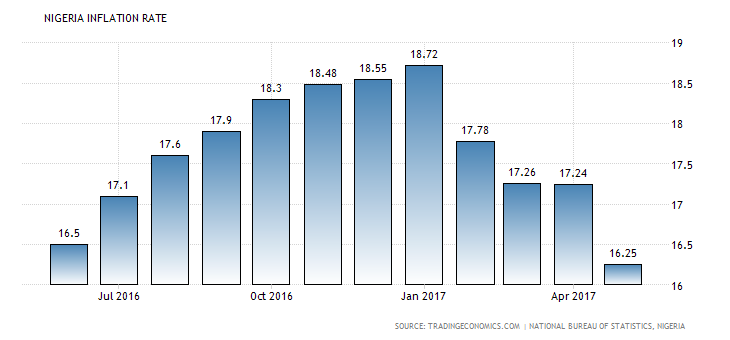
According to data released by the Nigerian Bureau of Statistics (NBS), inflation has decelerated from a high of 18.72 percent in January to 16.25 percent in May due largely to improved liquidity in the forex market, which has brought down the cost of imports. Nigeria relies more on imports for its consumables.
However, local research analysts are optimistic that the deceleration would continue in June.
Anticipating the release of data by the NBS for June, analysts at FSDH research have projected a further drop in inflation figures for the month of June.

“We expect the June 2017 inflation rate (year-on-year) to drop to 15.64 percent from 16.25 percent recorded in the month of May 2017,” they said, attributing their prognosis to the moderation in food prices in the month of June.

“The increase in the price of food items moderated in the month of June compared with May 2017. We also observed increases in some divisions that contribute to the Core Sub-Index, with the highest price observed in the clothing and footwear divisions.”

Based on the data release calendar on the National Bureau of Statistics (NBS) website, the inflation rate for the month of June 2017 would be released on July 17, 2017.

On the external sector, the EIU report indicated that although oil prices in the second half of the year would be up on the nadir seen during 2016, they will still be well below the averages recorded in the preceding years.

“The net effect is a current account close to balance in 2017- ­21—a stark contrast to the enormous surpluses witnessed during the last commodity boom.”

The EIU specifically noted that there would be little progress in terms of diversifying the country’s hydrocarbons-dominated export base, projecting that import growth will start to pick up from 2017, in line with subdued, albeit improving, economic prospects and an ambitious government spending agenda.

It, however, stated that the import bill in 2017 will still be more than 25 percent below the average value recorded in 2011 through 2014, when the oil boom and a stronger naira allowed a spending splurge.

“Trade-related services imports and profit repatriation (including some delayed from 2016 by dollar scarcity) will pick up in 2017-18 but—as with goods imports—will remain below the peaks seen during the last oil boom. Meanwhile, workers’ remittances will remain an important source of hard currency,” the report stated.

Overall, the EIU expects Nigeria’s current account to move into small deficits in 2019 amid worsening global conditions and a subdued oil price after a surplus equivalent to 1.1 percent of GDP in 2017, adding that the deficit will then move back to a small surplus of 0.2 percent of GDP in 2021 as global economic health (and with it oil prices) improves.


Admin
Admin
Previous Post

Nigeria Delta communities demand stake in ex-Shell oil block

Next Post

Zenith, Dangote Cement late rallies fail to lift Nigeria’s equities from bear zone

Next Post

Zenith, Dangote Cement late rallies fail to lift Nigeria’s equities from bear zone

  • Trending
  • Comments
  • Latest
Igbobi alumni raise over N1bn in one week as private capital fills education gap

Igbobi alumni raise over N1bn in one week as private capital fills education gap

February 11, 2026
NGX taps tech advancements to drive N4.63tr capital growth in H1

Insurance-fuelled rally pushes NGX to record high

August 8, 2025

Reps summon Ameachi, others over railway contracts, $500m China loan

July 29, 2025

CBN to issue N1.5bn loan for youth led agric expansion in Plateau

July 29, 2025

6 MLB teams that could use upgrades at the trade deadline

Top NFL Draft picks react to their Madden NFL 16 ratings

Paul Pierce said there was ‘no way’ he could play for Lakers

Arian Foster agrees to buy books for a fan after he asked on Twitter

GSMA presses telecoms to rethink business models for trillion-dollar B2B growth

GSMA urges rethink of spectrum policy to close rural digital divide

February 19, 2026
Unilever, Google Cloud partnership raises stakes in consumer goods digital transformation race

Unilever, Google Cloud partnership raises stakes in consumer goods digital transformation race

February 18, 2026
BUA Group leads Gulf–West Africa drive for integrated food and logistics corridor

BUA Group leads Gulf–West Africa drive for integrated food and logistics corridor

February 18, 2026
FairMoney expands SME credit access to boost financial capacity

FairMoney expands SME credit access to boost financial capacity

February 18, 2026

Popular News

  • Igbobi alumni raise over N1bn in one week as private capital fills education gap

    Igbobi alumni raise over N1bn in one week as private capital fills education gap

    0 shares
    Share 0 Tweet 0
  • Insurance-fuelled rally pushes NGX to record high

    0 shares
    Share 0 Tweet 0
  • Reps summon Ameachi, others over railway contracts, $500m China loan

    0 shares
    Share 0 Tweet 0
  • CBN to issue N1.5bn loan for youth led agric expansion in Plateau

    0 shares
    Share 0 Tweet 0
  • How UNESCO got it wrong in Africa

    0 shares
    Share 0 Tweet 0
Currently Playing

CNN on Nigeria Aviation

CNN on Nigeria Aviation

Business AM TV

Edeme Kelikume Interview With Business AM TV

Business AM TV

Business A M 2021 Mutual Funds Outlook And Award Promo Video

Business AM TV

Recent News

GSMA presses telecoms to rethink business models for trillion-dollar B2B growth

GSMA urges rethink of spectrum policy to close rural digital divide

February 19, 2026
Unilever, Google Cloud partnership raises stakes in consumer goods digital transformation race

Unilever, Google Cloud partnership raises stakes in consumer goods digital transformation race

February 18, 2026

Categories

  • Frontpage
  • Analyst Insight
  • Business AM TV
  • Comments
  • Commodities
  • Finance
  • Markets
  • Technology
  • The Business Traveller & Hospitality
  • World Business & Economy

Site Navigation

  • Home
  • About Us
  • Contact Us
  • Privacy & Policy
Business A.M

BusinessAMLive (businessamlive.com) is a leading online business news and information platform focused on providing timely, insightful and comprehensive coverage of economic, financial, and business developments in Nigeria, Africa and around the world.

© 2026 Business A.M

Welcome Back!

Login to your account below

Forgotten Password?

Retrieve your password

Please enter your username or email address to reset your password.

Log In
No Result
View All Result
  • Home
  • Technology
  • Finance
  • Comments
  • Companies
  • Commodities
  • About Us
  • Contact Us

© 2026 Business A.M