By Innocent Obasi
Long queues at petrol stations have become a recurring sight in Nigeria, which used to be Africa’s top oil producer until Angola, Libya and Algeria edged it to the fourth place. From Abuja, the seat of administration, to Lagos, the commercial nerve-centre, to the oil city of Port Harcourt and elsewhere in the country, the story is the same. Three months can hardly go by without hitches in petrol supply and the accompanying hike in the cost of the product.
With electricity supply grossly unreliable, businesses operating in the country rely on petroleum products, including PMS, to keep their machines buzzing and households to keep the lights in their homes on.
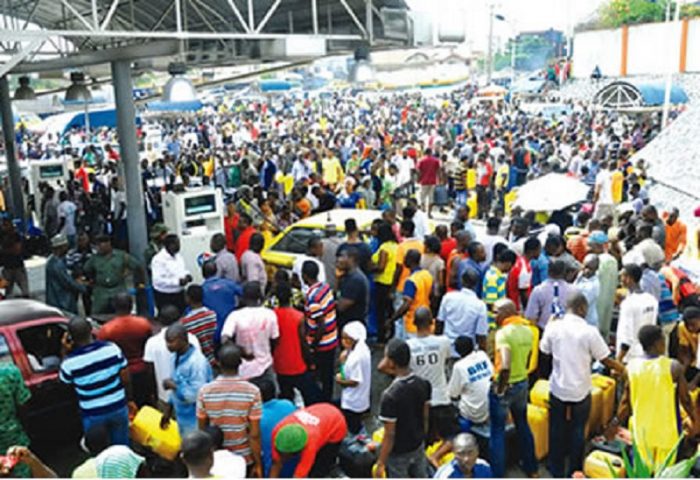
Nigeria imported 16.46 billion litres of petrol between January and August 2022, but analysts say this practice will not end the long queues at filling stations. According to them, the permanent solution lies in total deregulation of the oil sector and the establishment of more private refineries apart from the oncoming Dangote venture.
Major Oil Marketers Association of Nigeria (MOMAN) suggested that full deregulation of the petroleum downstream sector and full implementation of the Petroleum Industry Act (PIA) 2021 remain the most viable long-term solution to the challenges facing the supply and distribution of petrol in the country.
Chijioke Nwaozuzu, an energy economist and director, Emerald Energy Institute, is of the opinion that there is a permanent solution to the issue of fuel scarcity, but it depends on the government’s willingness to do the right thing.
According to him, energy consumption is at the heart of any meaningful growth and development of an economy, but the perennial inadequacy of electricity supply in Nigeria has compelled Nigerians and business operators to depend on petroleum products for power generation. And the growing population and the booming economic and transportation sector mean that fuel consumption is expected to increase.
The energy economist said to assuage increasing demand for fuel, the Nigerian government dedicated 445,000 bbl/day of its total crude oil production capacity for local refining in the four national refineries. However, due to lack of maintenance, limited financial authority, gross mismanagement and poor business model, over the years, these refineries have been operated at less than their installed capacity, thereby lowering their processing capacity and functionality.
“It will be safe to say that as at today, the refineries are not operational, meaning that the country will have to import these products to meet local demand/consumption,” he said.
But completely relying on imported petroleum products comes with implication, such as exposing the country and the consumers to the risks of supply shock, which may result in increased price of products, or even geopolitical risks, such as war, as well as sabotage and corruption, and ultimately, incessant issue of scarcity in the supply of petroleum products in the country.
One of the best ways to achieve sufficient supply of petroleum products that will meet domestic demand and curb the problem of scarcity, Nwaozuzu told Business A.M., is to increase refining capacity.
“On the average, Nigeria, with a population of over 200 million, needs a minimum of 1 million bbl/d refining capacity to adequately meet local demand. Unfortunately, the government may not be able to engage in such projects in the short term. Thus, there is need for Public Private Partnerships (PPP) with adequate guarantees to be able to pull off that trigger,” he said.
“Another viable option by which the government can increase local refining capacity, where funds are limited, is to adopt the modular refining approach. In which case, a 500,000 bbl/d refining capacity can be achieved in modules of 100,000bbl/d in five successive stages. This will reduce the funding challenges for the government or the investors,” he said.
Nwaozuzu further suggested that the government can also privatise the existing refineries. However, it should have increased and adequate regulation of the sector to avoid the problem of monopoly or even collusion among the operators.
“Investments in gas to liquid plants could also help to add additional volumes of petroleum products to the market, thus helping to alleviate the scarcity problem. These options of involving private sector investors may however not see the light of the day if the government is involved in price regulation. Therefore, there is a need for liberalization of the downstream petroleum sector to incentivize private sector participation,” he said.
Another strategy to curtail scarcity, he said, is to reduce demand.
“This could be achieved through improvement in electricity generation and distribution facilities. This will help to compensate for consumption of petroleum products, especially by the productive sectors (excluding transportation industry),” he said.
Nwaozuzu re-emphasised the need for renewed government will to end the fuel crisis by providing an enabling environment for increasing local refining capacity, as well as engineer adequate electricity supply that will curb reliance on petroleum products, and hence, reduce importation. To this end, he said the government can encourage investment in electricity generation, and also in green energy/power projects such as solar power generation.
“Recall that the NNPC bought a 20 percent stake in the 650,000 bbl/day (which translates to 133,000bbl/day) refinery of the Dangote Group. While this, in addition to revamping of the Port Harcourt refinery, will add some volumes of petroleum products to the local market, they are grossly not enough to meet local demand,” he said.
Oluwole Adelokun, associate director at KPMG, said the solution is actually for Nigeria to either refine locally or allow market forces to determine the price.
“So, today it is only NNPCL that could bring in refined products, that limits what is possible. If we allow individuals to import, it can force competition on price and conduct. So, the solution is to refine locally, which is why Dangote refinery is coming on stream,” he said.