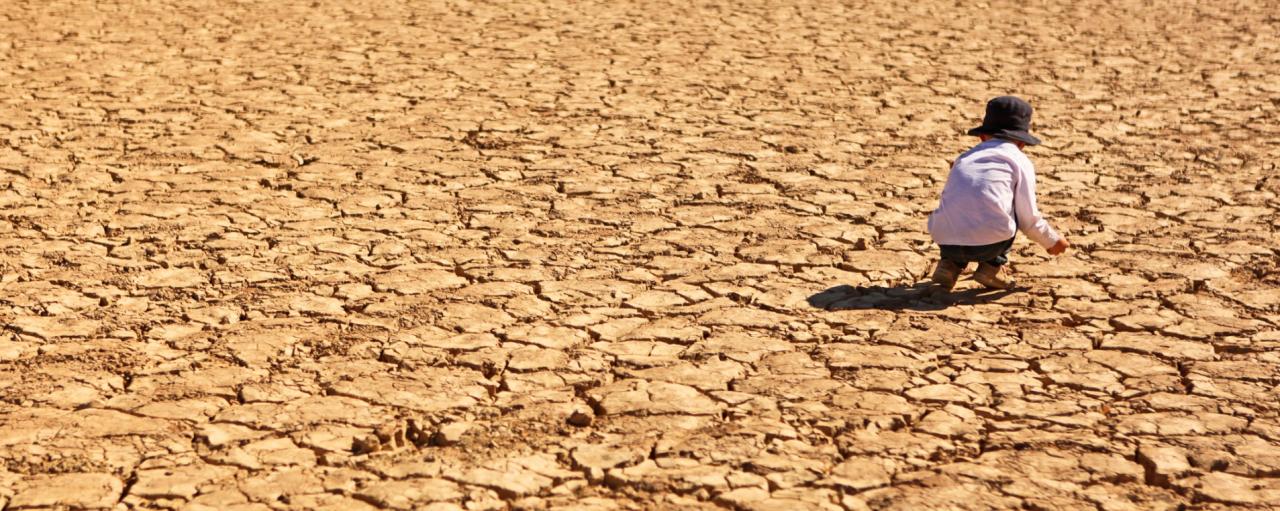
Climate change is having a devastating impact on the African continent – creating food insecurity, stressing water resources, depleting human health, displacing populations and impeding socio-economic development. Like elsewhere on the planet, its consequences are felt the most by those who can afford it the least.
The INSEAD panel, which featured four experts from diverse industries, explored the impact of climate change on Africa and possible solutions. Its impetus was to identify actions and innovations coming out of Africa that would benefit the continent, as well as provide ideas to other parts of the developing world reeling from similar problems. The panellists’ conversation led to several important takeaways, as highlighted below.
Climate challenges interlinked with development challenges
Panellists began by discussing how Africa’s climate challenges are interlinked with both local and global development challenges, and how potential solutions to these challenges must take this connection into account. Growth that is climate resilient and environmentally sustainable, for instance, has a positive impact on both global development and the planet.
Hania Dawood, Manager for Climate Finance & Economics at the World Bank, pointed to several statistics that affirm the linkages between climate and development. In Africa, she said, 50 million people are on the brink of falling below the poverty line for reasons connected to climate change, 100 million people are at risk of being displaced by climate change, and about 600 million people lack energy access. Forty-five African economies are dependent on commodity exports, including fossil fuels. At the same time, more than 30 percent of the continent’s population lives in extreme poverty.
“As we think about tackling and supporting countries in their climate development journey, ensuring a low-carbon and resilient pathway for development is critical,” said Dawood. While there are “opportunities to tackle climate change on the continent,” she observed, development challenges are inhibiting progress. These include barriers to private sector investments due to weak business environments that cover property rights to dispute resolution to bankruptcy and insolvency legislation.
Climate change is also amplifying economic development challenges in Africa and worsening socio-economic inequality. Africa has only contributed 3 percent of greenhouse gasses worldwide, and yet it is experiencing some of the worst impacts of climate change, such as drought and desertification that has left 20 million people on the brink of death due to starvation and thirst. By 2050, the continent’s population will have doubled, exacerbating the problem unless remedial actions are immediately implemented.
James Mwangi, Executive Director of Dalberg Group and Founder of Climate Action Platform for Africa, explained that Africans have been driven into survival mode in part because they were so close to the line to begin with.
“I cannot think of a single product value chain in the world in which Africa receives raw materials and engages in value addition, which is where a lot of value and wealth is created for citizens, and then exports back out,” he explained. “It all flows the other way. So long as that is true, the poverty trap continues.”
Mwangi argued for shifting greater amounts of value addition to the continent to help transform Africa into an economic engine of growth. “What we need is commercial investment into Africa that’s good for the planet and good for the continent,” he said. “That translates into the resilience and the growth that we need.”
Solving climate challenges for Africa and the world
Rather than focus on Africa as a victim of climate change, the panellists emphasised Africa’s potential to serve as a provider of climate solutions that benefit the continent and broader world.
With its young and growing population, large workforce, huge land mass, abundant natural resources and untapped renewable energy, Africa has an opportunity to steer away from business-as-usual and go green from the start. Seizing this opportunity could motivate global capital to drive decarbonisation, enable Africa to produce more value-added products for the globe, elevate the continent for its climate competitiveness, and create jobs for the world’s largest workforce. Perhaps most importantly, it could help Africa deploy its workforce “towards stewarding, supporting nature and building new approaches to sequestering and capturing carbon at scale,” said Mwangi.
The nation of Gabon, designated as a High Forest, Low Deforestation (HFLD) country, serves as a model for aligining climate action and development to advance socio-economic progress. By preserving its rainforests, Gabon has effectively safeguarded the Congo Basin, also known as the world’s largest carbon sink or the “lungs of Africa”. The Congo Basin captures 140 million tonnes of CO2 each year, contributing to an ambitious, global goal: According to the National Academics of Sciences, Engineering and Medicine, approximately 10 billion tonnes of CO2 must be removed from the atmosphere each year to limit global warming to 1.5°C.
Gabon’s carbon credits programme is also regarded as a model of environmental policy. The programme stems from more than 50 years of investment and commitment to environmental protections; Gabon created its first Ministry of Environment in 1960, first environmental law in 1992, and a network of national parks in 2006.
In 2010, the country banned the timber industry from exporting unprocessed logs, bringing positive impact to the economy, environment and wellbeing of citizens over the following decade. Within eight years, Gabon had reduced its annual deforestation rates to 0.1 percent and significantly reduced its emissions. Meanwhile, workers who had once served as log cutters moved up the industrial value chain and improved their livelihood. Today, Gabon has 90 million carbon credits – that is, credits for the CO2 emissions it has saved – which it is now in the process of selling.
“We are able to monetise carbon credits, and we are absorbing more carbon than we are emitting every day,” explains Akim Daouda, CEO, Fonds Gabonais d’Investissements Stratégiques (Sovereign Wealth Fund of Gabon), adding that Gabon only emits 35 million tonnes of CO2 each year.
A market fit for purpose?
Daouda cautioned that the carbon market is still in its infancy and has yet to accelerate progress in carbon capture. Dawood, however, was more optimistic. “I believe that high integrity and transparent carbon markets have the potential to unlock capital for climate action,” she said.
She pointed to recent estimates about the expected growth in voluntary carbon markets, driven in part from corporations that have met net-zero goals. Corporations’ voluntary commitments in addition to progress made on Article 6 of the Paris Agreement have the potential to drive significant growth carbon markets. She also noted the creation of Frontier Climate, an advance market commitment that aims to accelerate the development of carbon removal technologies, as a good example of how demand for emission reduction credits can unlock investments in new mitigation areas such as carbon removal.
Mwangi agreed carbon markets need to work better, citing the problem of too much intermediation. “By some estimates, for every dollar spent to buy a carbon credit on the global markets from Africa, 20 cents might make it to the local communities or the people on the ground doing the work,” he said. Young Africans, he added, should consider starting carbon-verification businesses to address this problem.
Indeed, there is both risk and opportunity at hand, Daouda said. “Centuries ago, someone put a price on the dead tree, and that was the beginning of the timber industry,” he said. “Now, we have to ensure that we are putting a fair price on the living tree so that we can keep those trees alive.”
Bringing inclusion to solutions
To create impact, climate action and development solutions need to meet another important criterion: They must be inclusive – engaging the entire population, and never leaving anyone behind.
In Africa, women and youth are often overlooked in business and society, said Pauline Koelbl, CEO of AfriProspect GmbH, and Founder and Managing Partner of ShEquity. “We are excluding the majority of the population that could be contributing to solving the challenges,” said Koelbl. “They are the future of the continent, but we’re not looking at them.”
The impact investor cited research indicating that climate change is impacting women more negatively than men, and the fact that women entrepreneurs face an unfair disadvantage when trying to raise capital. “African women on the continent face a US$42 billion gender funding gap,” noted Koelbl. “At the same time, they’re driving 40 percent of SMEs (small and medium enterprises) on the continent.”
To help close this funding gap, ShEquity invests in women-led businesses that address environmental and sustainability issues. One company is producing an insect protein and organic fertiliser, another company is helping to reduce the number of cars on the streets by creating a bus pool for professionals, and yet another is developing a superfood that only grows in desert areas like the Sahara.
“African women are driven to solve a challenge, and their businesses intersect with the [problem of] climate change,” says Koelbl. Collectively, we can lead solutions that are good for Africa and good for the planet. We don’t need to follow the narrative from the rest of the world.”