Africa emerged as a bright spot in global private capital markets, bucking a downturn in deal activity in 2025 which saw a structural shift in investor confidence toward the continent.
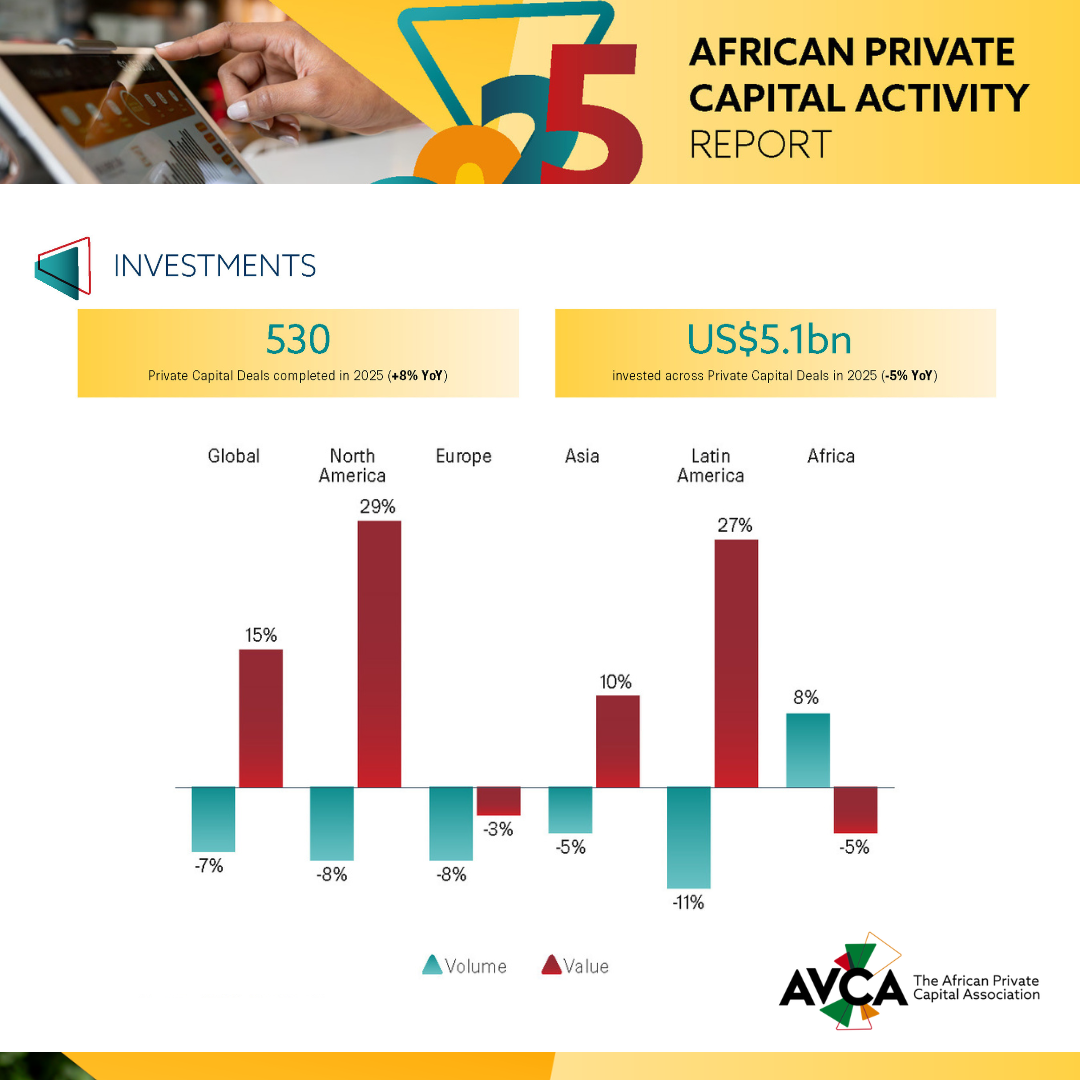
New data from the African Private Capital Association (AVCA) shows that deal activity across Africa rose by eight per cent year-on-year to 530 transactions in 2025, making it the only region globally to record growth in deal volume during the period. This contrasts with a seven per cent decline in global deal activity, underscoring Africa’s increasing resilience in a challenging investment climate.
The findings, published in the association’s 2025 Private Capital Activity in Africa report, point to a maturing ecosystem that is gradually decoupling from global capital market cycles. While total investment value stood at $5.1 billion, the more telling signal for investors is the breadth and consistency of deal flow, which reflects sustained appetite for African assets despite tighter global liquidity conditions.
One of the most notable developments in 2025 was an improvement in exit activity, often seen as a key indicator of market maturity. The continent recorded 81 exits during the year, representing a 27 per cent increase and marking the second-highest exit volume on record.
This uptick stands in contrast to global markets, where exit activity declined by 15 per cent over the same period. For fund managers, the ability to exit investments efficiently is critical to recycling capital and attracting new commitments. The data indicates that Africa is making tangible progress in addressing liquidity, one of its long-standing investment bottlenecks.
Domestic investors played a central role in this shift, accounting for 68 per cent of private capital acquisitions. International buyers made up the remaining 32 per cent, with Asian strategic investors leading cross-border acquisitions as they seek to expand their footprint in high-growth African markets.
Beyond traditional private equity and venture capital, private debt is rapidly emerging as a third pillar of Africa’s private capital landscape. Deal volume in this segment rose by 57 per cent year-on-year, driven largely by increased adoption of venture debt structures.
This evolution reflects a diversification of financing options for African businesses, particularly in an environment where equity capital has become more selective and expensive. The rise of private debt is also helping to bridge funding gaps for growth-stage companies that require flexible capital solutions.
Sectoral trends continue to underscore the centrality of technology and financial services in Africa’s investment narrative. The financial sector remained the most active, driven overwhelmingly by fintech, which accounted for 82 per cent of transactions within the segment.
The information sector ranked second, with investments spanning finance, healthcare, retail, and logistics; areas increasingly shaped by digital transformation and rising consumer demand.
Regionally, Southern Africa maintained its position as the most active investment destination, while East Africa and North Africa recorded strong performances, supported by growth in energy and information technology investments.
Despite strong deal activity and improving exits, fundraising conditions remained subdued, reflecting broader global headwinds. Total capital raised fell by 34 per cent year-on-year to $2.7 billion.
However, beneath the headline decline lies a more structural shift. This is as the growing role of domestic capital. African institutional investors accounted for 21 per cent of total commitments, led by sovereign wealth funds and pension funds that are steadily increasing their exposure to private markets.
Development finance institutions (DFIs) continued to anchor the ecosystem, contributing 64 per cent of total commitments. Their sustained involvement has provided a stabilising effect, particularly during periods of global uncertainty.
According to Abi Mustapha-Maduakor, the AVCA CEO, the data points to a continent that is gradually decoupling from global investment cycles.
“This year’s report tells a clear story: Africa is decoupling from the global slowdown,” she said, citing stronger exit performance, deeper domestic participation, and continued DFI support as evidence of a maturing market.