GRO HARLEM BRUNDTLAND, a medic with a public health background, was probably unaware of what major role awaited her when she launched out into politics and later emerged as the first woman Norwegian Prime Minister. Her nomination by Javier Perez de Cuellar, then UN Secretary General, to establish and chair an independent World Commission for Environment and Development (WCED) in 1983 – to formulate “a global agenda for change” – marked a watershed in the awareness about the world’s changing environment. Hitherto, a lot has been done to change the world without any serious interrogation about the consequences of such actions. In October 1987, Brundtland’s team was to publish a report titled, “Our Common Future,” also known as the Brundtland Report. The UN not only achieved a major feat that has led to a widespread awareness about the environment, it has also provided a platform for recognition of the roles of women in world development.
The 1980s was a period of technological and economic growth in many parts of the world. It was also a time some countries in political crises got some reprieve. The fall of the Berlin Wall and the disintegration of the former Soviet Union, nonetheless, contributed to unprecedented developments in many parts of the world as the Cold War gave way to new forms of political and economic cooperation. It was an era when it became evident that the world will have to grapple with a variety of conflicting issues ranging from intersections between technological development and environmental fallouts, social consequences, political realities, economic costs and benefits, as well as long-term sustainable development, cooperation between developed and developing nations and how to effectively manage environmental concerns. Diplomatic concerns obviously became evident as the world would need to manage differing international perceptions of long-term environmental issues while formulating strategies for protecting and enhancing the environment. Many influential voices obviously saw the efforts of Brundtland’s team then as needless, just as there are still strong deniers of any real negative environmental consequences to our development today. But events on a global scale today have proved Brundtland’s work as timely, relevant and fitting.
The changing climates, the cyclical and perennial flooding and drought, the rising environmental temperature and the disappearing biodiversity are witnesses to WCED’s foresight and the resultant Brundtland’s Report. They are also a manifestation of evidence of the downsides of the world’s terrific and exponential growth in development, economy and underlying technologies that drive the growth, and the consequential population increase. Many of the growths – particularly human population growth and technological development – have destructive impacts on the environment. The unabated development and the fears of possible irreversible damage to the planet prompted debates in some circles about the need to set bounds for development driven by science and technology. The fears earlier expressed by Thomas R. Malthus, a legendary demographer and economist, who was popular for his Population Theory, appeared to be turning into realities until some reasoned that such fears are unfounded as they can be prevented from becoming realities by deploying technological advancements and scientific breakthroughs.
Malthus was not altogether ignored or forgotten as his views seem to have been revised and refined in the context of recent realities. More recently, after Malthus, a book published under the title known as, “The Limits to Growth”, alluded to Malthus in some ways. This collection of analytical writings, based on what the authors referred to as a report for the “Club of Rome’s Project on the Predicament of Mankind”, devoted a chapter to the a topic on ‘Technology And The Limits To Growth’. In it, the authors argued that, over the past three hundred years, mankind has compiled an impressive record of pushing back the apparent limits to population and economic growth by a series of spectacular technological advances. These have led many people into expecting technological breakthroughs to go on raising physical ceilings indefinitely; they thus speak about the future with resounding technological optimism. In clear disagreement with Malthus, they argue that there are no substantial limits in sight either in raw materials or in energy that alterations in the price structure, product substitution, anticipated gains in technology and pollution control cannot be expected to solve. They affirm that, given the present capacity of the earth for food production, and the potential for additional food production if modern technology were more fully employed, the human race clearly has within its grasp the capacity to chase hunger from the earth within a matter of a decade or two.
They contend that “humanity’s mastery of vast, inanimate, inexhaustible energy sources and the accelerated doing more with less of sea, air, and space technology has proven Malthus to be wrong. Comprehensive physical and economic success for humanity may now be accomplished in one-fourth of a century.” That contention is now the trouble that the world is presently grappling with in various ways, with all the uncertainties, risks and threats. The entire globe is now endangered. The tropics, temperate, arctic regions and Antarctica are feeling the change which will impact significantly and negatively on terrestrial and marine lives, biodiversity, environment, infrastructure, food security, international diplomacy and world peace. The various signs are already showing up, albeit little here and there. Heat waves in extreme temperate regions have become an ominous sign of irreversible global warming. Summer in the temperate regions has become hellish with temperatures rising to unprecedented levels in recorded history as the world population is becoming increasingly urbanised and technological breakthroughs are increasing. On July 23, 2022, temperatures peaked, reaching 38 to 39 °C (100 to 102 °F) in European cities such as Zagreb, Osijek, Karlovac, Slavonski Brod, Knin. Valpovo recorded the highest temperature of 39.4 °C (102.9 °F). Elsewhere, unofficial weather stations recorded temperatures exceeding 40 °C (104 °F).
The United States typifies the contradictions in a temperate and sub-tropical climate during summer as the heat wave was hitting states near the west coast and north east while some near the east coast to midwest were experiencing excess rains and floods. In the last few days of July to the first few days of August 2022, Portland, Salem and Eugene in Oregon State all experienced seven consecutive days of highs above 95 degrees Fahrenheit. Earlier in July, heat threat warnings were issued from New York City to Las Vegas as temperatures rose well above 100 Fahrenheit. Dallas, Austin and San Antonio in Texas as well as Tulsa in Oklahoma were under threat of temperatures above 100 degrees for about a week. While all these lasted, vast swathes of forests went ablaze in California, Washington, Montana, Oregon, Texas and Idaho. In California alone, an estimated 147,034 acres of forest was reported burned.
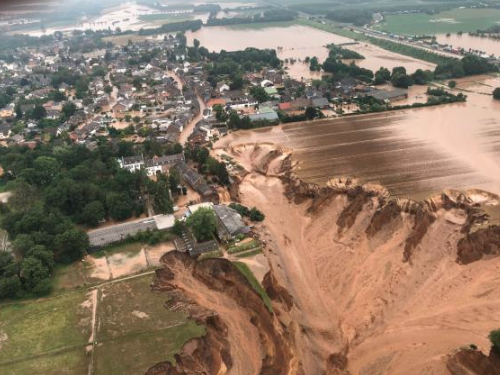
The flooding disasters in the US during this same period are rather alarming. This year alone, at least 39 people were reportedly killed during the flooding events in Kentucky and Missouri toward the end of July 2022, with two of those 39 deaths reported in Missouri and the remaining 37 in Kentucky. Similar reports emanated from Japan in which roughly 500,000 people were ordered to evacuate in Niigata, Ishikawa and Yamagata prefectures, according to Japan’s Fire and Disaster Management Agency, as heavy floods hit the northern part of the country on Thursday last week. Between April and June this year, South Africa experienced catastrophic floods and landslides in the provinces of KwaZulu-Natal and Eastern Cape after exceptionally heavy rainfall. It was clear that the country did not make emergency preparedness provisions for flood control as the shelters of many flood victims were damaged by unprecedented magnitude of rains.
Even in the west, where droughts are regular occurrences, heavy rainfall in June caused flooding in areas of Cape Town and areas of Western Cape Province. Severe flooding and landslides caused by heavy rainfall. The floods in April reportedly caused the death of 448 people, displaced over 40,000 people and completely destroyed over 12,000 houses in the south-east part. The extreme rainfall that triggered one of South Africa’s deadliest disasters of this century was made more intense and more likely because of climate change. The 2022 Eastern Australia floods have been adjudged as one of the nation’s worst recorded flood disasters with a series of floods that occurred in South East Queensland, the Wide Bay–Burnett and parts of coastal New South Wales, with a lot of damages in their trail. Flash floods in Sichuan and Gansu, experienced the loss of a dozen people to floods this year as some areas receive double their monthly rain in less than two days. Sichuan province now annually reports cases of landslides following heavy rains that endanger communities. Multiple parts of Iran, a desert country in the Middle East, experienced flash floods in July that swept away people, property and automobiles.
Global food security will be threatened this year by climate change-induced droughts and floods. It is so bad that droughts are causing crop failures, predisposing forests to wildfires, burning homes, livestock and wildlife, and destroying natural flora and fauna. Russia’s scorched earth war policy on Ukraine added this year to what will manifest in 2023 as food shortage of global implications. In Europe, the drought in summer has led to gloomy results manifesting in grim prospects of food insecurity as about a third of crops in Italy are predicted to fail in 2022. In addition to food, precious plants of medicinal use or those that simply serve to protect the land, or providing food for animals down the food chain are at great risk. This will undoubtedly affect the population of those herbivores depending on them for survival as the pyramid of biomass is upset by fire. Biodiversity is, therefore, also upset. The impacts of these isolated events in various parts of the world will have aggregate global impacts. The picture will be getting clearer as the world sees the increasing connections between countries as the case of grains in Ukraine has just proven this year. African countries would be operating under the wrong assumption to believe that they are isolated and that climate-induced events elsewhere will have little or no impact on them. The case of South Africa is here as a reminder. Africa must brace for the yet-to-be quantified multiple impacts of climate events that will happen within the continent in years ahead.
- business a.m. commits to publishing a diversity of views, opinions and comments. It, therefore, welcomes your reaction to this and any of our articles via email: comment@businessamlive.com