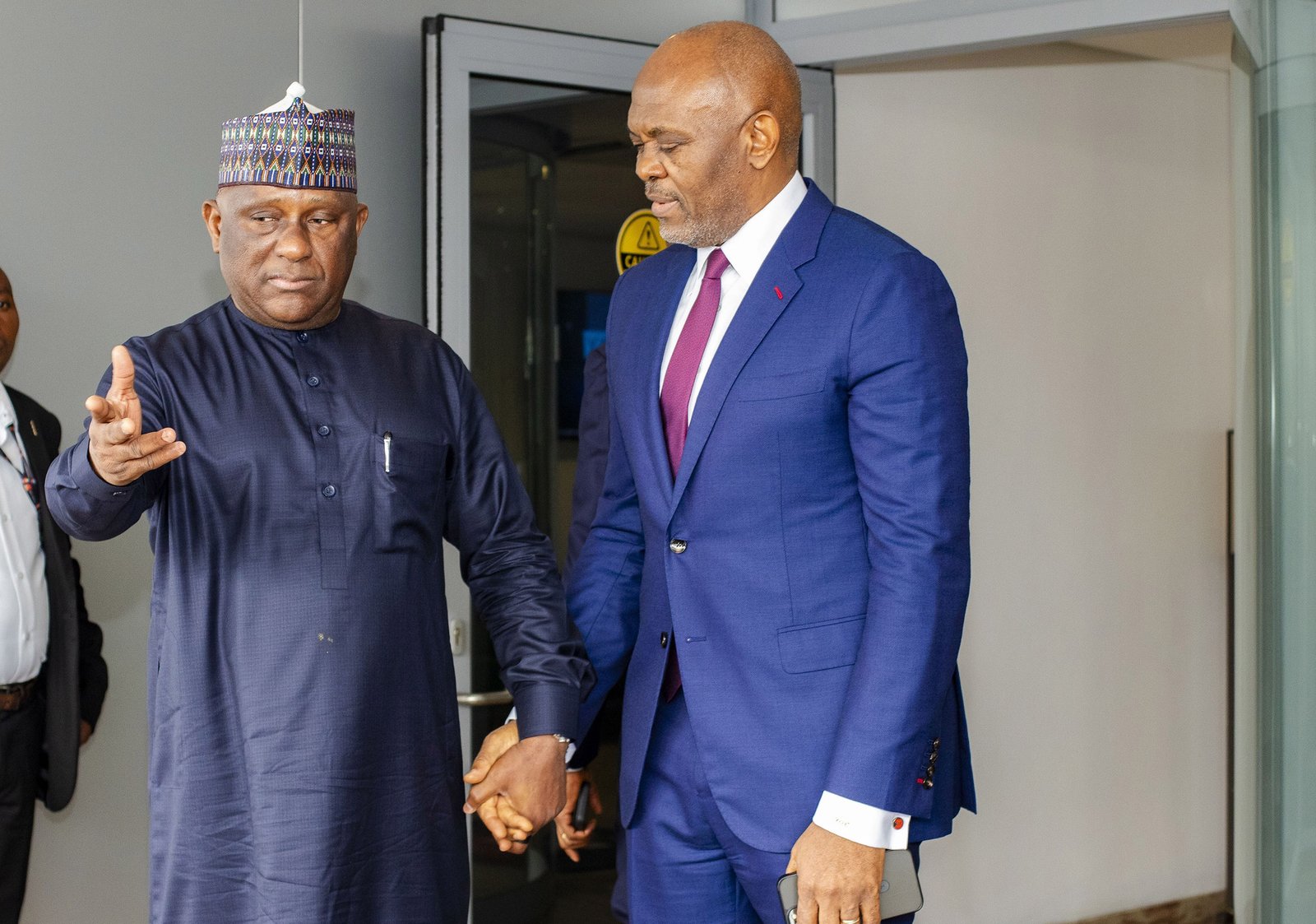
A high-level meeting between Abdul Samad Rabiu, founder and chairman of BUA Group, and Tony Elumelu, chairman of United Bank for Africa (UBA), has resulted in a renewed push to deepen collaboration between capital and industry, as both institutions explore expanded financing for large-scale manufacturing and economic growth.
The meeting, held at BUA Group’s Lagos headquarters, underscored a long-standing partnership that has quietly powered decades of enterprise expansion across Nigeria and, increasingly, the African continent. At a time when economic growth is shifting toward indigenous industrial capacity, the meeting showcased a commitment to scaling investments in manufacturing, strengthening domestic production, and unlocking export-oriented value chains.
The relationship between BUA Group and UBA dates back nearly 30 years, evolving from early collaborations during the era of Standard Trust Bank into a mature financial-industrial alliance. For Rabiu, the longevity of the partnership reflects more than transactional convenience, and represents a shared strategic vision for Nigeria’s economic trajectory.
“Enduring partnerships are not built on transactions, but on conviction. What we have built over the years is a shared understanding of where Nigeria is going and what it will take to get there,”Rabiu noted during the meeting.
That alignment is now being structured to meet current economic realities, with both institutions exploring expanded financing frameworks tailored to large-scale manufacturing and infrastructure development. The focus is on enabling capital flows into sectors that can deliver both scale and resilience;particularly food production, industrial processing, and export-driven industries.
Elumelu framed the partnership within a context of African-led growth, where financial institutions are increasingly expected to play catalytic roles in enabling enterprise scale.
“Institutions like BUA Group demonstrate what is possible when long-term capital meets disciplined execution. Our role is to continue enabling that scale, supporting enterprises that are not only growing, but reshaping the Nigerian economy,” he said.
This convergence of finance and industry comes at a critical juncture. Nigeria’s macroeconomic environment, while still facing structural pressures, is leaning towards real-sector investments, driven by policy support, rising domestic demand, and a renewed emphasis on import substitution.
The BUA–UBA engagement highlights how private-sector alliances are stepping in to fill financing gaps, particularly in capital-intensive sectors where long-term funding remains constrained.
In parallel with the strategic meeting, BUA Foods released its audited financial results for the year ended December 31, 2025.
The company reported revenue of N1.77 trillion, representing a 16 per cent increase from N1.53 trillion recorded in 2024. Growth was driven by sustained demand across key product lines, including sugar, flour, pasta, and rice, alongside continued execution of its capacity expansion strategy.
Profitability metrics showed even stronger acceleration. Gross profit rose to N737.26 billion from N540.82 billion, while profit after tax rose by 95 per cent to N518.4 billion. Earnings per share climbed to N28.80, reinforcing investor confidence in the company’s earnings strength.
In a move that underscores its commitment to shareholder returns, the Board proposed a dividend of N28 per share (more than double the N13 paid in 2024), translating into a total proposed payout of N504 billion, subject to shareholder approval.
Operational expansion remained a key driver of performance, with total assets growing by 27 per cent to N1.39 trillion. Cost of sales stood at N1.037 trillion, reflecting both input cost pressures and increased production volumes.
“Our 2025 performance reflects a business that is not only growing, but scaling with discipline. We are building capacity, deepening local production, and delivering consistent value to shareholders,” Rabiu said in his capacity as Chairman of BUA Foods. “
Managing Director Ayodele Abioye added that the company’s forward strategy remains anchored on capacity expansion, market penetration, and supply chain optimisation, noting that demand conditions remain robust.