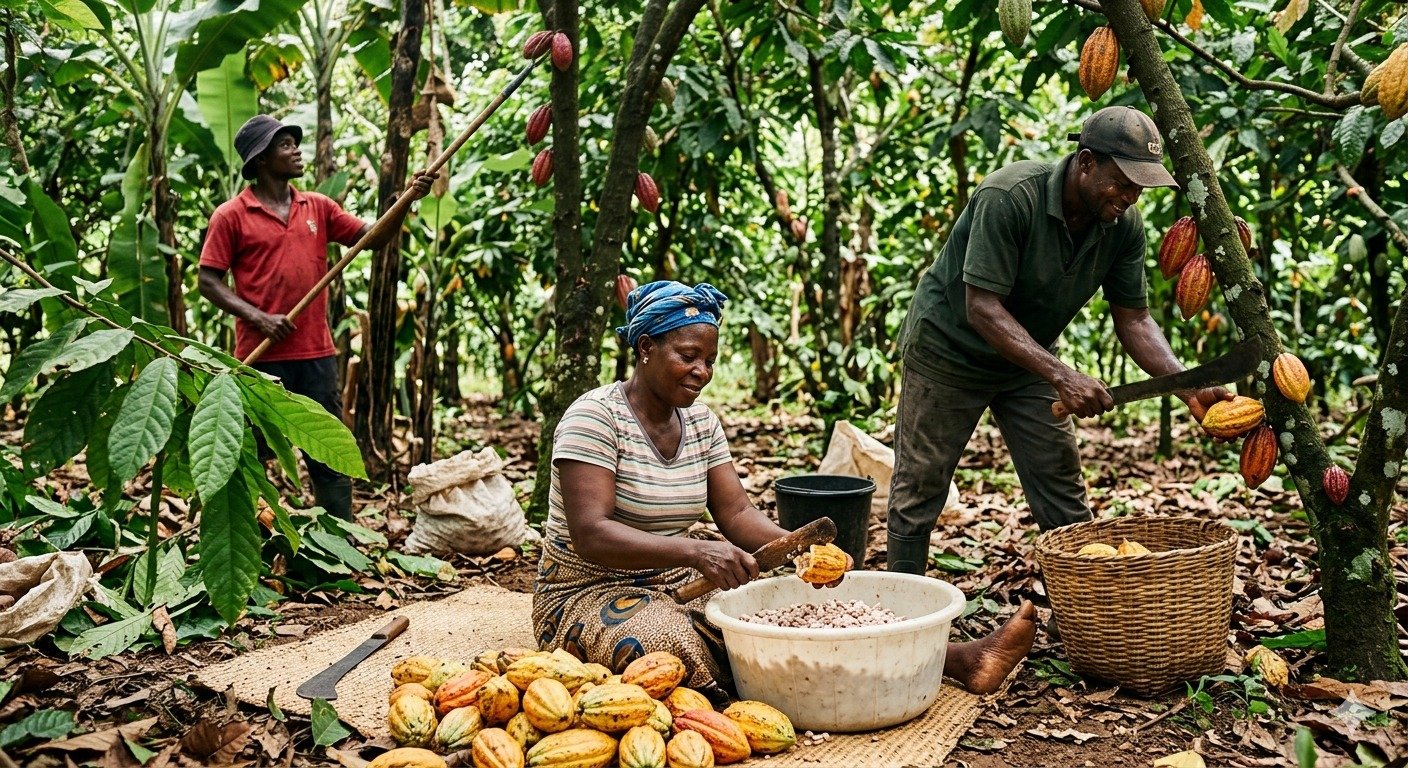
Africa’s cocoa farmers are losing faith in one of the industry’s most ambitious reforms. The Living Income Differential (LID), once hailed as a game-changer for farmer welfare, is now at the heart of growing concerns over whether current market interventions are truly delivering on their promise.
The Cocoa Farmers Alliance Association of Africa (COFAAA), representing producers across the continent, has raised fresh concerns over the failure of existing price-stabilisation mechanisms, warning that systems designed to shield farmers from market shocks are falling short. Beyond the immediate impact on farmgate earnings, the development highlights deeper structural questions about Africa’s bargaining position within the $147 billion global chocolate economy.
Introduced jointly by Ghana and Côte d’Ivoire, the Living Income Differential was designed as a structural correction to chronic underpayment of cocoa farmers. By adding a fixed $400 per tonne premium to global cocoa prices, policymakers hoped to create a predictable income floor, insulating farmers from the volatility that has long characterised commodity markets.
However, according to COFAAA President Adeola Adegoke, the policy’s real-world impact is proving inconsistent.
The issue is not the intent, which remains widely supported, but the transmission mechanism—how value moves from international buyers through national systems down to the smallholder farmer. In many producing countries, farmers report that the benefits of the LID are either diluted or delayed, raising concerns about inefficiencies within the supply chain.
This disconnect has become more pronounced over the past year, as global cocoa prices have retreated from their historic highs in 2024.
The cocoa market experienced a significant rally in 2024, with prices peaking at around $12,000 per metric tonne. The increase was driven by supply constraints, climate-related disruptions, and speculative trading. For a brief moment, it appeared that African farmers, who produce 70 per cent of the world’s cocoa, might finally capture a fairer share of value.
Sadly, in countries such as Ghana and Côte d’Ivoire, where pricing systems are regulated or semi-regulated, farmgate prices did not fully reflect the global rally. Governments, seeking to smooth volatility, set fixed producer prices ahead of the season. While this approach protects farmers during downturns, it also limits their ability to benefit from sudden price spikes.
As a result, many farmers watched the global boom from the sidelines.
Now, as prices decline, the limitations of both the LID and domestic pricing frameworks are becoming more apparent. The very systems designed to stabilise incomes are being criticised for failing to deliver either stability or opportunity.
A key challenge lies in the structural imbalance within the cocoa value chain, where African countries dominate production but have limited participation in higher-value segments such as processing, branding, and retail.
Institutions like the Conseil du Café-Cacao and the Ghana COCOBOD play critical roles in managing national cocoa sectors, including price setting, quality control, and export coordination. Yet their pricing models, though well-intentioned, are increasingly being scrutinised.
COFAAA argues that these frameworks are no longer fit for purpose in a rapidly evolving global market. Instead of insulating farmers, they often mirror international price movements with a lag, effectively transferring volatility rather than mitigating it.
The LID, layered on top of these systems, has not fully addressed this challenge.
“There is a growing sense that the tools we have relied on are no longer delivering the outcomes we need. We must rethink the architecture of cocoa pricing in Africa,” Adegoke noted in communications to stakeholders.
Another critical factor undermining the effectiveness of the LID is limited access to information at the grassroots level. Many farmers lack clarity on how the premium is calculated, distributed, or integrated into national pricing structures.
This opacity creates mistrust and weakens the perceived legitimacy of the policy.
COFAAA points to implementation gaps, noting that the benefits of the LID may be absorbed at intermediary levels or offset by other costs within the supply chain. Without transparent reporting and accountability mechanisms, it becomes difficult to assess whether the policy is achieving its intended goals.
For farmers already operating on thin margins, such uncertainty can be as damaging as price volatility itself.
While Ghana and Côte d’Ivoire pioneered the LID, the challenges it faces are being felt across the continent. Countries including Nigeria, Cameroon, Uganda, and Sierra Leone are grappling with similar pressures: falling prices, rising input costs, and persistent structural constraints.
Importantly, these countries are watching closely.
For emerging cocoa producers, the LID was seen as a potential model for income stabilisation. Its current struggles, however, raise questions about whether similar mechanisms would be effective elsewhere.
Based on this, COFAAA is calling for greater clarity from key institutions, including the Côte d’Ivoire-Ghana Cocoa Initiative, on the future direction of the policy. Such guidance, the association argues, is essential for informed decision-making across Africa’s cocoa sector.
Even as pricing mechanisms come under scrutiny, they represent only one dimension of a broader crisis facing cocoa farmers.
Across Africa, producers contend with a range of systemic issues including inadequate infrastructure, limited access to healthcare and education, and security threats such as illegal mining. These challenges compound the impact of low incomes, creating a cycle of vulnerability that is difficult to break.
There is also increasing pressure from the demand side.
Global chocolate manufacturers, particularly in Europe, are facing rising production costs and shifting consumer preferences. Sustainability standards are becoming more stringent, requiring traceability, environmental compliance, and ethical sourcing practices.
While these trends are positive in principle, they often impose additional burdens on farmers who lack the resources to meet new requirements.
The result is a paradox. Being that African farmers underpin a thriving global industry, yet remain among its least rewarded participants.
The case for a harmonised pricing model
In response to these challenges, COFAAA is advocating for a more coordinated, continent-wide approach to cocoa pricing. The goal is to create a harmonised framework that balances the interests of producers and buyers while ensuring greater income stability.
Such a model would require unprecedented levels of collaboration among African governments, regulatory bodies, and farmer organisations.
It would also necessitate a shift in mindset from national competition to collective bargaining.
“Africa cannot continue to operate in silos while the global market becomes increasingly integrated. We need a unified strategy that reflects our collective strength,” Adegoke emphasised.
The stakes are high. With Africa accounting for the majority of global cocoa production, a coordinated approach could significantly enhance the continent’s negotiating power.
As part of its response, COFAAA has announced the formation of a Global Members Assembly and Empowerment Forum. This initiative aims to bring together stakeholders from across the cocoa value chain, including farmers, policymakers, and industry experts.
The forum will serve as a platform for reviewing current developments, sharing insights, and developing a unified continental position on key issues.
Participation is expected from major producing countries, with each nation contributing representatives to ensure broad-based input. Expert-led subcommittees will focus on specific areas such as pricing models, sustainability standards, and farmer support systems.
Public engagement will begin with a virtual session scheduled for March 21, 2026, marking the start of what COFAAA hopes will be a more inclusive and collaborative approach to policymaking.
Rethinking value in the cocoa chain
Ultimately, the debate over the LID reflects a deeper question: How can Africa capture more value from its cocoa resources?
For decades, the continent has exported raw beans while importing finished products at significantly higher prices. This structural imbalance limits income potential and exposes farmers to the vagaries of global commodity markets.
Addressing this issue will require investment in local processing, value addition, and market diversification.
It will also require stronger institutions, better data systems, and more transparent governance.
The LID, while imperfect, represents an important step in this direction. Its shortcomings should not lead to its abandonment, but rather to its refinement.
Africa’s cocoa sector is approaching a critical inflection point, with mounting pressure exposing the limits of existing policy frameworks and market structures.
The concerns raised by COFAAA highlight the urgency of this choice.
For millions of farmers, the outcome will determine not only their incomes, but their ability to invest in their futures and those of their communities.
As the global market continues to evolve, the question is no longer whether change is needed, but how quickly and effectively it can be achieved.
In the words of Adegoke, the time for incrementalism may be over, as Africa cannot keep doing the same things and expect different results.
However, the future of cocoa and the livelihoods it supports may depend on what happens next.