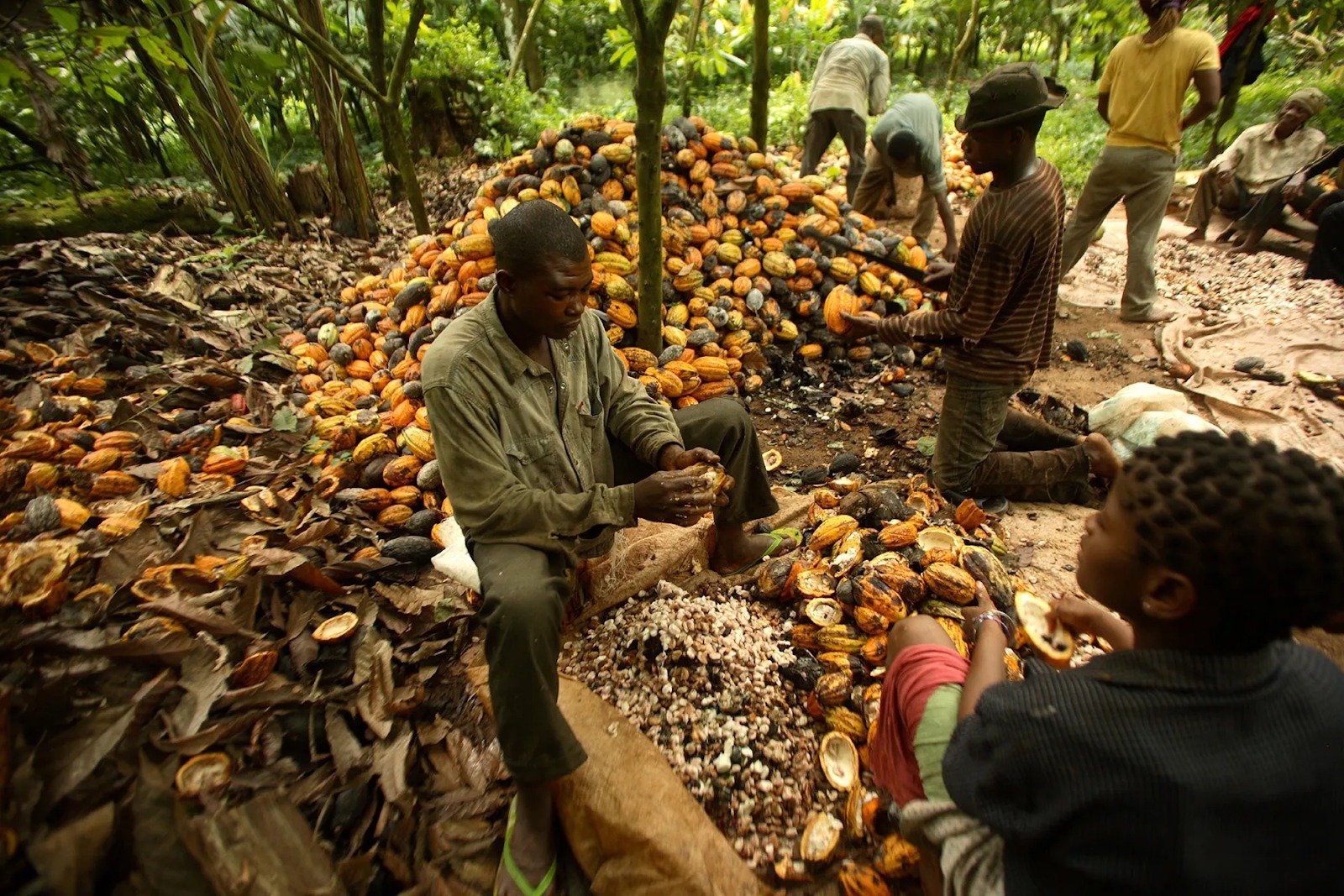
Ikom is a major cocoa-producing hub in Cross River State, and the decline in prices of the commodity has affected farmers, traders, and the subnational economy.
Globally, cocoa prices have plummeted by over 70 percent since hitting record highs in 2024, with futures peaking at over $12,500 and $12,900 per tonne, driven by severe supply deficit in West Africa, before dropping to around $3,613 per tonne. This decline has squeezed income margins, let alone profits, for farmers in Ikom, in particular, and Cross River, in general, who are struggling to cover input costs.
Many farmers had borrowed heavy credits and expanded their cocoa farms in mid-to-late 2025, thinking the commodity’s futures prices would keep soaring to pre-2025 levels. Today, how wrong they have been. Reports show that in Ikom, Etung, Boki, parts of Obudu, and down to Obubra, Biase, Odukpani and lower east of Calabar, most farmers have been reporting heavy losses since late 2025 and early this year. Farmers are unsure how to defray their loans, running into hundreds of millions of naira, the local currency of Nigeria. Some of them are considering switching to alternative crops or abandoning cocoa farming altogether.
Cocoa prices sold locally at N13,500 per kilogramme in 2024 to early 2025, from N2,500 in 2023. This prompted a frenzy of huge unplanned consumption investments by the farmers. In Ikom, which is the melting pot of the Cross River subnational economy driven by agriculture, most of them built new houses, rented new homes, bought new household properties, cars, some took holiday trips, including long hotel stays. Others reinvested, though without any thought of produce diversification, either into oil palm.
By far, the cocoa industry is a vital part of Ikom’s economy, with over 20 warehouses and numerous exporters operating in the area. The decline in prices has reduced economic activity in the expanding border town, affecting traders, transporters, and other stakeholders. The Cross River Cocoa Processing Factory, built at an estimated cost of N7 billion in 2017, remains abandoned, and its revival could create 5,000 jobs and generate some $6.8 million annually. But that doesn’t look like happening any time soon.
Recently, the Nigerian government talked of exploring ways to revive the cocoa industry, including investing in processing factories and supporting farmers. The minister of state for industry, trade, and investment, John Owan Enow (himself a homeboy, from Ikom) emphasized the need for value-added processing to boost the economy. Nothing has come out of that statement made at Ikom, where he visited the cocoa processing factory.
Impact on local communities
Indeed, the impact of the downward swing in cocoa prices on local communities in Cross River is significant and unprecedented. Many farmers now struggle to cover input costs. Some are virtually out of farming business due to paucity of funds to continue. The impact spreads on reduced farmer incomes, profit margins are squeezed, making it difficult for them to sustain their 2024 – early 2025 livelihoods. They also face challenges accessing credit, exacerbating their financial struggles. There are cases of abandoned farms, leading to reduced cocoa production and economic instability in the various cocoa producing communities. Women, who play a crucial role in cocoa production but often face challenges like limited access to land, inadequate funding, and poor storage facilities are more at risk. Blessing Amos, a farmer, spoke to our correspondent in Ikom, of considering withdrawing her four children from school to work on farms, and be taught by a private home teacher.
Longstanding farmer poverty
The Cocoa Barometer in a report in 2025, warned that the soaring cocoa prices was yet to reach most farmers. The biennial report said there was a complex picture of the global cocoa industry, describing a sector simultaneously facing “bad, better, and with a lot of room for improvement.” The report, produced by a consortium of civil society organisations, exposed that while Côte d’Ivoire and Ghana, which account for over 60 percent of global cocoa production, continue to shape market prices, and Nigeria emerged as a rising producer projected to deliver 350,000 tonnes in the 2024/ 2025 season, the benefits of soaring prices have not reached most farmers.
“Farmer poverty is at the root of virtually all problems in the cocoa sector, from deforestation to child labour and gender inequality,” the report said. “Paying farmers fairly is both a moral and legal obligation, thanks to new human rights and environmental legislation. But political resistance in Europe is threatening the hard-won progress in regulation.”
The report noted that forward-selling mechanisms have delayed the impact of price increases for farmers, even as yields fall due to aging trees, crop diseases, and erratic rainfall linked to climate change.
In addition, the Cocoa Barometer 2025 report warned that high prices were driving new waves of deforestation as farmers expand into untouched forests to maximise profits, a trend that could trigger oversupply and another price crash similar to 2016. This is the case in many parts of Cross River’s cocoa areas. Fresh forests have been chopped down to make way for cocoa farms.
In addition, the report painted the ongoing human rights abuses, with 1.5 million children still working in hazardous cocoa farming conditions in Ghana and Côte d’Ivoire, and women who perform the majority of farm labour largely excluded from profit-sharing and decision-making. Indeed, this also obtains in Ikom and other parts of Cross River’s cocoa producing belt.
The Cocoa Barometer 2025 report stressed that the absence of transparent farmgate pricing systems and limited accountability mechanisms continues to undermine progress.
It called for collective action by governments, companies, farmers, and civil society to achieve systemic reform through fair pay and commitment to a living income for farmers. Others are environmental protection through a global moratorium on deforestation linked to cocoa. Inclusive governance, which will ensure both men and women farmers are co-decision makers.
On its part, the Cocoa Association of Nigeria (CAN) is advocating for government support to address the challenges facing the sector.
Flora Takim-Ndifon, president of the Ikom Chamber of Commerce and Industry (IKOMCCIMA), leading the organised private sector in the border town, said in a recent note to Business A.M. that the absence of enabling infrastructure in the town is a big minus. “Ikom is self-driven, because it is poor or lacks infrastructure”.