
Onome Amuge
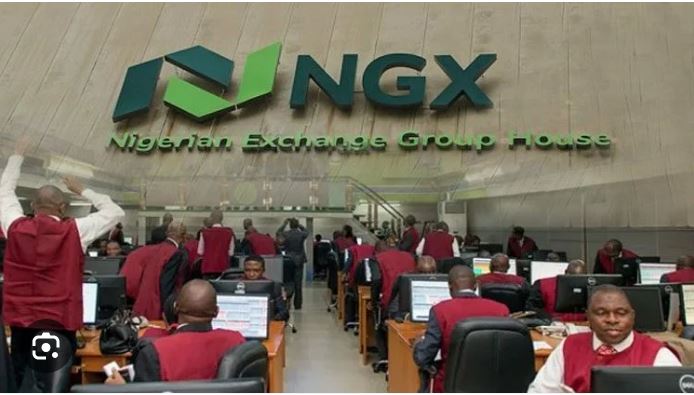
Nigeria’s equities market concluded Tuesday’s trading session with a sharp decline, as sustained profit-taking across bellwether stocks triggered a broad-based sell-off. This is as the Nigerian Exchange All-Share Index (NGX ASI) shed 1.46 per cent, paring its year-to-date return to 38.56 per cent. The day’s bearish sentiment resulted in a N1.33 trillion loss in market value for investors, with the total market capitalisation of listed equities falling to N90.23 trillion.
The negative trend was widely reflected across the market, with losers heavily outnumbering gainers, a clear sign of weak investor sentiment. While the number of deals and trading volume saw a decline, the total value of trades advanced to N17.43 billion, indicating that the sell-off was driven by large, high-value transactions. At the heart of this market retreat, industrial heavyweight Dangote Cement and insurance firm Royal Exchange were among the heaviest losers that epitomised the day’s profit-taking pressure.
The decline of Dangote Cement (DANGCEM) was a major factor in the market’s overall poor performance. As Nigeria’s largest company by market capitalisation and a key bellwether for the industrial sector, a nearly 10 per cent drop in its stock price holds significant sway over the NGX ASI. On Tuesday, its shares depreciated by 9.88 per cent, making it the second-worst performer of the day. The sell-off in such a prominent blue-chip stock indicates that investors, after a period of robust gains, are now opting to lock in profits, even at the cost of broader market stability. The sell-off in Dangote Cement contributed directly to the industrial goods sector’s steep 4.31 per cent loss, the steepest among all sectors.
According to analysts, the sell pressure on Dangote Cement and other large-cap stocks points to a strategic repositioning by institutional and foreign portfolio investors. For a stock of this magnitude, such a price swing is rarely an isolated event. It often reflects a broader investor calculus, influenced by both domestic profit-taking and the global risk-off sentiment that has been permeating international markets.
While Dangote Cement’s decline was significant due to its size, the steepest fall of the day belonged to Royal Exchange (ROYALEX), which saw its share price depreciate by a full 10 per cent. This sharp reversal in fortunes places the company at the top of the losers’ chart. As a key player in the insurance sector, its performance reflects the broader struggles of its industry, which posted the second-worst sectoral loss of the day, declining by 3.80 per cent.
Smaller, more volatile stocks like Royal Exchange are often disproportionately affected during periods of market-wide sell-offs. When investors become cautious, they typically shed riskier or less liquid holdings first. For the insurance sector, which has faced various challenges including macroeconomic headwinds and regulatory changes, the selling pressure was particularly acute. The sharp decline of Royal Exchange serves as a microcosm of this sector’s vulnerability to negative market sentiment. It highlights how even positive news in other parts of the economy, such as Nigeria’s moderating headline inflation, can be overshadowed by broad-based investor apprehension.
Meanwhile, the bearish sentiment was widespread, dragging down almost every major sector. The Banking index shed 2.06 per cent, weighed down by losses in major lenders like Zenith Bank and Stanbic IBTC. The Oil & Gas index also posted a loss of 0.08 per cent, despite an increase in global oil prices. The insurance sector’s 3.80 per cent loss further solidified the widespread nature of the sell-off.
On the flip side, the consumer goods sector emerged as the sole gainer, rising by 0.51 per cent. This performance signals a flight to defensive stocks, as investors seek refuge in companies that produce essential goods, which tend to be more insulated from market downturns. The commodity sector, meanwhile, closed flat, indicating a wait-and-see approach from investors in that space.
Analysts assert that the market’s performance cannot be viewed in isolation from the global financial landscape. Fixed income market analysts have observed a sustained bearish sentiment in the African Eurobond market, which has affected a number of African issuers including Ghana, Angola, and Egypt. This global risk-off sentiment is largely attributed to a tempering of expectations for a US Federal Reserve rate cut in September, following unexpectedly strong US economic data. This external pressure has translated into a cautious disposition among foreign portfolio investors, who are reducing their positions in emerging markets.
In the coming days, markets are projected to likely continue to trade cautiously as investors digest fresh data and global developments, including the outcome of the meeting between Donald Trump and Russian President Vladimir Putin. While the recent moderation in Nigeria’s inflation rate provides a positive domestic backdrop, the market’s direction will remain highly susceptible to global capital flows and risk appetite. Investors will be looking for a clearer signal from major economies before committing to significant new positions, making the market’s near-term outlook uncertain.