By Business a.m.
…says a ‘newly industrialized nation’ possible in 10yrs
Africa’s wealthiest man and president of Dangote Group, Aliko Dangote, has identified priority investments in infrastructure and core industries, creation of business-enabling policy framework, macroeconomic stability, among others as vital ingredients to boost Nigeria’s economy to its desired level among contemporary nations and in the world.
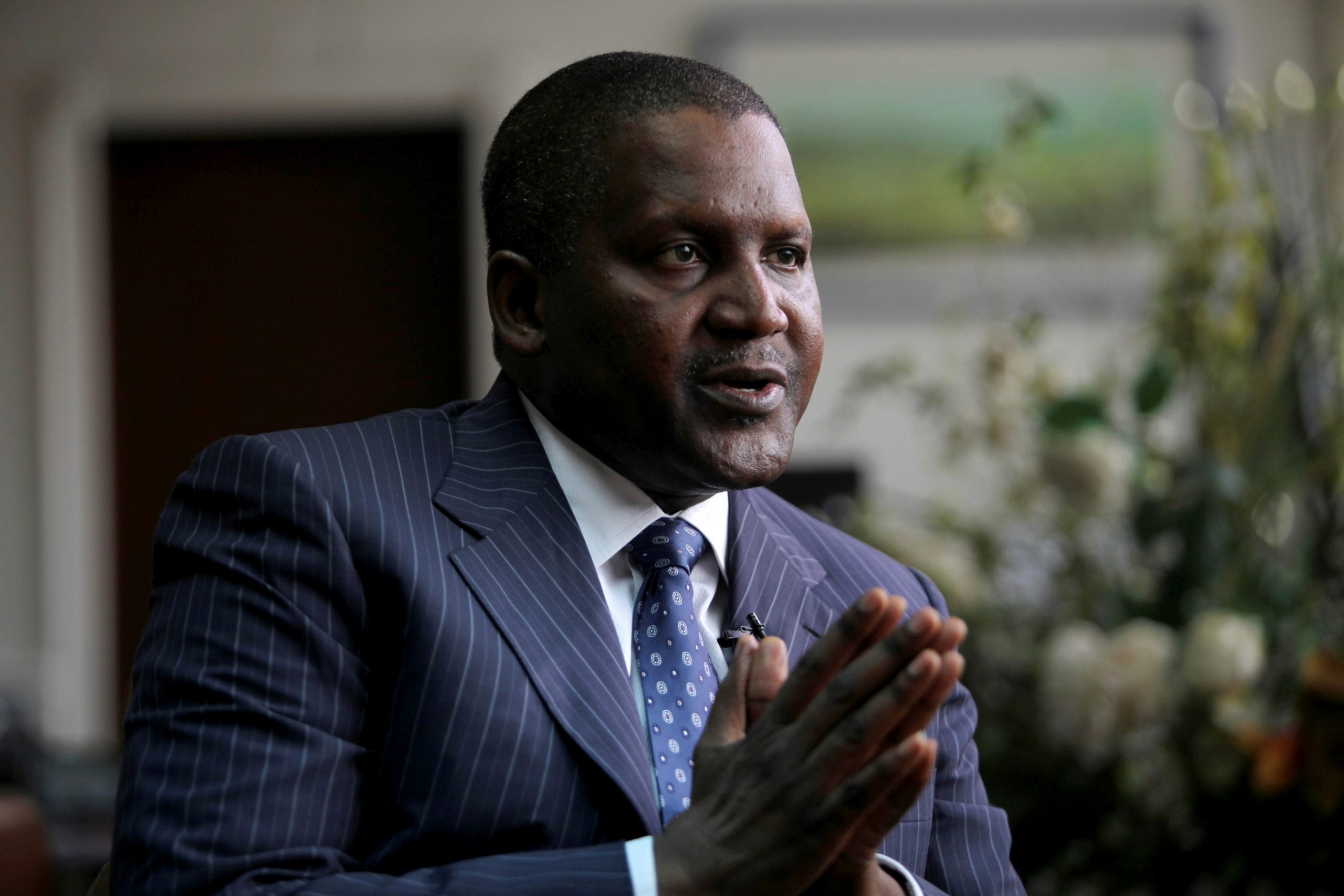
Dangote, in his address as guest speaker at the landmark 50th AGM of the Manufacturers Association of Nigeria (MAN) and the 2nd Adeola Odutola Lecture held Tuesday in Lagos, expressed optimism that with the collective effort of all stakeholders, Nigeria can move from “developing nation” to “newly industrialized nation”.
At the AGM, themed “An Agenda for Nigeria’s Industrialization for the Next Decade”, where a Blueprint for the Accelerated Development of Manufacturing in Nigeria 2.0 was unveiled, the foremost entrepreneur advocated jail terms for dealers in foreign textile materials in order to discourage imports and boost local production in the textile industry. For legislative backup, he also sought the enactment of a law prohibiting the sale of imported fabrics in the country.
Dangote identified various measures which needed to be put in place to allow Nigeria speed up its industrialization process and development growth. These measures included investment in infrastructure; creation of business-enabling policy framework; development of core industries; macroeconomic stability; facilitation of sectoral linkages and sustaining of the federal government’s recent efforts at ensuring security of lives, property and investments across the nation.
The business titan examined the performance of the industrial sector in Nigeria; identified the nexus between industrialization and economic development with Nigeria and China as case study; analyzed the manufacturing sector in the country with focus on its growth trajectory, current status and challenges, and set an agenda for the next 10 years with an implementation roadmap.
“The experience in various parts of the world has shown that industrialization drives economic growth and development, which improves living standards as evident by the high output and per capita income in industrialized countries,” Dangote said.
He said the rate of industrialization in Nigeria has been slow as evidenced by the low contribution of manufacturing to GDP, poor capacity utilization and constrained export of manufactured products within and outside the continent.
“For instance, Nigeria’s share of world output of 0.41 percent, ranked 29th in the world, which is unimpressive considering its size and resource endowments. It ranks poorly when compared with India at 3.1 percent, South Korea (3.0 percent) and China (28.7 percent),” he said.
He said Nigeria’s industrialization process has been greatly challenged by structural and institutional constraints, particularly funding, adding that these factors have over the years cumulatively contributed to the country’s disappointing performance.
Citing an instance, Dangote said in the last decade, average share of manufacturing value added to GDP in countries like China and Malaysia stood at 41 percent and 38 percent, respectively, compared to 25 percent in Nigeria.
In terms of capacity utilization, a major performance indicator which reflects the ability of manufacturing companies to meet rising demand without increasing cost, Dangote said Nigeria achieved a rate of 55 percent compared to 76 percent and 78 percent in China and South Africa, respectively. He said the country’s dwindling industrial performance has significant socio-economic implications, as poverty and unemployment continue to rise.
“From 1960 to 2003, the development trajectory of China by far outpaced that of Nigeria within the same period, even though Nigeria began on a seemingly better footing. It is therefore important to track back to where Nigeria ‘dropped the ball’ with a view to repositioning the country to the path of growth, development, and social upliftment,” Dangote said.
“Based on the comparative analysis of Nigeria and China, one can safely make the following deductions: (i) the numerical strength of a nation (population) can indeed be translated into economic wealth; (ii) steady growth in manufacturing output is possible when the operating environment is conducive; (iii) no nation can easily transit from ‘developing’ to ‘newly industrialized’ without a vibrant manufacturing sector; (iv) effective implementation of long-term plans backed with policy consistency will promote enduring economic growth and development,” he said.
The industrialist observed that Nigeria’s manufacturing sector is dominated by light manufacturing with only a few firms operating in the heavy segment of the sector.
He identified several factors that need to be in place to accelerate the growth of Nigeria’s manufacturing sector, including security and rule of law; industry-oriented government policy; adequate infrastructure; industry-oriented Research & Development (R&D); a well-developed SME sector; building of human capacity; and embrace of technology to improve efficiency through automation of manufacturing processes.
On the current status of the manufacturing sector, Dangote noted that manufacturing was singled out in the Nigerian Industrial Revolution Plan (NIRP) as the driver of industrialisation and economic growth.
He said the contribution of manufacturing to real GDP in Nigeria contrasts with what obtains in countries like China (27.16 percent in 2019); Germany (19.11 percent); Japan (20.74 percent); and South Africa (13.53 percent).
“To drive industrialization and sustained economic growth in Nigeria, it is important that deliberate policies that are manufacturing-specific should be designed to support manufacturing activities and address the perennial challenges of the sector. It is important to note that the current government policies, if fully implemented, are good enough to address most of the challenges we are now facing,” he said.
Among manufacturing challenges, he identified acute shortage of forex; dearth of long-term funds; limited infrastructure; policy inconsistency/implementation/ enforcement; over-regulation; multiple and high taxes for the industries (the manufacturing sector is beset with over 30 statutory taxes, levies, fees, etc. charged at multiple tiers of government), and insecurity.
“In consideration of the afore-mentioned challenges, there is an urgent need for a shift in policy approach and strategy to reposition the manufacturing sector for growth over the next 10 years. It is imperative that the familiar challenges limiting the pace of industrialization are frontally addressed while setting a clear-cut agenda for the next 10 years,” Dangote said.
To achieve industrialization goals, he said it is necessary for a nation to formulate plans and policies that will enhance and sustain industrial development.
“Sustainable industrial development involves establishment of a conducive environment to encourage investment and ensure efficient usage of resources to increase productivity and growth of the nation,” Dangote said.
“Nigeria needs to henceforth intensify efforts at promoting industrialization with specific focus on the attainment of the following targets in the next 10 years: 15 percent manufacturing sector growth, 20 percent manufacturing contribution to GDP, 15 percent growth in export of manufactured products, 10 percent increase in the share of manufacturing to total export merchandise, stronger inter-industry linkage between SMEs and large corporations, improved manufacturing contribution to government tax revenue, and 20 percent increase in manufacturing employment,” he added.
Dangote noted that the drive to transform Nigeria into an industrialized nation has been a consistent goal of successive governments since independence. He emphasised that it is imperative for the country to focus on sectors with great potential for inclusive growth, adding that sustainability must be central to the industrial development agenda.
Government at all levels also need to ensure that they consult widely with relevant stakeholders when taking far-reaching decisions on key sectors of the economy as this will make it much easier for manufacturers to make long-term business plans, he said.
“In addition, policies that have been ‘tried-and-tested’ should be backed with an Act of parliament to give them legal backing and make them less susceptible to arbitrary changes by successive governments,” he said.
Dangote said industrialization, driven by manufacturing, has the capacity to facilitate enduring economic growth, adding that the transition mechanism entails the availability of required resources, adoption of appropriate technology, provision of favourable operating environment, human capital development, stable macroeconomic environment and adequate infrastructure.
“With the collective effort of all stakeholders, it is feasible to move Nigeria from ‘developing nation’ to ‘newly industrialized nation’ status within the next 10 years,” he said.