
Onome Amuge
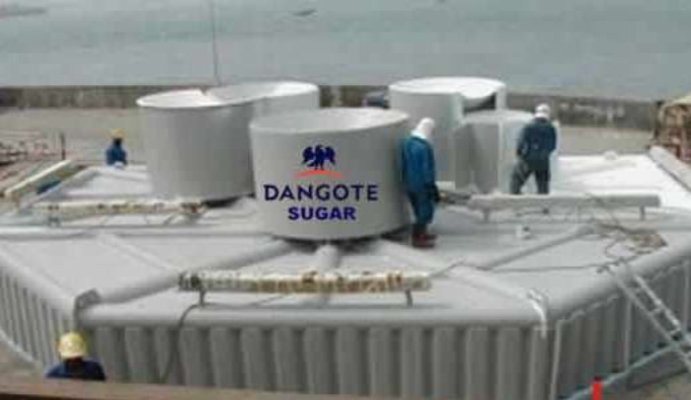
Dangote Sugar Refinery has reaffirmed its commitment to Nigeria’s industrialisation drive, unveiling a $700 million investment package aimed at ending the country’s dependence on imported raw sugar. The investment covers land acquisition, machinery, infrastructure, manpower, community relations, corporate social responsibility (CSR), and other critical initiatives, the company said at the ongoing Lagos International Trade Fair.
The announcement coincided with the unveiling of new Stock Keeping Units (SKUs) in sizes of 100g, 250g, 500g, and 1kg, as part of Dangote Group’s strategy to deepen backward integration in sugar production. Speaking at the event, Ravindra Singhvi, group CEO of Dangote Sugar Refinery, said the conglomerate is intensifying efforts to localise sugar production and stimulate domestic value addition.
“The SKUs we are introducing demonstrate our commitment to providing quality, locally produced sugar while supporting Nigeria’s goal of ending raw sugar importation,” Singhvi said.
The group’s industrialisation strategy extends beyond sugar. Fatima Aliko-Dangote, Dangote Group executive director, commercial operations, highlighted the organisation’s dedication to building a diversified economy through large-scale industrial projects. “Full industrialisation remains the best approach to adding value to our materials, creating jobs for our youth, and promoting the rise of ancillary industries,” she said.
Aliko-Dangote noted that the Dangote Petroleum Refinery’s capacity is set to expand from 650,000 barrels per day to 1.4 million barrels per day by 2028, while Dangote Fertiliser Limited and Dangote Polypropylene plants are also earmarked for expansion to increase domestic output and economic contribution.
The conglomerate is also partnering with Ethiopian Investment Holdings (EIH) to develop a $2.5 billion, three-million-tonne urea fertiliser complex in Gode, Ethiopia. Aliko-Dangote said the project, once operational, will generate thousands of direct and indirect jobs and bolster agricultural productivity in the region.
The theme of this year’s Lagos International Trade Fair, “Connecting Businesses, Creating Value,” was cited by Aliko-Dangote as particularly fitting. “It brings together manufacturers, suppliers, distributors, and consumers, facilitating collaboration and driving economic impact across sectors,” she said.
Gabriel Idahosa, president and chairman of the Council of the Lagos Chamber of Commerce and Industry (LCCI), commended Dangote Group as a symbol of industrial resilience and foresight. “Over the years, particularly during periods of economic uncertainty, the Dangote Group has sustained operations, safeguarded jobs, and invested in critical infrastructure and local supply chains,” Idahosa said.
He added that the company’s investments have reinforced confidence in Nigeria’s economy. “This underscores the importance of public-private collaboration, strategic investment in human capital and technology, and inclusive industrial policies that strengthen Nigeria’s competitiveness. These pillars are central to transforming potential into measurable national growth,” he said.








What will you leave when you’re gone?