Nigeria’s startup ecosystem continues to evolve at a rapid pace, reflecting a new wave of innovation, ambition, and global attention. From fintech disruptors reimagining payments to healthtech and edtech ventures pushing social impact boundaries, young Nigerian founders are rewriting the country’s entrepreneurial story. However, behind the excitement of record funding rounds and product launch lies a recurring challenge of sustainability.
Many promising ventures struggle to scale beyond their pilot stages, often tripped by premature expansion, weak financial discipline, and governance lapses. As global investors demand stronger business fundamentals and local market conditions grow tougher, the question of how to build resilient, context-driven startups has never been more urgent.
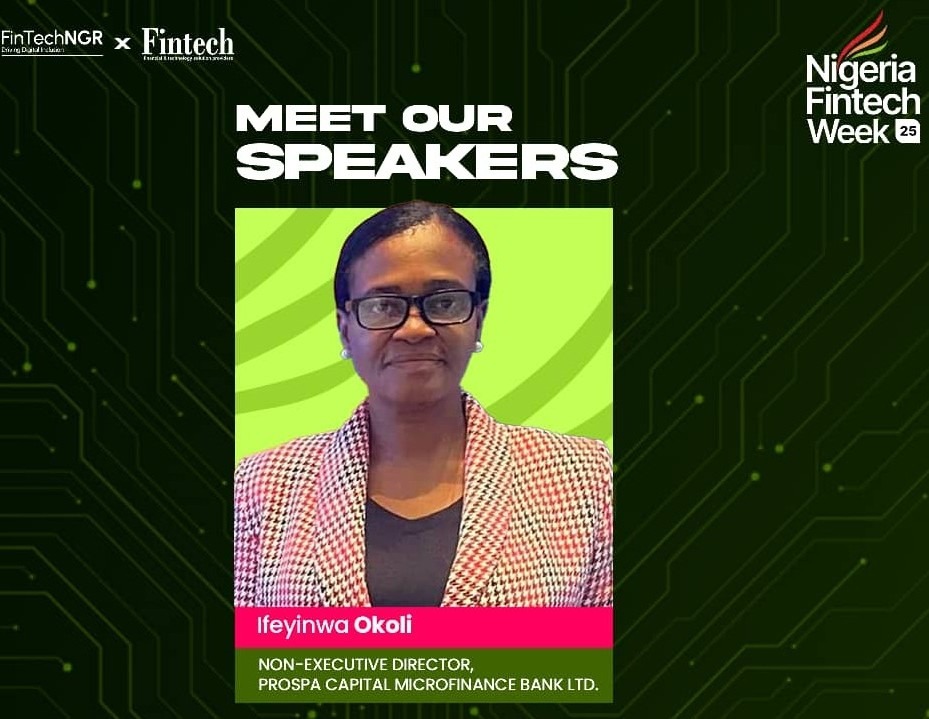
At the recently concluded Nigeria Fintech Week 2025 (NFW25), Ifeyinwa Okoli, fintech & cybersecurity leader and non-executive director at Prospa Capital MFB Ltd, brought fresh clarity to that conversation. Drawing on over two decades of experience in financial services, digital payments, fintech innovation, and cybersecurity strategy, she offered practical insights into what it takes for startups to grow responsibly and sustainably in Africa’s evolving digital economy.
Recognised for her leadership in driving financial inclusion and strengthening digital financial ecosystems across the continent, Okoli has played a pivotal role in shaping Africa’s digital finance narrative. Building on insights she first shared as a panellist at the Nigeria Fintech Week 2025, she expanded the discussion in a follow-up exchange with Business a.m., offering deeper reflections on the common pitfalls founders must avoid, the importance of designing for Africa’s unique market realities, and the transformative shifts that will define the continent’s fintech future.
What are the most common mistakes Nigerian startups make when trying to scale and how can they be avoided?
You know, one of the biggest mistakes I’ve seen is scaling too early. A lot of startups get excited once they see some traction, maybe a few thousand users or a successful pilot and they rush to expand. But the truth is, if your product-market fit isn’t solid, scaling just multiplies your problems. Another big issue is poor financial discipline. Some founders are more focused on raising funds than understanding their numbers, things like unit economics, cost of acquisition, or customer lifetime value. When the funding slows down, the business struggles. And then there’s weak governance.
As startups grow, they need structure, clear roles, accountability, and strong leadership. Without that, growth can quickly turn chaotic. So how can they avoid these pitfalls? Start by mastering your fundamentals. Know your market deeply, build processes early, and grow sustainably. Scaling is not about moving fast; it’s about moving strong.
Key takeaway: Don’t chase growth; chase readiness,because when your foundation is solid, scaling becomes natural.
How can founders avoid copying foreign startup models that may not fit the Nigerian or African market?
This one really hits home. We often see founders copy what worked in Silicon Valley or London and try to apply it here directly. But Nigeria and Africa are completely different markets. Our infrastructure, payment systems, and even cultural behaviors are unique. So instead of copying, founders should adapt and localize. Ask: what’s the core idea behind that model, and how can it work in our reality? For example, a delivery app that depends on fixed addresses might not work in Lagos where people move often. But if you tweak it with GPS location pins or WhatsApp confirmation, it suddenly makes sense. Founders also need to build for inclusion. Many of our users are mobile-first or even offline. So, design for how people actually live, not for how you wish they lived.
Key takeaway: Don’t import innovation — translate it. Build for our context, and you’ll build something that truly lasts.
In today’s high-inflation and unstable macroeconomic climate, what strategies can startups use to build resilience?
Honestly, this is the time when financial discipline and adaptability are everything. Inflation is high, forex is unstable. So founders need to focus on survival before scale. First, manage cash tightly. Track your burn rate, and always know how many months of runway you have. Secondly, diversify your revenue streams; one product or client should never define your business. Third, use technology to automate operations and cut costs wherever possible. Also, rethink your pricing model — try to price in local currency, and explore partnerships that share risks and resources.
Resilience isn’t about never falling, it’s about building a model that can bend without breaking. The startups that survive this season will be lean, flexible, and laser-focused on value.
From your experience, what are some overlooked opportunities in the African fintech ecosystem that more founders should explore?
A lot of founders are still focused on payments, yet the ecosystem is much bigger. There are major untapped opportunities in SME financial infrastructure, Regulatory Technology (RegTech), embedded finance, and data-driven credit solutions for underserved segments.
For example, small and medium enterprises need simplified tools for credit scoring, accounting, and cross-border transactions. Similarly, Regulatory Technology platforms can help financial institutions meet AML and KYC compliance more efficiently. Another promising area is interoperable digital identity, which will drastically reduce fraud and onboarding costs. These are areas with scalable impact and strong investor interest that remain underexplored.
What qualities will define Nigerian startups that stand the test of time?
The startups that will truly stand the test of time are those that combine resilience, innovation, and integrity. They’ll be problem-solvers, not just profit-seekers. They’ll have strong governance, ethical leadership, and a clear purpose that goes beyond hype. They’ll also be adaptable; ready to pivot when the environment changes, but always staying true to their mission.
Key takeaway: The future belongs to startups that don’t just chase growth, but create value for people, for communities, and for the country.
How important is regulatory collaboration for startups, and how should founders approach working with regulators?
In fintech, your regulator can be your biggest risk or your biggest partner. Startups that treat regulation as part of their product design, rather than an afterthought, tend to scale faster and with fewer disruptions.
The smartest founders build open communication lines with regulators early on. They participate in sandboxes, contribute to policy discussions, and are transparent about their risk controls. This proactive engagement not only reduces compliance friction but also builds credibility that competitors can’t easily replicate. Regulation, when approached correctly, can become a strategic advantage.
What role does cybersecurity play in building investor trust for African startups, especially in fintech?
Cybersecurity is not just a technical function it is a trust engine. For African fintechs, where user confidence and regulatory credibility determine growth, cybersecurity is what turns innovation into investment. Investors want assurance that a startup can safeguard sensitive customer data and maintain operational continuity under stress.
When startups demonstrate robust data protection policies, incident response readiness, and compliance with security standards, it signals governance maturity. That is what attracts venture capital and institutional funding. In essence, cybersecurity transforms a startup’s credibility into a measurable asset that drives both valuation and investor confidence.
What advice would you give to female founders or women looking to enter the fintech or cybersecurity space in Africa?
My advice is simple lead with impact, not permission and you don’t need to wait for validation. Your results will speak for you. Start by solving a real problem, build early traction, and let measurable outcomes open doors. Women bring unique perspectives to product design, risk management, and customer trust which are critical to fintech and cybersecurity.
It is very important to build networks, seek mentors, and leverage women-led founder communities. Also, do not shy away from the technical side, understanding cybersecurity fundamentals gives you a huge edge in leadership and investor discussions.
Looking ahead to the next five years, what shifts do you predict will shape the future of fintech in Nigeria and across Africa?
The next five years will bring a massive evolution. I see five major shifts defining the landscape:
Expansion beyond payments: Fintechs will evolve into full-service providers offering credit, savings, insurance, and investment products.
Rise of alternative data models: Credit scoring using telecom, utility, and social data will expand access to finance.
Interoperability and open banking: APIs will make financial systems more connected and efficient.
Regulatory clarity and RegTech innovation: Better frameworks and compliance tools will attract institutional capital.
Security and identity as competitive differentiators: The fintechs that embed cybersecurity and trust by design will lead regional and cross-border expansion. Ultimately, Africa’s fintech story will shift from financial inclusion to financial empowerment, driven by data, identity, and digital trust.