Onome Amuge
The European Union’s repeated delays in implementing its anti-deforestation regulation are drawing criticism after a new investigation revealed that Liberia’s expanding cocoa sector is driving widespread illegal forest clearance and fuelling labour exploitation, including the use of minors.
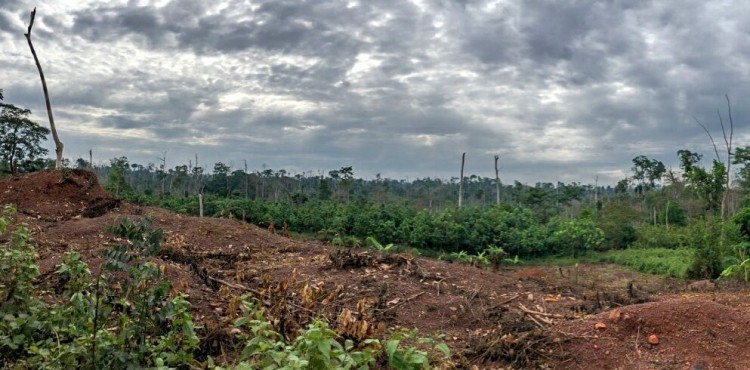
The report, released recently by the Initiatives for Community Development and Forest Conservation Association (IDEF), documents what it calls colossal deforestation in Liberia’s southeastern Grand Gedeh region, as thousands of producers from neighbouring Côte d’Ivoire cross the border in search of fertile land. Investigators also found evidence of possible child labour and human trafficking linked to cocoa farming, raising concerns that products destined for European markets are being tainted by rights abuses.
The findings expose the gap between Brussels’ regulatory ambitions and their real-world application. The EU Deforestation Regulation (EUDR), passed in 2023, was meant to bar imports of cocoa, coffee, palm oil and other commodities linked to forest loss after December 2020. But as the Commission considers further postponements to its rollout under pressure from industry and member states, campaigners warn that forest destruction is accelerating in some of the world’s most fragile ecosystems.
“While Europe dithers and keeps putting off the implementation of its law, there will be no forests left in Liberia and it will be too late. If Europe continues down this path, its international credibility will be called into question,” said Bakary Traoré, IDEF’s executive director.
Liberia has become a fresh frontier for cocoa production as land in Côte d’Ivoire, the world’s largest supplier, becomes exhausted after decades of deforestation and heavy pesticide use. The UN’s Food and Agriculture Organization estimates that Liberia still contains about 40 per cent of West Africa’s remaining primary forests, making it a target for cocoa expansion.
According to Global Forest Watch, Liberia has lost nearly a quarter of its tree cover since 2000, with cocoa farming a major contributor. In 2022 alone, forest loss reached 150,000 hectares.
IDEF’s survey in Grand Gedeh found an increase in the size of plots cleared for cultivation, with local families ceding between 50 and 300 hectares each, compared with 8 to 10 hectares documented in earlier years. Authorities have officially registered 38,000 newcomers to cocoa farming in the region, though the real number could be as much as three times higher once unrecorded migrants are included.
“The scale of deforestation is colossal. In ten years at most, Liberia’s vast forest cover could be nothing more than a distant memory,” Traoré said.
The report highlights not only ecological damage but also troubling labour practices. Migrant workers recruited to clear and cultivate cocoa plots are often hired informally through intermediaries, without contracts or wages. Instead, they are promised a share of profits once the land becomes productive, a system that leaves them dependent on landowners and vulnerable to exploitation.
Investigators noted that many of these workers appeared to be underage, despite claiming to be older than 20. “It is highly likely they were advised to do so by those who brought them here,” Traoré said.
Such findings risk reigniting concerns over child labour in West Africa’s cocoa supply chains, an issue that has dogged the industry for decades. Major chocolate manufacturers including Barry Callebaut, Nestlé and Mondelez have faced lawsuits and consumer backlash over their sourcing practices in Côte d’Ivoire and Ghana. There are concerns that Liberia’s emergence as a new supplier may complicate corporate compliance with sustainability pledges and expose companies to reputational risks.
Beyond environmental and labour issues, Liberia’s cocoa boom is also straining land governance. The country’s civil war in the 1990s left a legacy of contested property rights, and community leaders in Grand Gedeh say much of the land now being cleared for cocoa has been leased in violation of national law. Some plantations overlap with existing forestry concessions, increasing the likelihood of disputes.
“Land grabs have led to conflicts and tensions between community leaders, community members and cocoa farmers,” said Andrew Zelemen, secretary of the National Union of Community Forestry Development Committees of Liberia. He pointed to violent clashes earlier this year in the district of Gbarzon as evidence of the risks.
Local leaders have urged the government to strengthen oversight through the Liberia Land Authority, the Forestry Development Authority and the Ministry of Internal Affairs. But weak enforcement capacity and the economic allure of cocoa complicate efforts to halt encroachment.
The EU is by far the world’s largest importer of cocoa, accounting for more than 60 per cent of global demand. Brussels’ ability to police supply chains is therefore considered critical to shifting incentives for producers and governments in Africa.
The EUDR, in theory, provides a mechanism to ban imports linked to deforestation after 2020. But its implementation has been repeatedly pushed back amid industry complaints over costs and technical hurdles. Traders argue that smallholder farmers in developing countries lack the resources to comply with strict traceability requirements, raising fears of exclusion from the European market.
According to industry reports, cocoa produced in Liberia rarely enters the global market directly. Instead, much of it is funnelled through Côte d’Ivoire, raising the risk of laundering beans into Ivorian exports that are ultimately sold to European buyers. That complicates compliance with the EUDR, which requires companies to prove traceability back to specific plots of land.
The stakes are high for Liberia itself. Forests remain a key pillar of its economy, supporting timber exports and providing livelihoods for rural communities. They also represent one of West Africa’s most important carbon sinks, critical for global climate mitigation.
But without stronger governance, the country risks replicating the trajectory of Côte d’Ivoire and Ghana, where more than 80 per cent of forest cover has been destroyed over the past century. “We have the hindsight to know what happens if this is left unchecked. The consequences for communities that rely on forests and subsistence agriculture will be devastating,” Traoré said.