FAAN chief explains improvements in passenger experience at Nigerian airports

Sade Williams/Business a.m.

The Federal Airports Authority of Nigeria (FAAN) said it has in recent times rolled out different innovative solutions to improve passenger facilitation and experience at the nation’s airports.

Olubunmi Kuku, managing director of FAAN, participating in a panel on “Shaping the Future of Air Travel: A Global Airport Perspective” during the just concluded 35th Airports Council International World Annual General Assembly in Toronto, emphasised the need for continuous investment in airport infrastructure, adding that the current administration has invested a lot to address infrastructure deficit in aviation.

While stressing the  place of private sector participation, Kuku disclosed that FAAN had been self-sustaining through its internally generated revenue (IGR), but  praised the government for its support with the bigger projects.

“You can’t depend on the government alone in a market like ours, which is capital-intensive.  So we talk about where private sector participation and foreign direct investment are. We’ve been lucky at the Federal Airports Authority of Nigeria. I don’t necessarily want to say it’s a vote of confidence, but, you know, the fact that our government recognises there is indeed a need to drive some infrastructure upgrades means we’ve been able to secure partial funding from them. But we at the Federal Airports Authority are also primarily driven by our internally generated revenue, meaning we’re sort of self-sustaining, except for this major capital renewal we’re getting for infrastructure upgrades over the next 22 to 24 months,” she said.

Kuku explained that FAAN has put in place and is still installing modern technologies for seamless connections and passenger profiling.

She also mentioned the contactless payment system which was recently introduced to enhance transparency and accountability in revenue collection.

This initiative, launched in partnership with Paystack, uses a universal prepaid contactless card for services like airport access gates and car parks, making transactions faster, safer, and more efficient.

“I will say that I do believe there are many similarities across different experiences, but, of course, you will understand that specific markets are more advanced than others, as you will see in terms of technological advancements to improve the passenger experience. But one thing we’ve done — and I mentioned this at our last Africa Regional Conference — is we’ve developed, or are developing an airport environment that matches the lifestyle of our travellers.

“So, much as we’re keen to implement modern, advanced technology that makes it easier for passengers, we also want to ensure it’s seamless, understandable, and aligned with the profile of the passengers flying through our airport. So I mentioned that, for example, we’re implementing contactless in the airport environment with our e-gates. So we have e-gates both on departure and arrival. We didn’t have that before. So, on arrival, we do have many airlines keying in, so you can use that. And it’s interesting: when you talk about that experience and what’s happening with the airlines, I think one of the biggest challenges I’ve had with some of the airlines is actually getting them to key into the technology enhancements and modernisation within the airport environment.

“I chatted with someone yesterday about a passenger who flew from one of my airports. Some of the concerns they had were about visa restrictions, advanced passenger information, and ensuring we’re all in sync. So I would say yes, there is a lot of synergy. We’re getting much more cooperation from some airlines. I think the U.S. airlines, to be fair, have been quite forward-thinking in terms of what we do to make sure that our passengers have an improved experience door-to-door, right, from the departure airports to the transit airports and then to their final destination.”

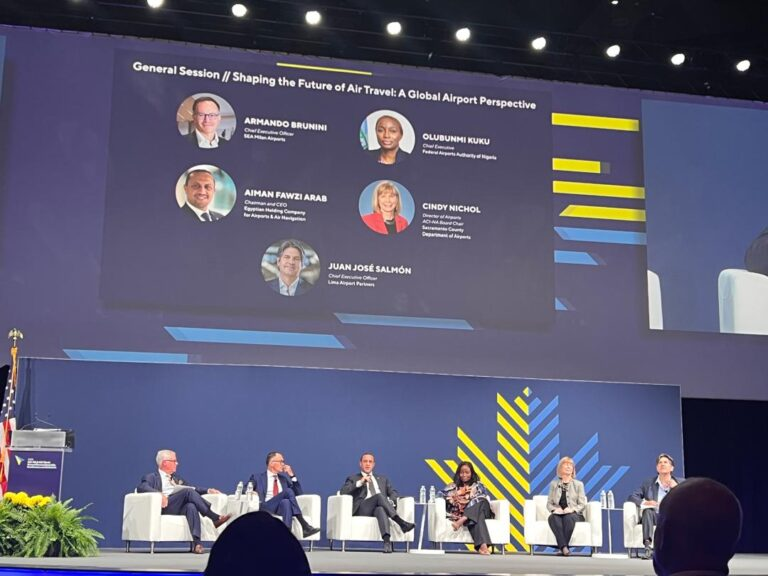
Panelists during the General Session: “Shaping the Future of Air Travel- A Global Airport Perspective” at the ACI-NA & ACI World Annual General Assembly, Conference and Exhibition 2025 in Toronto. Seated (from left) are Armando Brunini, CEO SEA Milan Airports; Aiman Fawzi Arab, Chairman and CEO Egyptian Holding Company for Airports & Air Navigation; Olubunmi Kuku, Managing Director/Chief Executive, Federal Airports Authority of Nigeria (FAAN); Cindy Nichol, ACI-NA Board Chair and Director of Airports, Sacramento County; and Juan José Salmón, CEO Lima Airport Partners.

Kuku  alluded to positive results from collaboration with sister agencies, saying: “We’ve also done well in Nigeria: our civil aviation authority, in collaboration with the Federal Airports Authority, has established a powerful consumer protection unit. We have, I will say, placed sanctions on many airlines that haven’t complied or supported our strategy to improve the customer experience. We’re seeing airlines fall into shape with that. But I think the good thing is really about collaboration, early stakeholder engagement. I think that really helps along the way, especially when you start rolling out new technologies or changes within the environment they’re used to. So, for example, with the airport rehabilitation works we’re doing, we made sure there was very early engagement with many of the airlines, and the feedback we received was interesting,” she added.

Leave a Comment

FAAN chief explains improvements in passenger experience at Nigerian airports

Sade Williams/Business a.m.

The Federal Airports Authority of Nigeria (FAAN) said it has in recent times rolled out different innovative solutions to improve passenger facilitation and experience at the nation’s airports.

Olubunmi Kuku, managing director of FAAN, participating in a panel on “Shaping the Future of Air Travel: A Global Airport Perspective” during the just concluded 35th Airports Council International World Annual General Assembly in Toronto, emphasised the need for continuous investment in airport infrastructure, adding that the current administration has invested a lot to address infrastructure deficit in aviation.

While stressing the  place of private sector participation, Kuku disclosed that FAAN had been self-sustaining through its internally generated revenue (IGR), but  praised the government for its support with the bigger projects.

“You can’t depend on the government alone in a market like ours, which is capital-intensive.  So we talk about where private sector participation and foreign direct investment are. We’ve been lucky at the Federal Airports Authority of Nigeria. I don’t necessarily want to say it’s a vote of confidence, but, you know, the fact that our government recognises there is indeed a need to drive some infrastructure upgrades means we’ve been able to secure partial funding from them. But we at the Federal Airports Authority are also primarily driven by our internally generated revenue, meaning we’re sort of self-sustaining, except for this major capital renewal we’re getting for infrastructure upgrades over the next 22 to 24 months,” she said.

Kuku explained that FAAN has put in place and is still installing modern technologies for seamless connections and passenger profiling.

She also mentioned the contactless payment system which was recently introduced to enhance transparency and accountability in revenue collection.

This initiative, launched in partnership with Paystack, uses a universal prepaid contactless card for services like airport access gates and car parks, making transactions faster, safer, and more efficient.

“I will say that I do believe there are many similarities across different experiences, but, of course, you will understand that specific markets are more advanced than others, as you will see in terms of technological advancements to improve the passenger experience. But one thing we’ve done — and I mentioned this at our last Africa Regional Conference — is we’ve developed, or are developing an airport environment that matches the lifestyle of our travellers.

“So, much as we’re keen to implement modern, advanced technology that makes it easier for passengers, we also want to ensure it’s seamless, understandable, and aligned with the profile of the passengers flying through our airport. So I mentioned that, for example, we’re implementing contactless in the airport environment with our e-gates. So we have e-gates both on departure and arrival. We didn’t have that before. So, on arrival, we do have many airlines keying in, so you can use that. And it’s interesting: when you talk about that experience and what’s happening with the airlines, I think one of the biggest challenges I’ve had with some of the airlines is actually getting them to key into the technology enhancements and modernisation within the airport environment.

“I chatted with someone yesterday about a passenger who flew from one of my airports. Some of the concerns they had were about visa restrictions, advanced passenger information, and ensuring we’re all in sync. So I would say yes, there is a lot of synergy. We’re getting much more cooperation from some airlines. I think the U.S. airlines, to be fair, have been quite forward-thinking in terms of what we do to make sure that our passengers have an improved experience door-to-door, right, from the departure airports to the transit airports and then to their final destination.”

Panelists during the General Session: “Shaping the Future of Air Travel- A Global Airport Perspective” at the ACI-NA & ACI World Annual General Assembly, Conference and Exhibition 2025 in Toronto. Seated (from left) are Armando Brunini, CEO SEA Milan Airports; Aiman Fawzi Arab, Chairman and CEO Egyptian Holding Company for Airports & Air Navigation; Olubunmi Kuku, Managing Director/Chief Executive, Federal Airports Authority of Nigeria (FAAN); Cindy Nichol, ACI-NA Board Chair and Director of Airports, Sacramento County; and Juan José Salmón, CEO Lima Airport Partners.

Kuku  alluded to positive results from collaboration with sister agencies, saying: “We’ve also done well in Nigeria: our civil aviation authority, in collaboration with the Federal Airports Authority, has established a powerful consumer protection unit. We have, I will say, placed sanctions on many airlines that haven’t complied or supported our strategy to improve the customer experience. We’re seeing airlines fall into shape with that. But I think the good thing is really about collaboration, early stakeholder engagement. I think that really helps along the way, especially when you start rolling out new technologies or changes within the environment they’re used to. So, for example, with the airport rehabilitation works we’re doing, we made sure there was very early engagement with many of the airlines, and the feedback we received was interesting,” she added.

[quads id=1]

Get Copy

Leave a Comment