LEADERSHIP & ORGANISATIONS
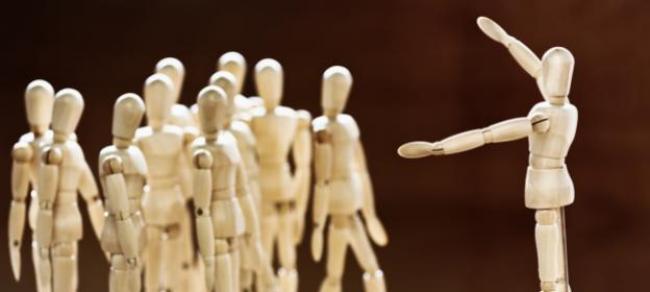
Dictatorial types gain and maintain power through a number of social processes and psychological dynamics.
From our Palaeolithic roots onwards, dictators – whether they led tribes, fiefdoms, countries, religions or organisations – have always been with us. We have always been attracted to individuals who appear strong. Some people are easily persuaded to give up their freedoms for an imaginary sense of stability and protection, not to mention an illusion of restored greatness.
Generally speaking, times of social unrest have always been the feeding ground for dictators. Periods of economic depression, political or social chaos give dictators the opportunity to appear as saviour and, when conditions allow it, seize power by coup d’état or other means. Their populist demagoguery can seduce broad swathes of the population. However, most of their inflated promises turn out to be no more than hot air. So how is it that they’re able to gain and maintain power? They succeed by taking full advantage of known social processes and dynamics.
Riding the confirmation bias: First, they are extremely talented at inflaming the “wish to believe”. Their cries of patriotism and righteousness are just what the populace wants to hear. The unquestioning acceptance of a dictator’s rhetoric is rooted in humankind’s most pervasive bias – the confirmation bias. This compels us to look for evidence to support our ideas and desires, while discounting contradictory information. Such a bias simplifies the complexity of our world, but can also be seen as a form of “neurological laziness”. As expert manipulators, dictators take advantage of this universal cognitive shortcut.
Identification with the aggressor: Dictators are also especially good at targeting socially and economically vulnerable people – those who are not always very well educated or informed and, as such, often feel confused and insecure. Dictators exploit the rage and frustration of this population through the psychological process of “identification with the aggressor”. Many of the disempowered see in the “strong” man or woman both a reflection of themselves and the promise of a victory over their downtrodden state. They are caught in the allure of illusions and magical thinking. They become brainwashed.
The blame game: Whatever the societal wrong, dictators are adept at inciting blame and scapegoating. They play off the primitive defence mechanism of “splitting”, positioning issues in terms of in- and out-groups, magnifying external threats and fanning a collective paranoia. At the same time, dictators offer themselves as steadfast saviours. Buying into the simplistic, binary propositions, their followers align themselves with the “good fight” against evil and become intolerant of those they perceive as different.
Propaganda lords: Dictators quickly learn the value of indoctrination. To maintain their hold on power, they seek to control information, ideally by centralising all mainstream media. Positive news is attributed to them and negative news is ascribed to enemies of the state. With the help of the propaganda machine, dictators become an integral part of everyone’s life. During elections, they manipulate the final outcome by curtailing press freedom, limiting the opposition’s ability to campaign and spreading misinformation – “fake news”. Dictators also try to prevent or destroy social frameworks and institutions serving as countervailing forces.
Who’s responsible for dictators?
There will always be people whose personality makeup predisposes them to dictatorship. Many past and contemporary dictators suffer from extraordinarily high levels of narcissism, psychopathy and paranoia. They have an inflated sense of self-importance and feel entitled to the admiration of others. An inherent lack of empathy, guilt or remorse allows the most malignant to commit unspeakable atrocities.
But while it is easy to vilify dictators, we should also realise that, in many ways, we (the people) are the ones enabling them. After all, a dictator cannot function without followers. Although we may not admit it out loud, it’s attractive to have others tell us what’s right and what’s wrong. But abdicating personal responsibility cripples freedom of expression and derails democratic processes. The good news is, however, that although we enable dictators, we can also disable them.
Creating a responsible electorate
In many established democracies, the descent towards dictatorship is becoming a real threat. In this light, we need to consider two urgent questions: Can dictators in the making be “cured”? And can we prevent dictators from assuming power?
I’m afraid that the response to the first question is: “not likely”. Historical experience has proven otherwise. From a clinical perspective, most psychotherapists believe that dictators (with their psychopathic traits) tend to be untreatable. Thus, many opposing powers are needed to address the second question on how to prevent their ascension.
Prevention is better than cure, so we need to recognise potential dictators before they stealthily compromise and destroy our lives. Once they are in power, it is often too late.
A healthy democracy finds footing in a populace able to listen to different points of view and manage ambiguities. It also implies a voting population that’s knowledgeable, mobilised and engaged – not the kind to believe that voting is somebody else’s business. To prevent dictators from coming to the fore requires a population that cares for liberty and takes responsibility for it. Furthermore, the government, the head of State, the legislature, the courts, the press and the electorate should all be independent to provide countervailing oversight.
Striving for a better world
In the 1940 film The Great Dictator, Charlie Chaplin satirises Nazism and Adolf Hitler while playing the role of a Jewish barber who, in a case of mistaken identity, is forced to impersonate the absolute ruler of fictional Tomainia. At the end of the film, Chaplin delivers an impassionate speech asking the populace to unite and fight against dictatorship:
“You, the people, have the power to make this life free and beautiful, to make this life a wonderful adventure… In the name of democracy let us use that power; let us all unite…
Dictators free themselves but they enslave the people… Let us fight to free the world, to do away with national barriers, to do away with greed, with hate and intolerance.”
Unfortunately, we are still far from the kind of world that Chaplin described. Many of our present world leaders are making a great effort to endanger the democratic processes. Narrow-minded nationalism, xenophobia, greed and unimaginable violence is present everywhere. It makes it even timelier to strive for the kind of world envisioned by Chaplin.
Manfred Kets de Vries is the Distinguished Clinical Professor of Leadership Development & Organisational Change at INSEAD and the Raoul de Vitry d’Avaucourt Chaired Professor of Leadership Development, Emeritus. He is the Founder of INSEAD’s Global Leadership Centre and the Programme Director of The Challenge of Leadership, one of INSEAD’s top Executive Development Programmes.
Professor Kets de Vries is also the Scientific Director of the Executive Master in Coaching and Consulting for Change (EMCCC). His most recent books are: You Will Meet a Tall, Dark Stranger: Executive Coaching Challenges; Telling Fairy Tales in the Boardroom: How to Make Sure Your Organisation Lives Happily Ever After; and Riding the Leadership Rollercoaster: An Observer’s Guide.