Onome Amuge
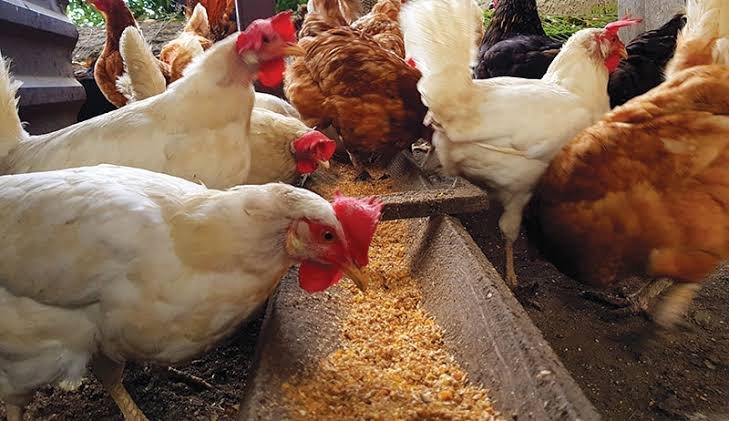
Nigeria’s poultry industry, the largest in West Africa and a major source of affordable protein, is in turmoil. Farmers, squeezed by rising costs, had hoped that the sharp decline in maize prices this year would ease their burden. Instead, feed prices which account for up to 70 per cent of poultry production costs have remained frustratingly high.
Farmers insist that the fall in maize should have translated to lower feed costs, but feed millers argue that maize alone cannot determine prices. Other inputs,many of them imported and vulnerable to foreign exchange volatility, remain expensive, keeping overall feed prices sticky.
The impasse is threatening livelihoods, thinning out smallholder farmers, and pushing up the cost of eggs and chicken for millions of Nigerian households.
For many outside the industry, maize and feed prices are seen as synonymous. But maize, while making up the largest portion of poultry diets, is just one piece of a complex cost puzzle.
“People assume feed equals maize. That’s not the case,” said Musa Yakubu, managing director of AgroPro Feeds, a large feed miller based in Kano.
Yakubu said that while a 25-kilogramme bag of broiler feed that once cost N25,000 now sells for between N14,500 and N15,000, this represents only a partial relief.
“Soybeans, which is a major protein source in poultry feed, is still around N70,000 to N78,000 per 100kg bag. Add to that minerals, amino acids, enzymes, vitamins, and antibiotics, most of which are imported, and you see why feed is still expensive,” he explained.
Packaging and equipment have also added pressure. “The sacks we use to bag feed are up 250 percent. Sewing machines that cost N15,000 a few years ago are now over N100,000. Machinery repairs and spare parts have also skyrocketed,” Yakubu added.
Import dependence and the forex trap
Nigeria’s feed industry depends heavily on imported micro-ingredients, from methionine and lysine (amino acids) to vitamin premixes and acidifiers. With the naira under constant pressure and access to foreign exchange constrained, millers pay far more than international benchmarks.
Ibrahim Danladi, founder of VetLife Agrovet, said the forex bottleneck is the single most important factor preventing significant price reductions.
“Even with maize coming down, feeds cannot come down at the same rate because almost 30 percent of the additives we use are imported. And we pay for them in dollars. With the current naira situation, it is impossible to cut prices further,” he explained.
Danladi, who has combined feed milling and poultry farming for over 30 years, added: “Nearly 45 percent of farmers have closed shop in the last three years. They couldn’t survive. For those left, many are selling their birds just to feed the remaining flock.”
He explained the concept of hidden losses, which he considered a silent killer in poultry economics. “If 1,000 layers used to give 28 crates of eggs daily, now you may only get 25 crates or less, even if you don’t notice immediately. That is income gone. Farmers then keep egg prices steady not because demand is high, but because they are trying to cover invisible losses,” he said.
For small and medium-scale farmers, survival now depends on cutting corners or scaling back.
At Unity Hatchery Farms in Kaduna, owner Haruna Bello said the rising cost of vaccines and feed has left him exposed. “If you lose one bird today, it is like losing a fortune. In the past, if five or ten died, you could absorb it. Today, even one death cuts deep,” Bello noted.
The desperation has pushed many to alternative feeds. In Makarfi market, a measure of maize bran now sells for N700, compared to N2,500 for an equivalent quantity of compounded feed.
“Farmers are buying bran because they cannot afford complete feed,” said Aliyu Umar, a maize farmer in Mayere village. “But for us crop growers, it is painful. Fertiliser prices went up just when maize prices dropped, so we are not even gaining from the higher demand,” he added.
In Plateau State, one of Nigeria’s poultry hubs, feed prices have recorded declines but not enough to restore profitability.
“Three months ago, feed was N19,000 to N20,000 a bag. Now it’s N16,000 to N16,400,” said Grace Samuel, a poultry farmer near Jos South. “That small reduction helps. I now make a tiny profit from eggs. But we were expecting something bigger,” she said.
The Plateau chapter of the Poultry Farmers Association of Nigeria (PFAN) agrees that the slight drop has brought only limited relief.
“The reduction is too slight to rejuvenate the industry. Feed prices are still not commensurate with the drop in maize. On top of that, medicines are still too expensive, and cold weather here reduces water intake, which lowers egg production,” said John Philip, a poultry farmer and member of the association.
Philip warned that millers risk losing their customer base. “If poultry owners shut down, who will buy from millers? Price hikes may benefit them in the short term but hurt everyone in the long run,” he added.
At the retail level, the story is no different. In Kano, Abdul Mamman, a salesman at FarmChoice Agrovet, said broiler feed retails for N24,000 per bag, while layer feed costs N15,500.
He noted that demand patterns differ. “Broilers eat more aggressively. A hundred broilers can consume half a bag in a single day. Layers eat differently. That’s why broiler farming is more expensive,” he observed.
Mamman insisted that farmers should not assume maize prices will continue to fall, noting that the maize drop might be temporary. According to him,if prices climb again, feed costs will rise too.
Nigeria’s poultry industry provides more than 14 million direct and indirect jobs, according to industry estimates, and is one of the country’s biggest non-oil sectors. It also plays a vital role in food security by supplying affordable protein in a country where beef and fish prices are beyond the reach of many households.
But the sector’s fragility is increasingly clear. Feed costs remain stubbornly high, energy costs unpredictable, and import dependence unresolved.
“When 40 to 45 percent of farmers exit, it is not just their business that is at stake. It is Nigeria’s food security. Eggs and chicken are daily protein for millions. If feed prices stay high, production will keep shrinking, and prices will go up further,” said Danladi of VetLife Agrovet.
Stakeholders are calling for urgent interventions to stabilise the industry, including allowing feed producers access to foreign exchange at preferential rates to ease the burden of importing additives, investing in research to locally produce enzymes, amino acids and vitamins to reduce import dependence. They also pointed out the relevance of reliable electricity supply to cut milling costs and reduce reliance on diesel generators, providing subsidies for packaging materials and machinery such as sacks, sewing machines and mixers to ease millers’ operational expenses, and creating credit schemes to help poultry farmers cope with input price volatility and prevent further exits from the sector.
Despite the hardship, some farmers remain committed. “We cannot abandon poultry. It feeds our families and feeds Nigeria,” said Grace Samuel in Jos. John Philip, urged resilience, noting that the industry has weathered crises before and could bounce back with the right policies, but warned that government and millers must act decisively, otherwise the country risks losing the backbone of its protein supply.
As it stands, the industry remains caught between falling maize and stubbornly expensive feed, a situation that underscores deeper structural weaknesses. Stakeholders assert that without urgent reforms, Nigeria’s poultry dream risks turning into a nightmare for both farmers and consumers.